The Great European Return: Navigating the Complexities of E-commerce Logistics and Sustainability
In the modern digital economy, the completion of a transaction is no longer marked by the "purchase confirmed" notification. For the contemporary e-commerce merchant, the true end of the purchasing cycle often occurs weeks later, inside a cardboard box traveling in reverse. Returns have evolved from a mere administrative nuisance into a foundational pillar of the European e-commerce landscape. As consumer expectations shift toward frictionless shopping, retailers find themselves at a crossroads: balancing the need for customer loyalty against the mounting financial and ecological costs of a high-return culture.
An Overview of the European Return Landscape
The European e-commerce market is not a monolith; it is a complex tapestry of varying consumer behaviors, regulatory frameworks, and logistical hurdles. In the current climate, returns are an inseparable component of the customer experience. For merchants operating across borders, understanding the "why" and "where" of returns is no longer optional—it is a prerequisite for survival.
Statistics and the Geography of Returns
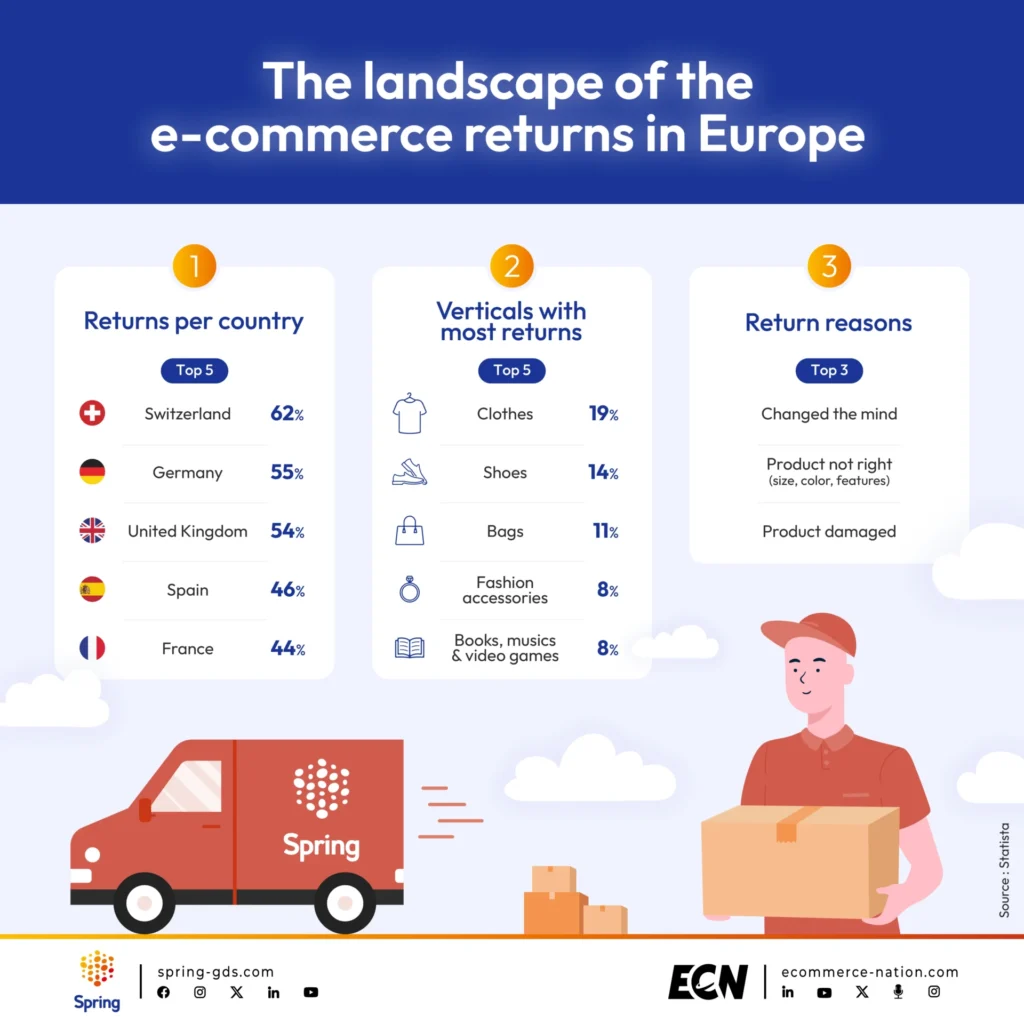
Recent data underscores the sheer scale of the phenomenon. In Europe, the average return rate for online purchases fluctuates between 30% and 40%, but these figures mask significant regional disparities. According to 2023 data from Statista, Switzerland leads the continent with a staggering 62% return rate per online buyer. Germany follows closely at 55%, with the United Kingdom at 54%.
These statistics are not merely abstract percentages; they represent billions of Euros in logistical overhead, inventory devaluation, and lost operational efficiency. The high rates in nations like Germany and Switzerland are often attributed to a deeply ingrained "try-before-you-buy" culture, where consumers treat their homes as personal fitting rooms.
Chronology of a Return
To understand the burden on the supply chain, one must map the lifecycle of a return:
- The Intent: The customer decides to return an item, often triggered by a mismatch in expectations or sizing.
- The Initiation: The customer navigates the retailer’s portal or reaches out to support. This is a critical touchpoint for brand sentiment.
- The Logistics: The item enters the reverse logistics stream. It must be transported, potentially across borders, requiring customs clearance and tracking.
- The Processing: The item arrives at a warehouse. It must be inspected, cleaned, repackaged, or—in worst-case scenarios—discarded.
- The Resolution: The refund is issued, or an exchange is fulfilled.
Each step in this timeline introduces friction and cost, transforming a simple sale into a multifaceted operational project.
Supporting Data: Why Products Go Back
Retailers often struggle to reduce return rates because the drivers of these returns are multifaceted. The fashion and apparel industry remains the most heavily impacted sector, with return rates frequently exceeding 50%. This is largely due to the inherent subjectivity of style and the lack of universal sizing standards.
The Rise of "Bracketing"
A significant trend contributing to these figures is "bracketing"—the practice of ordering multiple sizes or colors of the same item with the explicit intention of returning the ones that don’t fit or aren’t preferred. While this practice boosts initial sales volume, it is devastating for bottom-line profitability, as it essentially doubles or triples the logistics cost per unit sold.
Common Drivers for Returns:
- Size/Fit Discrepancies: The primary culprit in fashion.
- Product Quality: Discrepancies between digital imagery and physical reality.
- Manufacturing Defects: Electronics and household goods often see returns due to functional failures.
- "Buyer’s Remorse": A psychological phenomenon where the initial impulse to buy fades before the delivery arrives.
- Shipping Issues: Items arriving damaged or late, leading to an immediate request for a refund.
The Triple Threat: Logistical, Financial, and Ecological Implications
The management of returns represents a "triple threat" to business stability.
Logistical Complexity
Cross-border returns in the EU are particularly harrowing. While the Single Market facilitates trade, the logistical reality of reverse logistics remains fragmented. Merchants must coordinate return addresses, manage customs documentation for non-EU returns (such as the UK or Switzerland), and maintain visibility on inventory that is effectively "in limbo."
Financial Strain
The cost of a return far exceeds the shipping fee. It includes the labor costs of inspection, the cost of re-stocking, the potential loss of value if the item is returned in a non-saleable condition, and the opportunity cost of having capital tied up in returned inventory. Increasingly, retailers are moving away from the "free returns" model, implementing return fees to discourage abuse and recover processing costs.
The Ecological Toll
Perhaps the most pressing concern for the modern consumer and regulator is the environmental impact. The transportation of millions of packages across Europe generates significant carbon emissions. Furthermore, the "hidden" cost is the disposal of goods. When the cost of processing a return exceeds the value of the item, some retailers opt to destroy the returned products—a practice that is increasingly under scrutiny by European environmental regulators.
Official Responses and Regulatory Pressure
The European Union has begun to signal a shift in how it views e-commerce waste. Recent directives on circular economy principles are pushing businesses to improve product durability and provide better information to consumers before they click "buy."
Official policy responses are beginning to focus on:
- Packaging Standards: Mandating that return packaging must be reusable and recyclable.
- Transparency: Requiring clearer communication regarding the environmental cost of returns at checkout.
- Waste Management: Stricter reporting requirements for companies that destroy unsold or returned goods.
For the merchant, the implication is clear: the era of unchecked, consequence-free returns is drawing to a close. Brands must now treat sustainability not as a marketing buzzword, but as a core component of their logistics strategy.
Strategic Recommendations for Optimization
To survive and thrive in this landscape, merchants must move from a reactive to a proactive model.
1. Leverage Data for Predictive Analytics
Data is the merchant’s best defense. By analyzing return reasons at the SKU level, companies can identify patterns. If a specific dress is returned 40% of the time due to "sizing issues," it is a clear signal to update the size chart or add video content showing the fit on different body types. Proactive communication reduces the customer’s uncertainty, which is the root cause of the return.
2. Implement Technological Solutions
Automation is key. Modern Return Management Systems (RMS) allow for real-time tracking, automated refund processing, and intelligent routing. By integrating these systems with inventory management, companies can ensure that a returned item is available for re-sale as quickly as possible, minimizing the time it sits idle.
3. Adopt an Ecological Mindset
Sustainable logistics are not just good for the planet; they are good for the brand. Encouraging consumers to use consolidation points, offering "no-rush" shipping options, and educating customers on the carbon footprint of returns can foster a sense of shared responsibility. Furthermore, investing in biodegradable packaging and local return processing hubs can significantly reduce the carbon cost per return.
4. Optimize the Policy, Not Just the Price
A user-friendly return policy does not necessarily mean "free." It means "clear." Consumers value certainty more than they value a zero-cost return. Providing a transparent, easy-to-understand portal where the status of a return is clearly visible reduces customer anxiety and prevents "where is my refund?" support tickets, which are a major drain on resources.
Conclusion: Turning a Burden into a Competitive Advantage
The "Great European Return" is a challenge that defines the current generation of e-commerce. It is a hurdle that tests a company’s logistical agility, its financial discipline, and its commitment to sustainability.
However, viewed through a different lens, the return process is also an opportunity. It is a chance to interact with the customer, to demonstrate reliability, and to prove the value of the brand. Companies that can master the art of the return—by reducing the need for them through better product presentation, simplifying the logistics, and minimizing the environmental footprint—will find themselves with a significant competitive advantage. In the digital age, how you treat your customer when they want to give something back is just as important as how you treat them when they are ready to buy.