Beyond the Grind: Rethinking Pipeline Growth in an Era of "Doing More with Less"
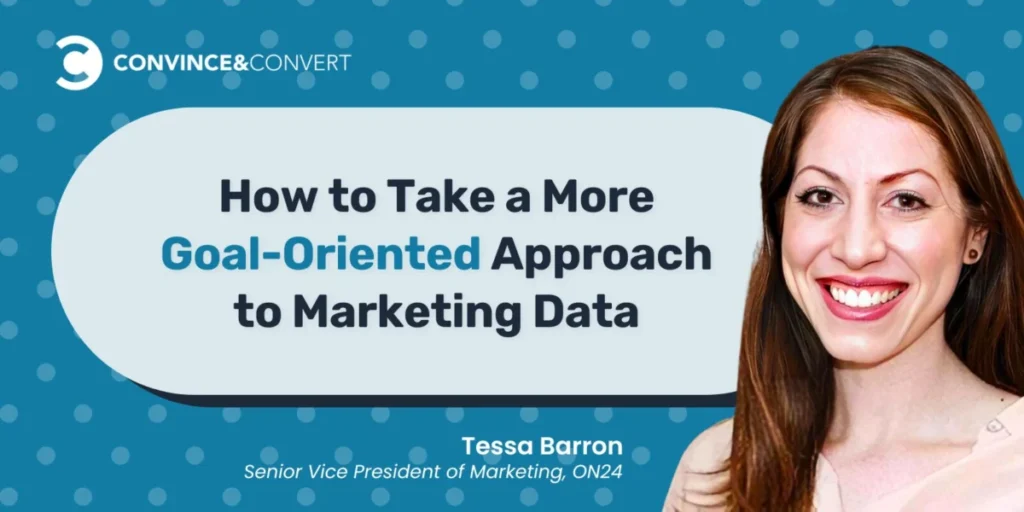
The mantra "do more with less" has become the perennial anthem of the modern marketing department. In an economic climate characterized by tightening budgets, shrinking resources, and increasingly aggressive pipeline targets, this directive often feels less like a strategy and more like a paradox. For many, the instinctive reaction is to double down on activity: more webinars, more blog posts, more whitepapers, and more social media noise.
However, according to Tessa Barron, former Senior Vice President of Marketing at ON24, this "tactic-first" approach is fundamentally flawed. In a recent appearance on the Data-Driven Decisions podcast, Barron argued that the solution to the current marketing malaise isn’t to increase the volume of output, but to fundamentally recalibrate the relationship between data, strategy, and the sales pipeline.
The Paradigm Shift: Moving from Tactic-Oriented to Goal-Oriented
The disconnect in modern marketing often stems from a failure to evolve. Since the onset of the pandemic, the buyer’s journey has undergone a permanent metamorphosis. Despite this, many marketing teams remain anchored in playbooks developed three or four years ago.
"We as marketers have to check in with ourselves and ask: Are we still doing what we were doing three years ago?" Barron posits. "If the answer is yes, that is the first sign that we need to stop expecting that if we execute the same way, we’re going to get more in return."
The Danger of "Activity Bias"
Marketing departments frequently suffer from "activity bias"—the tendency to equate volume with value. When a team plans "four webinars for Q1," they are measuring success by completion rather than contribution. Barron suggests a radical pivot: start with the business goal, not the content calendar.
Instead of setting a goal of "run four webinars," the objective should be framed as "reach X number of new accounts" or "achieve a 10% uplift in pipeline conversion." This pivot shifts the focus from the output (the webinar) to the outcome (the conversion). By starting with the goal, marketers can reverse-engineer the tactics that will actually influence buyer behavior, rather than simply filling a content pipeline with noise.
Decoding the Buyer: The Science of "Signals"
In the digital age, marketers are drowning in data. Yet, as Barron points out, data without direction is merely noise. The key is to distinguish between vanity metrics and what she calls "signals"—specific indicators that a buyer is closer to a purchase decision.
From Data Collection to Strategic "Traps"
Once a marketing team identifies what a "high-intent" buyer looks like, they can design interactions—or "traps"—to capture those signals. At ON24, the platform utilizes over 20 distinct interaction points during webinars—including polls, surveys, Q&A submissions, and interactive calls-to-action—to map a prospect’s intent.
Case Studies in Strategic Capture
Barron highlights two industry-specific examples that illustrate how to turn data into a competitive advantage:
- The Tech Sector Pivot: A technology firm aiming to regain market share discovered that prospects using a specific cloud provider were ten times more likely to convert. Rather than targeting a broad audience, they used their webinar platform to ask one specific, high-value question: "Which cloud provider are you currently using?" This simple, data-driven "trap" allowed them to instantly segment the audience and prioritize high-intent leads for the sales team.
- Healthcare Precision: In the pharmaceutical space, the goal was to identify physicians with high-acuity patient bases who were most in need of new therapeutic breakthroughs. By asking, "How would you rate the risk of your patient base?" during an educational session, the company effectively qualified their leads in real-time, identifying the doctors who were most likely to benefit from further engagement.
These examples underscore a vital truth: data collection is not about gathering as much information as possible; it is about gathering the right information to inform the next best action.
The Sales-Marketing Synergy: Building the Bridge
One of the most persistent issues in B2B marketing is the silo between sales and marketing. Barron contends that if marketers want to impact the pipeline, they must move beyond their own internal metrics and engage directly with the frontline.
Understanding the "Frontline" Reality
Sales teams are the gatekeepers of the pipeline. They know exactly why a deal stalls, what objections arise during a demo, and what specific information triggers a "yes." Yet, many marketers design campaigns without ever speaking to a salesperson about their daily reality.
Barron suggests that marketers should ask their sales counterparts: "What questions do you ask to determine if a lead is qualified?" These questions, when embedded into the marketing content strategy, become the foundation for a high-converting pipeline.
"Marketers are creating the net to catch people who might turn into pipeline," Barron notes. "But it’s the salespeople on the front lines who actually create that pipeline." The marketer’s role, therefore, is to provide the sales team with a fully formed, high-definition picture of the prospect before the first sales call even takes place.
Operationalizing the Strategy: The "In-Between" Spaces
If the pipeline is the end goal, the space between an initial lead and a closed-won opportunity is where marketing can exert the most influence. This "in-between" stage is often where the most significant conversion losses occur.
Turning the Dials
Marketers often overlook the mundane but critical elements of the funnel: outdated lead forms, non-specific messaging, and a lack of follow-up interaction. Barron emphasizes that meaningful growth is often found by "turning the dials" in these neglected areas.
By shortening lead forms, tailoring messaging to specific pain points identified by sales, and providing continuous opportunities for interaction, marketers can incrementally improve conversion rates. These small, structural changes often yield a higher return on investment than launching an entirely new, expensive brand campaign.
The Communication Challenge: Making Data Meaningful
Finally, the ability to translate data into actionable insights is a leadership skill. When presenting to stakeholders or executive leadership, the "noise" of raw data must be distilled into a clear, visual narrative.
The Art of Executive Reporting
Stakeholders are not interested in the nuances of click-through rates or page views unless those metrics directly correlate to revenue. Barron recommends a visual approach to reporting that focuses on:
- Directionality: Is the conversion rate trending up or down?
- Impact: How does the specific strategy impact the pipeline target?
- Budget Efficiency: Is the current allocation of resources yielding the intended results?
By aligning the entire organization around a unified data strategy—where everyone understands that "success" is defined by pipeline health rather than content volume—marketing teams can shed the "do more with less" burden.
Implications for the Future of Marketing
The shift advocated by Tessa Barron represents a maturation of the marketing profession. We are moving away from an era of "spray and pray" digital marketing toward a precision-based model where every interaction is designed to reveal a piece of the buyer’s intent.
The implications for this approach are significant:
- Reduced Burnout: By focusing on high-impact tactics, teams can stop the endless churn of "more, more, more" and focus on work that actually moves the needle.
- Higher Revenue Attribution: As marketing aligns its efforts with sales-qualified signals, the contribution of marketing to the bottom line becomes clearer and easier to prove to the C-suite.
- Better Customer Experience: By asking the right questions—and using that data to provide more relevant content—brands become more helpful to their prospects, creating a more personalized and effective buying journey.
In conclusion, the path to overcoming the constraints of limited resources is not found in working harder, but in working with greater intention. By treating every piece of content as a diagnostic tool and every campaign as an opportunity to learn about the buyer, marketers can stop simply "doing more" and start, for the first time, "achieving more."
For those looking to deepen their understanding of these strategies, the full insights from Tessa Barron can be found on the Data-Driven Decisions podcast series, available via Convince & Convert.