From Notebooks to Production: 5 Essential Python Pillars for AI Engineering
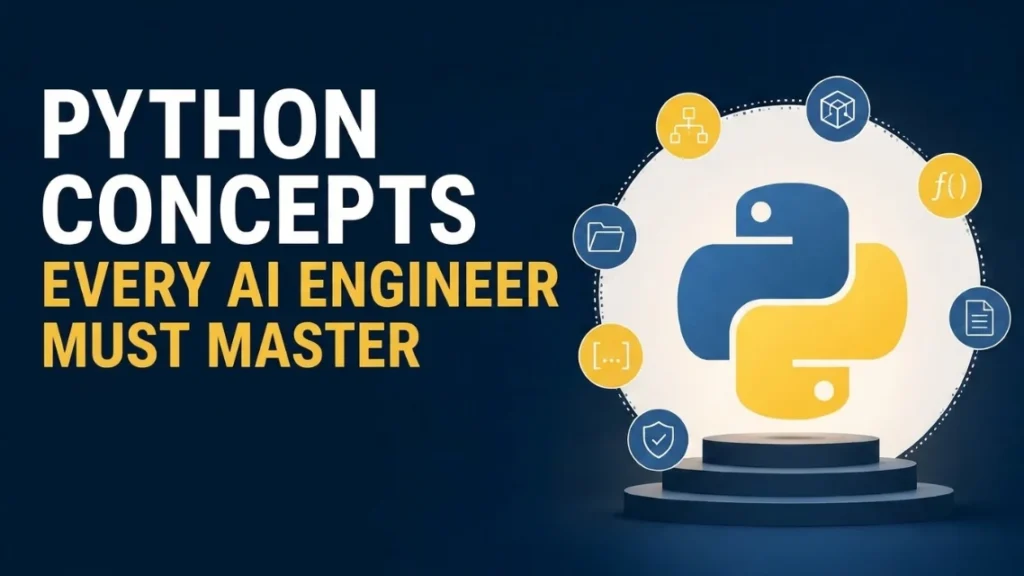
The transition from experimental research to production-grade AI is rarely a smooth path. Many practitioners begin their journey in Jupyter Notebooks, where dynamic typing, global variables, and sequential execution are the norm. However, when moving toward real-world AI systems—where latency, memory constraints, and reliability are paramount—these prototyping habits become technical debt.
Building scalable AI requires a transition from "scripting" to "software engineering." To deploy models that handle millions of requests, manage hardware resources efficiently, and integrate with complex cloud infrastructures, an AI engineer must master the native language constructs that power modern deep learning frameworks.
In this article, we explore five critical Python concepts that distinguish a prototype from a production-grade system.
1. Generators & Lazy Evaluation: Taming Massive Datasets
In the era of Large Language Models (LLMs) and high-resolution computer vision, datasets often exceed the capacity of available RAM. A common pitfall for novice AI engineers is loading an entire dataset into a list or a NumPy array before processing. This "greedy" approach leads to immediate Out-of-Memory (OOM) errors.
The Mechanism of Lazy Evaluation
Generators, powered by the yield keyword, implement lazy evaluation. Instead of computing all values at once, they produce them on demand. When your model iterates over a generator, Python only holds a single batch in memory, streaming the rest from disk or a network socket.
Implications for Production:
By utilizing generators, you shift your memory profile from linear growth (O(n)) to constant memory (O(1)). Whether you are streaming 100 images or 100 million, your RAM usage remains flat. This is essential for training loops where data augmentation and preprocessing are done on-the-fly. Using tracemalloc to compare a naive list-based load against a generator-based stream often reveals a 50% to 80% reduction in peak memory consumption, allowing you to run larger batch sizes without upgrading your hardware.
2. Context Managers: Robust Hardware Resource Management
AI applications are notorious for their heavy consumption of state-bound resources, such as GPU memory, database connections, and file handles. Managing these manually using try-finally blocks is prone to human error; forgetting to close a connection or reset a hardware state can lead to silent resource leaks that crash a service hours after deployment.
Simplifying Teardown Logic
Context managers, initiated by the with statement, encapsulate setup and teardown logic within __enter__ and __exit__ methods. This ensures that even if an exception occurs during the heavy lifting of model inference, the cleanup code—such as clearing the CUDA cache or reverting a model to evaluation mode—is guaranteed to execute.
Professional Best Practices:
In a production setting, context managers act as a safety net. For instance, when profiling inference latency, a context manager can ensure that the timer starts precisely when the model receives data and stops exactly when the output is generated, regardless of whether the process succeeded or crashed. This abstraction keeps your core logic clean, readable, and resilient to failure.
3. Asynchronous Programming: Eliminating I/O Bottlenecks
Modern AI systems, particularly agentic workflows, are rarely compute-bound; they are often I/O-bound. If your agentic system needs to query an LLM API, a vector database, and a search engine, executing these calls sequentially creates massive latency. If each call takes 100ms, a sequence of 20 calls results in a 2-second delay per user request.
Scaling Through Concurrency
asyncio allows Python to handle network I/O concurrently. By using async and await, your program can dispatch multiple API requests simultaneously. Instead of waiting for a response to arrive, the program pauses the current task and shifts focus to another, essentially "multiplexing" the wait time.
Implications for System Design:
Transitioning from synchronous to asynchronous processing can provide an exponential speedup. In systems where concurrency is high, such as an API gateway for a chatbot, this approach reduces total request time from the sum of all tasks to the duration of the single slowest task. This is the difference between a sluggish interface and a responsive, high-throughput production system.
4. Dataclasses & Pydantic: The Foundation of Type Safety
Machine learning configuration is a hidden minefield. A typo in a hyperparameter name, such as learnin_rate instead of learning_rate, can cause a model to default to an incorrect value, leading to poor convergence or "silent" failures that are difficult to debug.
Enforcing Data Integrity
While Python’s built-in dataclasses provide a basic way to structure data, Pydantic takes this to a professional level by enforcing runtime type validation. Pydantic doesn’t just check that your batch_size is an integer; it can enforce constraints (e.g., must be greater than 0) and perform type coercion (e.g., converting a string "64" to an integer 64).
Implications for Production AI:
In production pipelines, Pydantic models serve as the "contract" between your configuration files and your training code. Furthermore, because Pydantic models can automatically generate JSON schemas, they are perfectly suited for LLM tool calling. When you need your AI to output structured data to a database or a function call, Pydantic ensures the output is valid, schema-compliant, and ready for ingestion.
5. Magic Methods: Building "Pythonic" Abstractions
Custom classes often act as the backbone of a data pipeline. However, if these classes do not implement the "dunder" (double-underscore) methods that Python’s core ecosystem expects, they become difficult to integrate with libraries like PyTorch or Scikit-Learn.
Making Classes Protocol-Compliant
Methods like __len__, __getitem__, and __call__ allow your objects to behave like native Python types. For instance, if you implement __len__ and __getitem__ in your custom dataset class, PyTorch’s DataLoader can automatically batch, shuffle, and parallelize your data loading.
The Power of __call__:
The most important magic method for AI engineers is __call__. By implementing this, you can invoke an instance of a class as if it were a function (e.g., model(x)). This is not just syntactic sugar; it is essential for framework compatibility. PyTorch’s nn.Module overrides __call__ to handle internal hooks for gradients and logging. If you bypass this and call model.forward(x) directly, you lose these features, leading to broken training loops and gradient tracking errors.
Chronology of Engineering Maturity
The evolution of an AI engineer can be mapped through their approach to these five pillars:
- The Prototyping Phase: Focuses on functionality; uses lists, dictionaries, and global state.
- The Refactoring Phase: Begins using
dataclassesand generators to solve memory and configuration bugs. - The Production Phase: Implements
asynciofor performance and context managers for resource reliability. - The Framework Phase: Builds custom, protocol-compliant abstractions using magic methods that integrate seamlessly into the broader AI ecosystem.
Implications for Future AI Systems
As AI models become more complex, the code that supports them must become more disciplined. We are moving toward a future of "Software-Defined AI," where the quality of the model is inextricably linked to the quality of the surrounding code.
By mastering these five concepts, AI engineers can move beyond the constraints of the notebook. They can build systems that are not only capable of running sophisticated algorithms but are also robust, maintainable, and ready to meet the demands of enterprise-scale production environments. The ability to write "production-grade" Python is no longer an optional skill—it is the baseline requirement for the next generation of AI innovation.