Cybersecurity Crisis at CISA: Congressional Leaders Demand Answers Over Massive Credential Leak
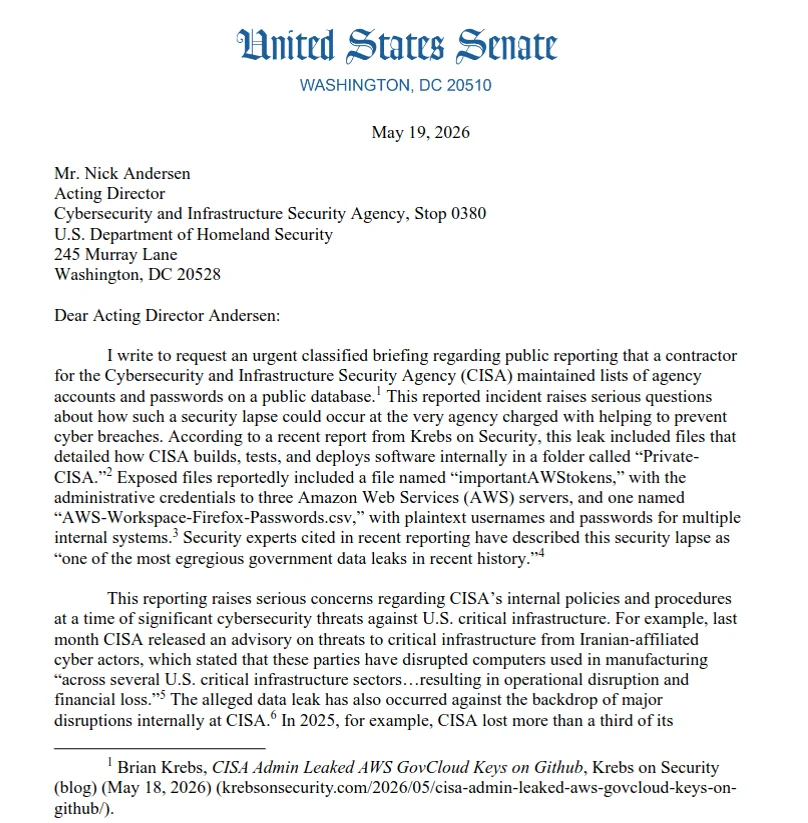
In a stunning security failure that has sent shockwaves through the federal government, the U.S. Cybersecurity and Infrastructure Security Agency (CISA)—the very entity tasked with safeguarding the nation’s digital backbone—has been exposed for a catastrophic lapse in operational security. Following a report by KrebsOnSecurity, it was revealed that a contractor with administrative privileges intentionally published highly sensitive AWS GovCloud keys and internal agency secrets to a public repository on GitHub.
The incident, which involves the exposure of plaintext credentials for dozens of internal systems, has prompted immediate and aggressive inquiries from lawmakers in both chambers of Congress. As CISA scrambles to contain the fallout and rotate thousands of potentially compromised keys, the agency faces a growing chorus of criticism regarding its internal security culture, its management of third-party contractors, and its overall preparedness to defend critical infrastructure.
A Chronology of the Breach
The discovery of the "Private-CISA" repository—the name given to the public GitHub profile created by the contractor—has laid bare a series of failures that began months ago.
- November 2025: Initial investigation suggests the repository was created. Experts believe the contractor utilized the public GitHub space as a "scratchpad" or synchronization mechanism to move files between professional and personal machines, circumventing secure enterprise channels.
- Late April 2026: The repository received its most sensitive updates, including critical plaintext credentials and configuration files for CISA’s cloud infrastructure.
- Mid-May 2026: Security firm GitGuardian alerted CISA to the exposure. Despite the notification, the credentials remained live and accessible to the public for a significant period.
- May 18, 2026: KrebsOnSecurity publicly breaks the story, identifying that the contractor had specifically bypassed GitHub’s built-in protections designed to flag and block the publication of sensitive keys.
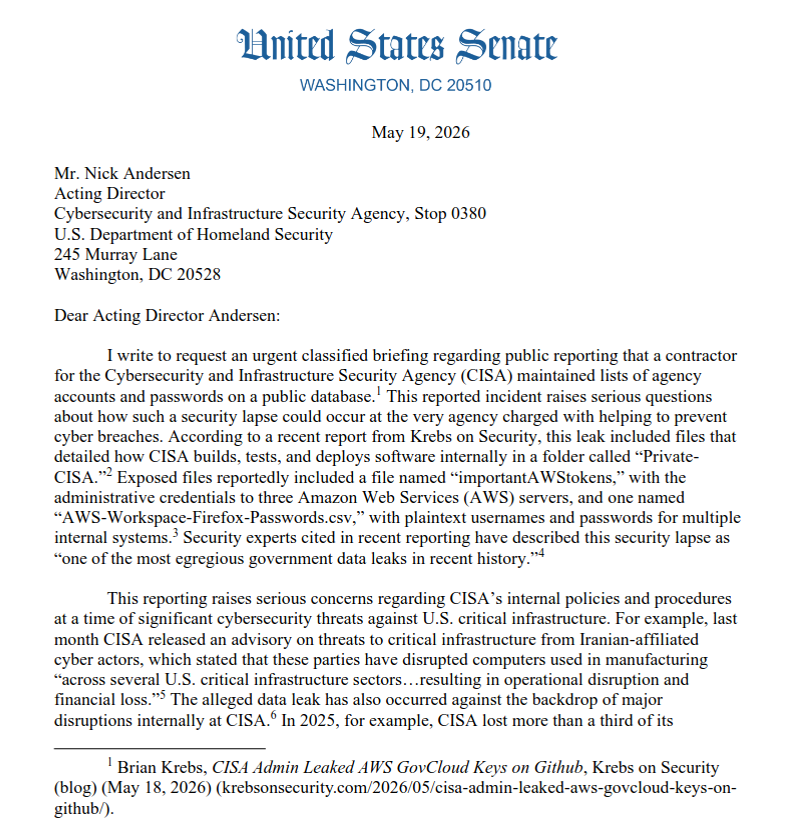
- May 19, 2026: Sen. Maggie Hassan (D-NH) and Rep. Bennie Thompson (D-MS) issue formal letters to CISA’s acting leadership, demanding immediate explanations and a full audit of the agency’s contractor policies.
- May 20, 2026: Dylan Ayrey, creator of the open-source security tool TruffleHog, reveals that a high-level RSA private key remained active despite CISA’s initial efforts to "clean" the repository. This key granted broad administrative access to CISA’s entire GitHub enterprise organization.
The Scope of the Exposure: A Roadmap for Adversaries
The "Private-CISA" repository was not merely a collection of minor passwords; it was a treasure map for malicious actors. According to security researchers who analyzed the cache before it was taken down, the repository contained files with alarming labels such as “Important AWS Tokens.txt,” “kube-config.txt,” and “AWS-Workspace-Firefox-Passwords.csv.”
The most dangerous element of the leak, identified by Dylan Ayrey, was a GitHub app token that provided unrestricted access to the CISA-IT GitHub organization. As Ayrey explained, an attacker possessing this key could perform a "total takeover" of the agency’s software development lifecycle. This includes reading private source code, hijacking Continuous Integration/Continuous Delivery (CI/CD) pipelines—the automated systems that test and deploy software—and modifying administrative rules to maintain long-term persistence within the agency’s network.
For foreign intelligence services, such as those associated with Russia, China, and Iran, this information is invaluable. By monitoring public GitHub "firehose" feeds—a practice now standard for both security researchers and cyber-criminals—adversaries likely had access to these credentials within minutes of the contractor pushing them to the repository.
Institutional Vulnerabilities: A Diminished Security Culture
The timing of this breach is particularly concerning for lawmakers. Sen. Maggie Hassan highlighted in her correspondence that the incident occurred while CISA is navigating a period of unprecedented internal instability. Recent reports indicate that CISA has lost more than a third of its workforce and a significant portion of its senior leadership following a series of mandatory early retirements, buyouts, and resignations initiated by the Trump administration.
This "brain drain" has created a vacuum of oversight. Rep. Bennie Thompson, ranking member of the House Homeland Security Committee, noted that the breach reflects a "diminished security culture." The inability of the agency to properly vet the practices of its contractors—or even to maintain a mechanism for detecting such blatant violations of security policy—suggests that the agency’s internal controls have eroded to a dangerous degree.
Official Responses and Damage Control
CISA’s response to the crisis has been widely characterized as reactive and insufficient. In a brief written statement following the KrebsOnSecurity report, the agency claimed: "There is no indication that any sensitive data was compromised as a result of the incident."
However, this statement has been met with skepticism by cybersecurity professionals. In the world of high-stakes network security, proving that a breach did not result in unauthorized access is notoriously difficult, especially when the credentials were exposed on a public platform monitored by automated scanners.
When pressed specifically on the failure to rotate the critical RSA key identified by Truffle Security, CISA issued a follow-up statement: "CISA is actively responding and coordinating with the appropriate parties and vendors to ensure any identified leaked credentials are rotated and rendered invalid and will continue to take appropriate steps to protect the security of our systems."
Despite these assurances, sources indicate that as of late May, the agency was still struggling to identify and invalidate every leaked credential tied to its broader technology portfolio.
The Human Element: Can Technology Prevent Negligence?
The incident has sparked a broader debate among industry experts regarding the limitations of technical controls. James Wilson of the Risky Business security podcast noted that while organizations can set top-down policies on corporate-managed GitHub accounts to prevent the publication of keys, it is significantly harder to police what an individual does on their own time.
"This is a human problem," said Adam Boileau, a security researcher and co-host of the podcast. "You’ve hired a contractor to do this work, and they have decided of their own volition to use GitHub to synchronize content from a work machine to a home machine. I don’t know what technical controls you could put in place given that this is being done presumably outside of anything CISA managed or even had visibility on."
This perspective highlights a fundamental challenge in the modern federal workforce: the reliance on a fragmented, contract-heavy labor model where security protocols are often treated as obstacles rather than safeguards. If a contractor is able to bypass built-in security features, it suggests that the training and vetting process for those with administrative access is fundamentally flawed.
Implications for Future Federal Policy
The fallout from the CISA leak will likely be felt in the coming months as Congress prepares to hold oversight hearings. The incident serves as a grim reminder that the federal government’s transition to cloud-based development and remote work environments has outpaced its ability to enforce robust security hygiene.
Key questions that CISA must now answer include:
- Vetting and Oversight: How was a contractor with such high levels of administrative access allowed to operate without mandatory endpoint monitoring?
- Incident Response: Why was there a delay of more than a week between the initial notification by GitGuardian and the full rotation of the compromised credentials?
- Structural Reform: How does CISA plan to rebuild its security culture in the wake of the recent workforce reductions?
As CISA continues to work with vendors to purge the leaked secrets from the digital ecosystem, the agency remains under intense pressure. The "Private-CISA" incident will likely serve as a case study for years to come—a cautionary tale of how, in an era of sophisticated nation-state threats, the most dangerous vulnerability remains a single, poorly managed user account.