A New Era for WordPress Swag: Inside the Architectural Overhaul of the Mercantile Storefront
The WordPress project has long been synonymous with community, open-source values, and a culture that bridges the gap between technical prowess and creative expression. For years, the official swag store, Mercantile, has served as the tangible manifestation of this identity. However, as the platform has evolved into a powerhouse of modern web development, the digital home for its physical goods required a transformation to match its ambition.
This week, the WordPress community unveiled a completely reimagined Mercantile storefront. More than just a cosmetic update, the project serves as a sophisticated showcase of what a modern WordPress and WooCommerce ecosystem can achieve when built entirely on the foundation of blocks and the latest core features.
Main Facts: A Blueprint for Modern E-commerce
The redesign of Mercantile is defined by a "catalog-first" philosophy. Upon visiting the new site, users are immediately greeted by a responsive, streamlined product catalog designed to scale seamlessly across desktop, tablet, and mobile devices.
Beyond aesthetics, the user experience has been meticulously tuned. Developers have implemented intuitive features, such as the automatic selection of product variants when only one SKU remains in stock, and a customized transactional email system that mirrors the brand identity of the store itself.
Perhaps most significantly, the site is a masterclass in modern WordPress architecture. It is built almost entirely using blocks—the modular system that has redefined the WordPress editing experience. From the cart and checkout pages to the mini-cart and order confirmation screens, every interaction is powered by custom theme blocks. Under the hood, the store leverages WordPress 7.0 and the Interactivity API, which facilitates fluid, high-performance catalog navigation and modal states without the need for traditional page reloads.
A Chronology of the Redesign
The road to the new Mercantile was a multi-phased endeavor that culminated in a real-world stress test at WordCamp Europe 2026.
Phase 1: Conceptualization and Design
The initial design phase focused on embedding the "soul" of WordPress into the interface. Designers wanted to avoid the generic "e-commerce template" look. Instead, they incorporated visual nods to the WordPress dashboard—such as the iconic metaboxes and the admin bar—while sprinkling in hidden "Easter eggs" for code-savvy users.

Phase 2: Development and Engineering
Development prioritized performance and accessibility. The team ensured the site adhered to strict color contrast standards and respected user-defined reduced-motion preferences, ensuring that the store is inclusive for all members of the global WordPress community.
Phase 3: The WordCamp Europe Pilot
In June 2026, the new storefront faced its first major challenge: acting as the digital infrastructure for the Mercantile booth at WordCamp Europe. The team introduced "local pickup" functionality and specialized event-only merchandise to the site’s database.
Phase 4: Optimization and Future-Proofing
Following the successful deployment at the event—where 50 orders were processed via in-person payments—the team entered the post-launch phase, focusing on fine-tuning product attributes (such as material and care instructions) and preparing for upcoming "experimental" features.
Supporting Data and Technical Architecture
The new Mercantile is not merely a store; it is a repository of technical documentation for the future of WooCommerce. The site’s performance is bolstered by several key technical pillars:
- Block-Based Everything: By moving away from legacy templates, the store achieves a level of modularity that allows for rapid updates to the user interface.
- The Interactivity API: This allows for a "Single Page Application" (SPA) feel. As shoppers navigate between product categories, the state of the application is maintained, leading to faster perceived load times and a more immersive shopping experience.
- Accessibility Compliance: The project team prioritized WCAG standards. This includes keyboard navigation, screen reader optimization, and the respect of OS-level reduced-motion settings, ensuring the site is as usable as it is beautiful.
- Product Granularity: Detailed metadata on product pages provides shoppers with precise information on size, material, and care, reducing the need for customer service inquiries and improving the overall conversion funnel.
Official Perspectives and Community Impact
The project was the result of a collaborative effort involving designers, developers, and community managers. According to contributors, the goal was to create a storefront that "feels uniquely WordPress."
"We didn’t just want to build a shop," one lead developer noted. "We wanted to build a love letter to the WordPress contributors who have sustained this project for decades."
The integration of Wapuu, the unofficial mascot of the WordPress community, into the visual language of the store is a testament to this philosophy. By balancing professional-grade e-commerce tools with a playful, community-centric design, the project team has succeeded in creating a storefront that feels authentic to the project’s mission of democratizing publishing.

Furthermore, every purchase made through Mercantile flows directly into the WordPress Foundation, a 501(c)(3) nonprofit. This funding is essential for the foundation’s mandate: to preserve the open-source nature of WordPress, support community events, and ensure that the software remains free and accessible for generations to come.
Implications: The Future of the WordPress Marketplace
The launch of the new Mercantile has wider implications for the broader WordPress ecosystem. By demonstrating that a high-traffic, feature-rich store can be built entirely with blocks and the Interactivity API, the project sets a new standard for WooCommerce developers.
The Command Line Experiment
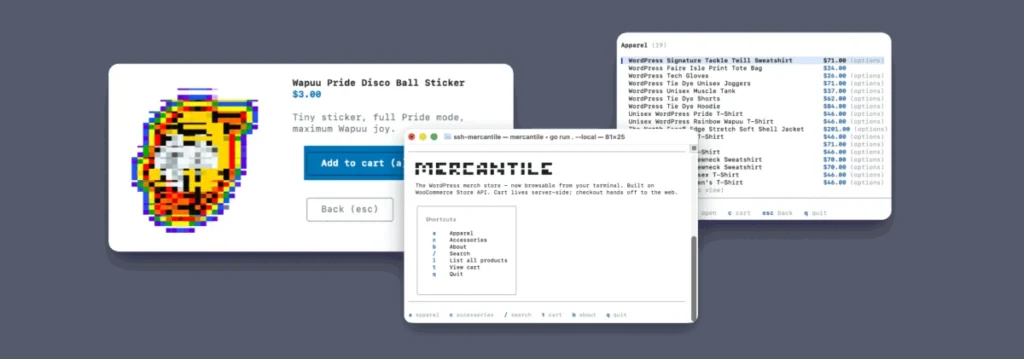
Perhaps the most intriguing takeaway is the team’s announcement of a "text-based" version of the store accessible via the command line. This nod to the developer community—who often spend their days in the terminal—highlights a shift in how the project perceives its audience. It is an acknowledgment that the "WordPress user" is not a monolith; they are developers, designers, bloggers, and hobbyists, all of whom deserve a unique interface to interact with the brand.
A New Standard for Theme Development
For theme developers, the Mercantile site serves as a live, open-source reference. By observing how the team implemented the block-based checkout and the Interactivity-powered modal states, other developers can learn how to build high-performance e-commerce sites without relying on bloated, third-party plugins.
The Sustainability of the WordPress Foundation
Ultimately, the success of this redesign is tied to the sustainability of the WordPress Foundation. As the web becomes increasingly fragmented, the ability of an open-source project to generate its own revenue to support its nonprofit mission is a critical advantage. The new Mercantile ensures that when a user buys a t-shirt, a sticker, or a laptop sleeve, they are doing more than just purchasing swag—they are actively participating in the longevity of the open web.
Conclusion
The new Mercantile is more than a facelift; it is an architectural evolution. By leaning into the core strengths of the WordPress platform, the team has created a store that is as robust as it is culturally significant. Whether you are browsing for the latest Wapuu apparel or inspecting the block-based source code to learn new development tricks, the new storefront offers a glimpse into the future of WordPress.
As the team continues to roll out new features—including the highly anticipated command-line store—it is clear that the project is not standing still. For those interested in the future of the web, keeping an eye on the Mercantile storefront is a necessity. It is not just selling products; it is selling the future of open-source commerce.