Bridging the AI Skills Gap: How the ‘AI Leaders’ Program is Redefining Workforce Readiness
On June 23, the city of Chicago served as the backdrop for a milestone in technological education. Forty students from the University of Illinois Chicago (UIC), Louisiana Tech University, and the University of Louisiana at Lafayette gathered to celebrate a collective achievement: becoming the inaugural cohort to earn the "AI Leaders" Micro-Credential.
This program, the nation’s first workforce-focused artificial intelligence literacy course tied to a recognized, industry-standard credential, represents a departure from traditional academic models. Rather than relying on theoretical exams or passive learning, these students spent months building real-world projects, integrating generative AI into professional workflows, and contributing to the open-source software infrastructure that underpins over 40% of the modern web.
To mark the occasion, each graduate received a $1,000 stipend—a financial incentive made possible through a strategic partnership between Automattic and UIC. This celebration was the culmination of a vision first announced in February 2026, aimed at proving that the future of work requires more than just a degree; it requires a demonstrated ability to contribute to the global digital commons.
The Chronology of a Pilot Program
The road to the June 23 graduation began with a fundamental question: Can open-source learning serve as a direct bridge to high-quality employment, rather than just providing a certificate that sits on a shelf?
The February Launch
In February 2026, the AI Leaders initiative was unveiled as a collaborative pilot program. It was designed to address the widening gap between rapid AI advancement and the skills currently taught in traditional university curricula. The organizers sought to create a pipeline that didn’t just teach students about AI, but taught them how to apply it within the WordPress ecosystem—a massive, real-world testing ground for digital innovation.
The Curriculum Phase
Between February and June, participants engaged in an intensive, hands-on curriculum. Unlike traditional courses, the AI Leaders program required students to:
- Contribute to Open Source: Students were tasked with submitting code, documentation, or design improvements to the WordPress core, effectively contributing to the backbone of the internet.
- Generative AI Integration: Participants explored how generative AI is used in professional environments, focusing on ethical usage, prompt engineering, and workflow automation.
- Portfolio Development: Each student curated a digital portfolio of their contributions and projects, providing employers with tangible evidence of their capabilities.
The Chicago Summit
The pilot concluded with a formal gathering in Chicago, where students had the unique opportunity to network with industry leaders, prospective employers, and agencies. This event was not merely a graduation; it was a career fair designed to place the graduates directly into roles where their newfound skills could be immediately utilized.
Supporting Data: Why Open Source Matters
The AI Leaders program is built on the belief that access to technology is a human right. By utilizing WordPress as the primary learning vehicle, the program leverages a platform that powers 40% of the web, ensuring that the skills acquired are globally transferable and highly relevant.
The Economic Impact
The $1,000 stipends awarded to graduates—funded by the UIC Tech Solutions Open Source Fund and Automattic—served to lower the barrier to entry. For many students, the ability to engage in professional-level work without the burden of unpaid labor is a significant factor in democratizing access to high-tech careers.
The Ecosystem Advantage
The program’s success is anchored in the synergy between its partners:
- University of Illinois Chicago: Provided the academic framework and the Tech Solutions Open Source Fund.
- Automattic: Provided the industry expertise and financial support required to make the program viable.
- The WordPress Foundation: Contributed to the pedagogical development, ensuring the curriculum reflects the highest standards of the open-source community.
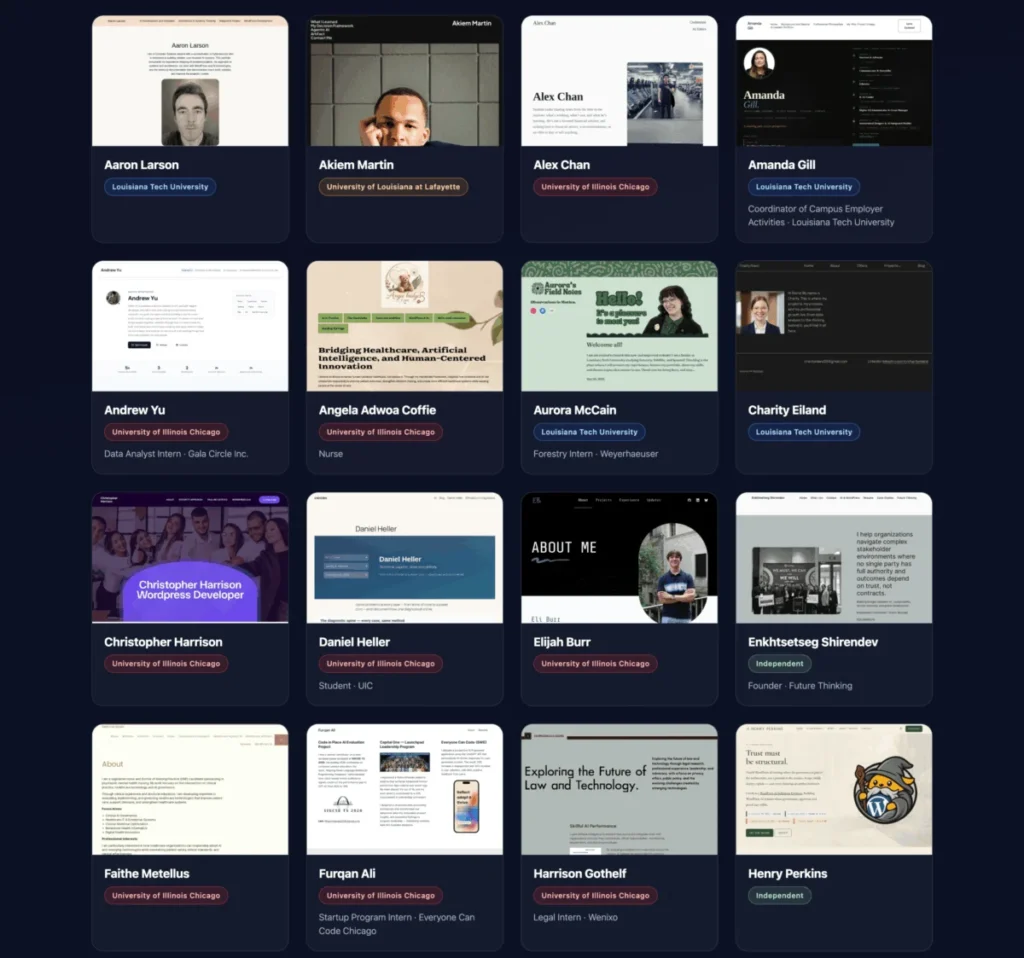
The portfolios produced by this year’s cohort are now publicly available at aileaderswp.blog, serving as a living document of what students can achieve when given access to open-source tools and mentorship.
Official Responses and Strategic Vision
The program represents a significant departure from traditional "siloed" learning. By integrating corporate, academic, and non-profit entities, the AI Leaders program has created a template for future workforce development.
"WordPress was built to expand access to publishing and participation on the open web," stated a spokesperson for the initiative. This philosophy is the bedrock of the AI Leaders curriculum. The goal is to strip away the gatekeeping that often accompanies high-tech training, replacing it with a meritocratic system where the quality of one’s contribution speaks louder than their resume.
For the participating universities, the program provides a way to satisfy the increasing demand for "job-ready" graduates. For Automattic, the program fosters a pipeline of talent that is already familiar with the specific technologies and community-driven methodologies that the company values.
Implications: A New Model for Higher Education
The success of this first cohort suggests that the AI Leaders model may soon be adopted by other sectors. As artificial intelligence continues to reshape the labor market, the need for "AI literacy" is becoming as fundamental as reading or basic mathematics.
Bridging the Digital Divide
The program addresses a core societal issue: the digital divide. By ensuring that students from various geographic and socioeconomic backgrounds have the same access to high-quality training, the AI Leaders program is working to ensure that the AI revolution does not leave segments of the population behind.
Employer Verification and the "Living" Credential
One of the most significant aspects of the AI Leaders credential is its verifiability. Because the work is documented in the open-source space, employers do not need to take a student’s word for their skills; they can audit the student’s contributions to the code or documentation. This creates a high-trust environment that is increasingly rare in the hiring process.
The Future of the Program
The Chicago event was only the beginning. With the first cohort successfully transitioned into the workforce or advanced project phases, the organizers are already planning for the next round. The gathering allowed the program to refine its feedback loops, identifying which modules were most effective and which areas need further development for the next group of students.
How to Get Involved
The AI Leaders program is committed to scaling its impact. For students, educators, and industry professionals looking to participate in future cohorts, the path forward is clear:
- Stay Informed: The program is currently preparing for its next recruitment cycle. Interested parties are encouraged to subscribe to updates through the official AI Leaders channels to receive notifications about application windows.
- Explore the Resources: The WordPress ecosystem offers a wealth of educational opportunities for those not currently enrolled in the program. From workshops and lesson plans to community-led meetups, there are numerous ways to begin developing the skills that define an AI Leader.
- Engage with the Community: The strength of the program lies in its community. By participating in WordPress contributor days or exploring the documentation at WordPress.org/education/, individuals can begin building the skills necessary to succeed in a technology-driven economy today.
Conclusion: Setting a Precedent
The graduation of the first 40 AI Leaders marks a turning point in the intersection of artificial intelligence, open-source development, and higher education. By proving that a workforce-focused credential can be both rigorous and accessible, the program has established a new standard for how we prepare the next generation of digital professionals.
As the industry moves forward, the success of these students serves as a testament to the power of collaborative, open-source learning. In an era where technological change is constant, the most valuable skill a worker can possess is the ability to adapt, contribute, and innovate within an ecosystem that belongs to everyone. The AI Leaders program is not just teaching students how to use AI; it is teaching them how to build the future of the web, one contribution at a time.
With the next cohort on the horizon, the program stands as a beacon for what is possible when academia and industry align behind the common goal of empowering the next generation of digital architects. Whether you are a student looking to start your career or an employer seeking verified talent, the AI Leaders initiative offers a clear, effective, and inclusive path forward in an increasingly AI-driven world.