The Renaissance of Indian Manufacturing: How Deep-Tech Startups are Redefining the Industrial Landscape
India is currently undergoing a structural transformation in its industrial sector. Moving away from the traditional, labor-intensive assembly-line models that defined the last decade, the nation is pivoting toward a high-value, technology-led manufacturing ecosystem. This shift is characterized by a surge in precision engineering, localized electronic component production, aerospace logistics, and advanced industrial automation.
As capital—both public and private—flows into deep-tech capabilities, the narrative of "Make in India" is being rewritten. No longer just a catchphrase for basic manufacturing, it is now synonymous with intellectual property, sophisticated supply chains, and globally competitive industrial infrastructure.
The Winds of Change: Key Market Developments
The past several weeks have served as a microcosm of this broader trend. Investor appetite for hardware and advanced manufacturing has reached a fever pitch, underscored by the recent $28.5 Mn Series B funding round for Ethereal Machines. This injection of capital into precision engineering serves as a bellwether for the growing confidence in India’s ability to build the backbone of industrial infrastructure domestically.
Simultaneously, the entry of industry titans like Reliance Retail into the manufacturing space—specifically targeting vertically integrated production of garments and fresh produce—signals that even the retail giants are recognizing the strategic necessity of owning the supply chain.

Government support remains a bedrock of this evolution. The recent inauguration of Jabil’s state-of-the-art facility in Pune by Union Minister Ashwini Vaishnaw exemplifies the strategic alignment between global manufacturing giants and India’s industrial roadmap. Jabil’s focus on AI data centers, networking hardware, and automotive electronics highlights that India is not merely an assembly hub, but a vital node in the global high-tech value chain.
Chronology of Progress: A Shift Toward Specialization
The evolution of India’s manufacturing sector can be viewed through a clear, three-stage trajectory over the last few years:
- The Foundation (2020–2022): Initial focus was on import substitution and basic hardware. Startups like Airth and Estro Tech Robotics emerged, identifying critical gaps in domestic technology availability for air filtration and retail engagement.
- The Scale-Up (2023–2024): As global supply chains faced turbulence, Indian manufacturers began attracting international attention. Companies like FledgeTec Systems stepped in to provide precision-engineered components, proving that Indian engineering could meet the stringent standards of the aerospace and defense sectors.
- The Innovation Frontier (2025–Present): We are now seeing the rise of "First-in-India" technologies. From autonomous cargo aircraft being developed by Aspera Industries to proprietary thermal management substrates from Helionis Labs, the current landscape is defined by original research, patent-heavy business models, and global market aspirations.
Supporting Data: The Economic Upswing
The market data paints a compelling picture of why this transition is sustainable. The sectors in which these startups operate are not just growing; they are expanding at an exponential rate.
- Air Purification: The Indian air purifier market is projected to reach $1.8 billion by 2034, a massive leap from $579 million in 2025.
- Aerospace Components: With a projected valuation of $21.48 billion by 2030, the aerospace parts segment is growing at a robust CAGR of 6.8%.
- Insulated Metal Substrates (IMS): As EV adoption accelerates, the demand for effective thermal management is skyrocketing, with the IMS market expected to nearly double to $1.58 billion by 2034.
Five Manufacturing Startups to Watch: The Vanguard of Innovation
Inc42’s fourth edition of Five Manufacturing Startups To Watch highlights the ventures that are pushing the boundaries of what is possible in the Indian industrial sector.

1. Airth: Democratizing Clean Air
Founded in 2020 by Ravi Kaushik and Abhimanyu Kumar, Airth has successfully challenged the high-cost barrier of the air purification market. By developing proprietary filtration technology that retrofits existing AC units, they have converted a premium appliance into an essential utility. With over 75,000 units upgraded, their collaboration with prestigious institutions like IISc Bengaluru and IIT Delhi highlights the marriage of academic research and market-ready industrial hardware.
2. Aspera Industries: Rethinking Logistics
Logistics is the lifeblood of commerce, yet air freight has historically been prohibitively expensive. Khushi Mittal’s Aspera Industries, founded in 2025, is developing autonomous amphibious aircraft designed to disrupt traditional shipping costs. While currently in the prototype stage, their vertically integrated model—handling both manufacturing and logistics—provides a template for how Indian companies can capture value in the global transport sector.
3. Estro Tech Robotics: The Future of Retail Media
The retail landscape is shifting from passive displays to interactive experiences. Estro Tech Robotics, led by a team of four co-founders, has introduced "RobAd," a robotic platform that leverages light, motion, and audio to drive consumer engagement. In a retail media market projected to hit $34.73 billion by 2031, Estro Tech is effectively bridging the gap between physical retail and digital advertising.
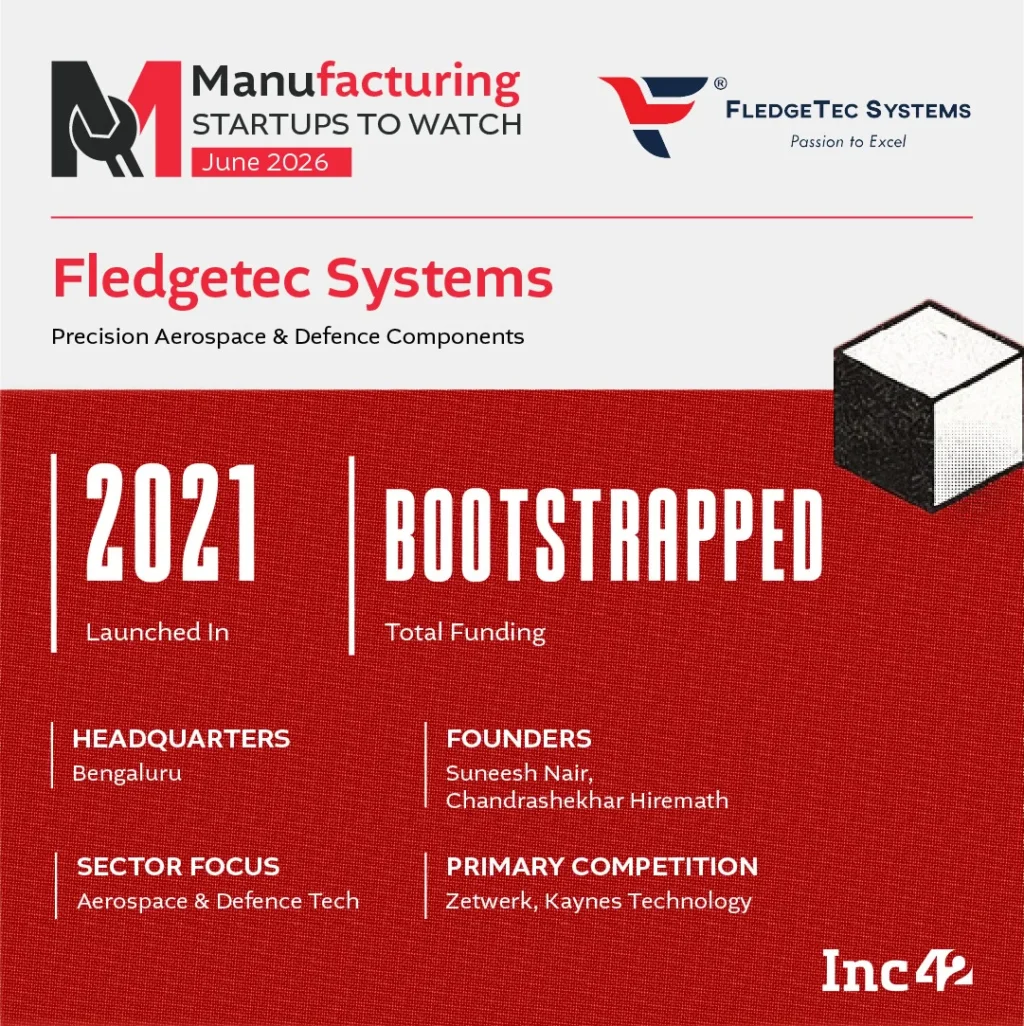
4. FledgeTec Systems: The Backbone of Defense
FledgeTec Systems represents the maturation of India’s precision engineering sector. By providing custom-built, mission-critical components for the aerospace and defense industries, Suneesh Nair and Chandrashekhar Hiremath are helping India move toward self-reliance in high-precision manufacturing. Their end-to-end support—from design and testing to production—makes them a critical partner for complex industrial projects.

5. Helionis Labs: Solving the Thermal Crisis
Managing heat in high-performance electronics is a global engineering challenge. Helionis Labs, founded in 2024, is addressing this with its proprietary insulated metal substrate boards. By printing dielectric materials directly onto aluminum, they have developed a solution that lowers operating temperatures by up to 20 degrees Celsius. This is a classic example of "Deep Tech" innovation that solves a fundamental pain point for the EV and power electronics industries.
Official Perspectives and Strategic Implications
The government’s stance is clear: the focus is on creating a "Global Quality" manufacturing environment. By fostering localized supply chains—as seen with the support for Jabil and other electronics manufacturers—the government is aiming to insulate the economy from global geopolitical shocks.
The implications for the broader startup ecosystem are profound. First, capital intensity is no longer a deterrent. Investors are increasingly comfortable with the longer gestation periods of manufacturing startups compared to software-as-a-service (SaaS) models. Second, talent is shifting. Top-tier engineering talent, which previously flocked to IT services, is now increasingly applying its expertise to hardware, robotics, and aerospace.
Finally, the shift toward "Made in India" products for the global market—not just for domestic consumption—is the ultimate test of maturity. Startups like Aspera Industries, which is already looking toward New Zealand and Southeast Asia, indicate that Indian manufacturing is ready to compete on a global stage.

Conclusion: A Future Built on Precision
As we move into the second half of the decade, the momentum in India’s manufacturing sector appears irreversible. The convergence of AI, robotics, and advanced material science is allowing Indian entrepreneurs to leapfrog traditional stages of industrial development. While challenges in infrastructure and supply chain integration remain, the rapid pace of innovation and the influx of high-quality capital suggest that India is well on its way to becoming a global manufacturing powerhouse.
The startups highlighted in this edition are not merely building products; they are building the industrial architecture of the future. Whether it is keeping the air clean, making retail interactive, or powering the next generation of electric vehicles, these companies represent the vanguard of a new, highly specialized, and globally integrated India.
Editor’s Note: This list is not a ranking. It is a curated selection of manufacturing startups that have stood out to the Inc42 editorial team this month based on technological innovation, market potential, and recent operational milestones.