Beyond the Tactic Trap: How to Pivot from "Doing More" to Driving Pipeline
In the modern marketing landscape, the rallying cry of “do more with less” is often met with a weary groan. As budgets tighten and leadership demands increasingly aggressive pipeline targets, the standard response—simply increasing output—is failing. For many teams, the answer isn’t to work harder or run more campaigns; it is to fundamentally dismantle the "tactic-first" mentality that has dominated marketing departments for the last decade.
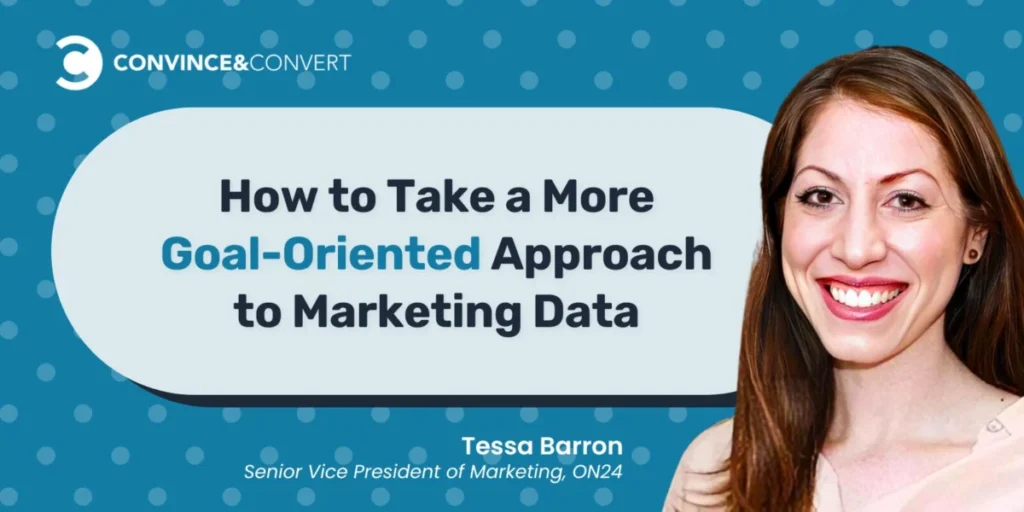
Tessa Barron, the former Senior Vice President of Marketing at ON24, argues that the path to growth requires a radical shift in perspective. By moving from a tactic-oriented mindset to a goal-oriented one, marketers can stop treating their audience as a monolith and start treating them as a source of actionable intelligence. In a recent appearance on the Data-Driven Decisions podcast, Barron outlined a framework for aligning marketing actions with the specific, revenue-generating metrics that actually move the needle.
The Tactic Trap: Why Doing "More" No Longer Works
The post-pandemic business environment has fundamentally altered buyer behavior, yet many marketing departments remain trapped in a 2019 playbook. They continue to churn out webinars, whitepapers, and blog posts because that is what they have always done.
“We as marketers have to check in with ourselves and ask: ‘Have we changed? Are we still doing what we were doing three years ago?’” says Barron. “If the answer is yes, that is the first sign that we need to stop expecting that if we execute the same way and do more and more, we’re going to get more in return.”
The Shift from Tactic-First to Goal-First
The problem with the traditional marketing model is that it begins with the delivery mechanism. A team might decide to run four webinars in Q1 simply because "that’s our webinar strategy."
Barron advocates for a complete reversal of this process. Instead of starting with the tactic, marketers should start with the outcome. A better Q1 goal, according to Barron, would be: “We need to reach X number of new accounts or achieve a 10% uplift in pipeline conversion.”
Once the goal is defined, the tactics become secondary. If the goal is a 10% increase in first-meeting conversions, the marketing team’s role shifts from content creation to identifying the specific educational gaps that prevent a prospect from taking that meeting. If the data suggests that target accounts are struggling with a specific industry regulation, the webinar becomes a surgical tool to address that pain point, rather than a generic top-of-funnel broadcast.
Uncovering Key Signals: Turning Noise into Intelligence
We live in an era of data abundance, yet many marketers suffer from a paradox: they are drowning in information but starving for insight. Barron suggests that the key is to stop viewing data as a collection of metrics and start viewing it as a collection of "signals."
A signal is any data point that indicates a buyer is moving closer to a purchase decision. Once these signals are identified, the marketer’s job is to set "traps"—or, more accurately, strategic interactions—that encourage prospects to reveal their intent.
Case Studies in Strategic Data Capture
ON24, a platform built for digital engagement, has utilized this approach to help its clients transform passive content into active lead qualification.
- The Cloud Provider Strategy: A technology company aiming to regain market share discovered that prospects using a specific cloud provider were 10 times more likely to convert. Rather than targeting everyone, the marketing team integrated a simple poll into their webinars: “Which cloud provider are you currently using?” This question acted as an immediate filter, allowing the sales team to prioritize the high-intent prospects who identified the "correct" provider.
- The Healthcare Risk Assessment: A pharmaceutical company needed to reach doctors treating patients with specific, urgent needs. During a webinar on new drug therapies, the company asked a targeted question: “How would you rate the risk of your patient base?” By segmenting attendees into high, medium, and low risk, the company could immediately tailor follow-up communications to the high-risk segment, who had the most urgent need for the new treatment.
These examples underscore a crucial truth: data is only as valuable as the question you ask to extract it.
Bridging the Divide: The Sales-Marketing Nexus
A perennial point of friction in B2B organizations is the misalignment between sales and marketing. Marketing teams often focus on "content quality" metrics—how many people clicked, how many minutes they stayed, or how many social shares were generated. While these metrics reflect the health of the content, they rarely correlate with the health of the pipeline.
Why Sales Must Inform Marketing Strategy
Barron suggests that the most effective marketers spend less time looking at marketing analytics and more time listening to sales calls.
“Salespeople sit at the front lines of the prospect’s communication,” Barron notes. “They hear the hesitations, the doubts, and the specific language that triggers a ‘yes’ or a ‘no.’ If you aren’t building your marketing strategy around the questions that sales is already asking to qualify a lead, you’re missing the point.”
The partnership should be symbiotic:
- Marketing creates the net: The role of the marketer is to develop a strategy that catches potential buyers and, crucially, qualifies them.
- Sales captures the value: The role of the salesperson is to convert those leads into tangible pipeline.
The goal is to provide the sales team with a "full picture" of the prospect before they even pick up the phone. When marketing understands exactly what a "qualified" prospect looks like, they stop sending over leads that are merely curious and start sending over prospects who are ready to engage.
Implications for Organizational Structure and Messaging
For this framework to succeed, it requires a shift in how marketing teams present their performance to the wider organization. When dealing with stakeholders who sit outside the marketing department, the "noise" of data can be overwhelming.
The Art of Presenting What Matters
Barron emphasizes that data should be presented to stakeholders with extreme simplicity. Leadership does not necessarily need to see the nuances of A/B testing or email open rates. They need to see the correlation between marketing spend and pipeline growth.
When a team can demonstrate that a specific interaction (like the cloud provider poll) directly led to a 10% increase in qualified meetings, they gain the "permission" to stop chasing irrelevant vanity metrics. This, in turn, fosters a culture of accountability where every dollar spent and every piece of content produced has a clear line of sight to a revenue-generating outcome.
Addressing the "In-Between" Spaces
A common blind spot in the buying journey is the "in-between" stage—the period after a lead is captured but before they become a pipeline opportunity. Many organizations have outdated lead forms, stagnant nurturing sequences, or disjointed messaging that causes friction in this critical phase.
By applying a goal-oriented mindset to these gaps, marketers can optimize their own internal processes. Whether it is shortening a form on a landing page or providing more tailored, consultative content, these small "dials" can lead to massive improvements in overall conversion rates.
Conclusion: The Path Forward
The mandate to "do more with less" is only a burden if you define "more" as "more noise." By shifting the focus toward intentional data collection, alignment with sales, and a rigorous focus on the metrics that define pipeline growth, marketers can transform their function from a cost center into a growth engine.
The future of marketing is not found in the volume of content produced, but in the precision of the signals captured. As Barron’s framework illustrates, the marketers who win in the coming years will be those who stop executing for the sake of execution and start designing for the sake of conversion.
For more on these strategies and how to implement a data-driven approach, listeners can tune in to the full episode of the Data-Driven Decisions podcast, available on the Convince & Convert website.