Beyond Binary: Mastering Multi-Label Text Classification with Scikit-LLM
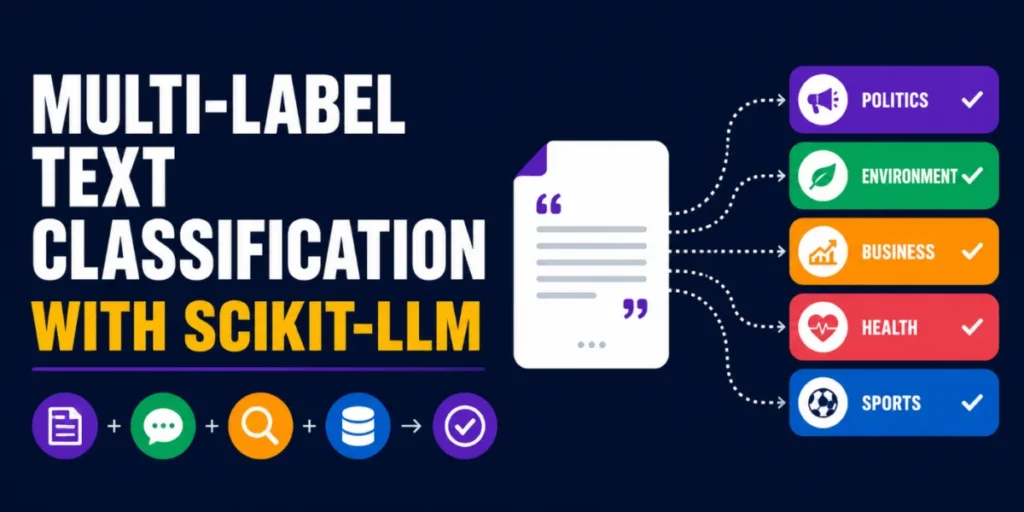
In the traditional landscape of natural language processing (NLP), text classification has long been treated as a binary or single-choice problem. We are accustomed to categorizing emails as "spam" or "not spam," or product reviews as strictly "positive" or "negative." However, human language is rarely so compartmentalized. A single sentence can encapsulate a complex, nuanced tapestry of emotions, intents, and topics. Consider the statement: "I absolutely love the enhanced battery life, but the new design is incredibly awful." This is simultaneously a compliment and a grievance.
To bridge the gap between rigid machine learning constraints and the fluidity of human expression, developers are turning to multi-label text classification. By leveraging the reasoning power of Large Language Models (LLMs) through the intuitive scikit-LLM library, practitioners can now bypass the grueling requirement of massive labeled datasets and complex neural architecture design.
Main Facts: The Evolution of Classification
Multi-label text classification is the process of assigning one or more tags to a piece of text. Unlike standard multi-class classification, where a document belongs to exactly one category, multi-label systems allow for overlapping and non-exclusive assignments.
Historically, this required thousands of annotated examples to "teach" a model the nuances of labels. Today, the shift toward zero-shot learning—where a model makes predictions on categories it hasn’t seen during training—has fundamentally changed the economics of AI. scikit-LLM serves as a high-level bridge, wrapping sophisticated LLM APIs within the familiar, modular interface of scikit-learn. By using these pre-trained giants, developers can perform inference on diverse, subjective tasks with minimal configuration, effectively treating advanced generative models as drop-in components for standard data science workflows.
Chronology: From Neural Networks to Zero-Shot Reasoning
The history of text classification reflects the broader evolution of AI:
- The Rule-Based Era (Pre-2010s): Classifiers relied on regex and keyword matching. They were fast but brittle, struggling with context and sarcasm.
- The Statistical Era (2010–2018): Models like Naive Bayes and SVMs became the gold standard. They required feature engineering (TF-IDF, Bag-of-Words) and were limited by their inability to understand semantics.
- The Deep Learning Era (2018–2022): The rise of BERT and transformer architectures allowed for state-of-the-art accuracy. However, these required GPUs and massive, domain-specific labeled datasets, making them inaccessible to many small teams.
- The LLM/Zero-Shot Era (2023–Present): With the advent of GPT-style architectures, we entered the age of "instruction-based" classification. We no longer train models; we prompt them. Libraries like
scikit-LLMemerged to formalize this process, allowing researchers to treat LLMs as estimators in a pipeline.
Supporting Data: Implementing the Workflow
To implement this in a real-world scenario, we use the go_emotions dataset—a collection of Reddit comments annotated for fine-grained emotional sentiment.
1. Environment Setup
The initial step is to install the necessary packages. Because we are using LLMs, we must ensure our environment is configured for API interaction.
pip install scikit-llm datasets2. Configuration and Model Initialization
We utilize the Groq API for high-speed inference. By setting a custom endpoint, we can access open-source models like Llama 3.3.
from skllm.config import SKLLMConfig
from skllm.models.gpt.classification.zero_shot import MultiLabelZeroShotGPTClassifier

SKLLMConfig.set_openai_key("YOUR_FREE_API_KEY")
SKLLMConfig.set_gpt_url("https://api.groq.com/openai/v1/")

clf = MultiLabelZeroShotGPTClassifier(model="custom_url::llama-3.3-70b-versatile", max_labels=3)
3. Data Ingestion
Using the Hugging Face datasets library, we load the emotion-tagged comments.
from datasets import load_dataset
import pandas as pd

dataset = load_dataset("google-research-datasets/go_emotions", split="train[:100]")
df = dataset.to_pandas()
texts = df['text'].tolist()
4. The "Zero-Shot" Fit
The beauty of this approach is that fit() does not involve gradient descent or weight updates. It is merely a configuration step to define the "label space" for the LLM.
candidate_labels = ["admiration", "amusement", "anger", "annoyance", "approval", "curiosity", "disappointment", "joy", "sadness", "surprise"]
clf.fit(None, [candidate_labels])
5. Inference
Running predictions on new, unseen text allows the model to map the input to the most appropriate labels based on its latent linguistic knowledge.
Official Perspectives: The Trade-offs
Industry experts highlight that while scikit-LLM significantly lowers the barrier to entry, it is not a "magic bullet" for all production environments.
- Latency Considerations: Unlike a local DistilBERT model, which might run in milliseconds, calls to an LLM involve network overhead and compute time. For high-throughput applications (e.g., millions of classifications per hour), this approach may become cost-prohibitive.
- The "Hallucination" Factor: Because LLMs are probabilistic, they can occasionally assign labels that are technically plausible but contextually incorrect. Unlike deterministic models, their outputs can shift slightly based on the model version.
- Data Privacy: Utilizing third-party APIs like Groq or OpenAI requires strict adherence to data governance policies. For sensitive corporate or medical data, the use of local, self-hosted LLMs via the same
scikit-LLMinterface is strongly recommended.
Implications for Industry and Research
The implications of this technology are profound. For small to mid-sized enterprises, the "Data Bottleneck"—the time and money spent labeling thousands of rows of data—is effectively removed.
Enhanced Customer Experience
Companies can now perform real-time sentiment analysis on customer support tickets, detecting multiple issues (e.g., "frustration" and "billing error") simultaneously. This allows for automated routing to the correct department without the need for a legacy rule-based system.
Market Research
Researchers can analyze thousands of social media posts to identify subtle trends in consumer behavior. The ability to identify multiple emotions in a single post provides a depth of insight that traditional binary sentiment analysis misses.
Future-Proofing the Pipeline
As LLMs continue to shrink in size and improve in reasoning capability, the accuracy of this zero-shot classification will only increase. By building on a framework like scikit-LLM, developers ensure that their codebase remains modular. If a superior model is released tomorrow, swapping the underlying engine requires changing only a single configuration string, rather than refactoring the entire training pipeline.
Conclusion: The Path Forward
To move from a prototype to a production-ready application, practitioners should focus on three key areas:
- Evaluation Loops: Always implement a validation set. Use metrics like F1-score (macro and micro) to quantify how well the LLM matches human-annotated ground truth.
- Prompt Engineering: While
scikit-LLMhandles the heavy lifting, the ability to pass custom system prompts allows developers to refine the classification logic significantly. - Few-Shot Refinement: If zero-shot performance is insufficient,
scikit-LLMsupports few-shot learning. By providing 5–10 examples of how you want a specific comment classified, you can dramatically improve consistency for edge cases.
The era of complex, resource-heavy model training is giving way to a more agile, reasoning-centric approach. By embracing libraries that simplify this integration, we are democratizing access to high-level AI, turning complex linguistic challenges into manageable, scalable tasks. Whether you are a solo developer or part of a global data science team, the tools to analyze the nuances of human emotion are now firmly within your reach.