Biomimicry Takes Flight: JSS Science and Technology University Students Redefine Robotics
By Technology Correspondent
June 14, 2026
Main Facts: A Convergence of Nature and Engineering
The campus of JSS Science and Technology University (JSS STU) in Mysuru transformed into a hub of futuristic innovation on June 6, 2026, as the Advanced Integrated Systems for Cybernetics (AISC) club unveiled a series of groundbreaking robotic systems. During the university’s annual "Open Day," the student-led collective captivated visitors by bridging the gap between mechanical engineering and biological mimicry.
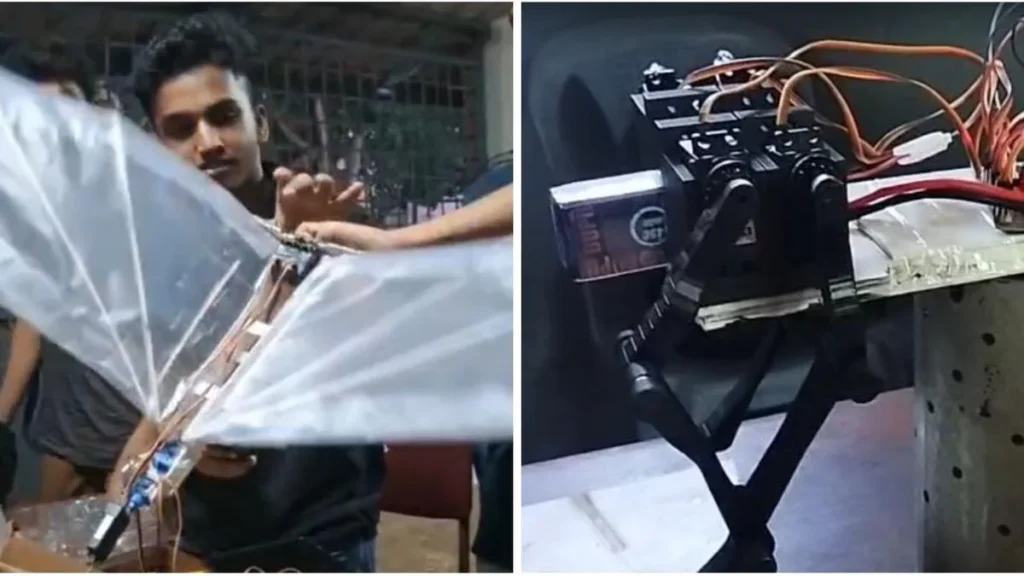
The star attractions—a bird-inspired surveillance ornithopter named "Jatayu," a highly agile quadruped robot, and a precision-engineered 6-axis robotic arm—demonstrated a sophisticated integration of mechanical design, embedded control systems, and adaptive algorithms. These projects are not merely academic exercises; they represent a concerted effort by the student body to solve real-world problems in surveillance, industrial automation, and terrain navigation through biomimicry.
Chronology of Innovation: From Concept to Campus Display
The journey of these robots began months prior to the Open Day, rooted in the AISC club’s interdisciplinary culture.
- Early 2026 (Ideation Phase): The club members identified the limitations of traditional rotary-wing drones, particularly in terms of noise pollution and lack of stealth. This led to the conceptualization of "Jatayu."
- March – April 2026 (Development): Engineering students worked on material science, selecting carbon fiber for the airframe to ensure a high strength-to-weight ratio. Simultaneously, the software team began developing the autopilot fusion algorithms.
- May 2026 (Prototyping): The "RoboDog" quadruped underwent rigorous testing for gait stability and joint compliance, ensuring it could handle uneven terrain.
- June 6, 2026 (Public Exhibition): The projects were officially unveiled at the JSS STU campus, drawing significant interest from industry experts, local tech enthusiasts, and prospective students.
- June 14, 2026 (Formal Recognition): Following the successful showcase, the university administration officially recognized the club’s contributions to institutional research output.
Technical Deep Dive: The Mechanics of Biomimicry
The ingenuity behind the AISC projects lies in their commitment to emulating biological systems.
The "Jatayu" Ornithopter: Surveillance Reimagined
"Jatayu" is a masterclass in lightweight engineering. Unlike fixed-wing or quadcopter drones, the ornithopter utilizes a flapping-wing mechanism that provides efficient, low-noise propulsion. The technical specifications shared by the design team highlight a carbon fiber reinforced airframe, which provides the necessary structural rigidity while maintaining extreme lightness. The wing sections are constructed from flexible foam, allowing for natural aerodynamic deformation during flight.
The propulsion system is hybrid in nature: a compact brushless actuator drives the primary wing flapping, while a small pusher propeller provides the necessary thrust for climbing and cruising at higher altitudes. The integration of a GPS module and a downward-facing camera allows the device to perform waypoint navigation and automated survey passes. The onboard autopilot is particularly notable, as it fuses GPS data with inertial sensors, allowing the drone to remain stable even in gusty conditions—a feat often difficult for small-scale ornithopters.
The "RoboDog": Quadrupedal Agility
The RoboDog project serves as a testament to the students’ grasp of dynamics and control theory. The robot is built upon a modular leg design that utilizes compliant joints. These joints mimic the elasticity of animal tendons, allowing the robot to absorb shock and traverse unpredictable terrain. By keeping the center of gravity low and implementing an efficient power management system, the students have created a quadruped capable of rapid turns and sudden shifts in direction without losing balance.
Supporting Data and Methodology
The AISC club operates on a philosophy of "Learning by Doing." Their methodology focuses on three core pillars:

- Mechanical Design: Utilizing Computer-Aided Design (CAD) to simulate stresses and optimize skeletal frames.
- Embedded Control: Programming microcontrollers to handle high-frequency sensor inputs, ensuring real-time response times for all robotic appendages.
- Adaptive Algorithms: Developing software that allows the robots to adjust their movement patterns based on environmental feedback, such as changes in wind speed or ground texture.
The club’s research into sensing and actuation has yielded a 6-axis robotic arm that is remarkably adaptable. During the demonstration, the arm showcased the ability to replicate complex human-like motions, making it a viable candidate for delicate industrial assembly tasks that require high precision and spatial awareness.
Official Responses: Fostering a Culture of Research
In an official statement released following the event, the university administration lauded the AISC club for their dedication. "The work showcased by the AISC members is a clear indicator of the caliber of talent we have at JSS Science and Technology University," the statement noted. "By encouraging students to step outside the classroom and engage with interdisciplinary teams, we are not just teaching engineering—we are fostering the next generation of technological pioneers."
Faculty mentors assigned to the club highlighted the importance of the "Open Day" as a bridge between the laboratory and the public. "It is one thing to write a research paper," said one faculty member. "It is another to demonstrate a functional, bird-like drone in front of an audience. This experience teaches students how to articulate their research, manage project timelines, and handle the pressure of live public performance."
Implications: The Future of Robotics at JSS STU
The success of the AISC club has far-reaching implications for the institution and the broader tech landscape in Mysuru.
Industrial and Defense Applications
The development of low-noise ornithopters like Jatayu has massive implications for search and rescue operations, wildlife monitoring, and discreet surveillance. Because they mimic biological flight, they are less likely to disturb local fauna, making them superior to traditional drones in sensitive ecological zones.
Educational Impact
The AISC model of collaborative, project-based learning is gaining traction as a gold standard for undergraduate engineering education. By removing the silos between mechanical, electrical, and software engineering, the club has created a microcosm of the modern professional workplace. This approach ensures that graduates are not merely "book smart" but are ready to integrate complex systems in professional engineering roles.
A Growing Tech Ecosystem
Mysuru, often overshadowed by the tech giants of Bengaluru, is beginning to carve out its own niche in robotics and artificial intelligence. The presence of student-led innovation at JSS STU provides a talent pipeline for startups and larger firms looking to invest in specialized engineering talent.
Conclusion: Looking Ahead
As the academic year continues, the members of the AISC club have already turned their attention toward their next set of goals. Discussions are underway regarding the potential commercialization of the 6-axis arm and the scaling of the Jatayu drone for longer-range missions.
The Open Day of June 2026 will be remembered not just as a display of student projects, but as a turning point for the AISC club. It solidified the club’s role as a powerhouse of innovation and proved that with enough determination, the students of JSS Science and Technology University can turn the abstract theories of cybernetics into reality. As the field of robotics continues to evolve, the integration of biological elegance with mechanical precision remains the ultimate frontier—and for the students of AISC, the sky is no longer the limit; it is the testing ground.