The Standardization of AI: How the Model Context Protocol (MCP) is Rewriting the Rules of Integration
Large Language Models (LLMs) are, by their very design, prisoners of their own training data. While these models represent a quantum leap in natural language processing, they suffer from a fundamental architectural limitation: they are essentially static snapshots of knowledge. The moment the training process concludes, the model’s world stops.
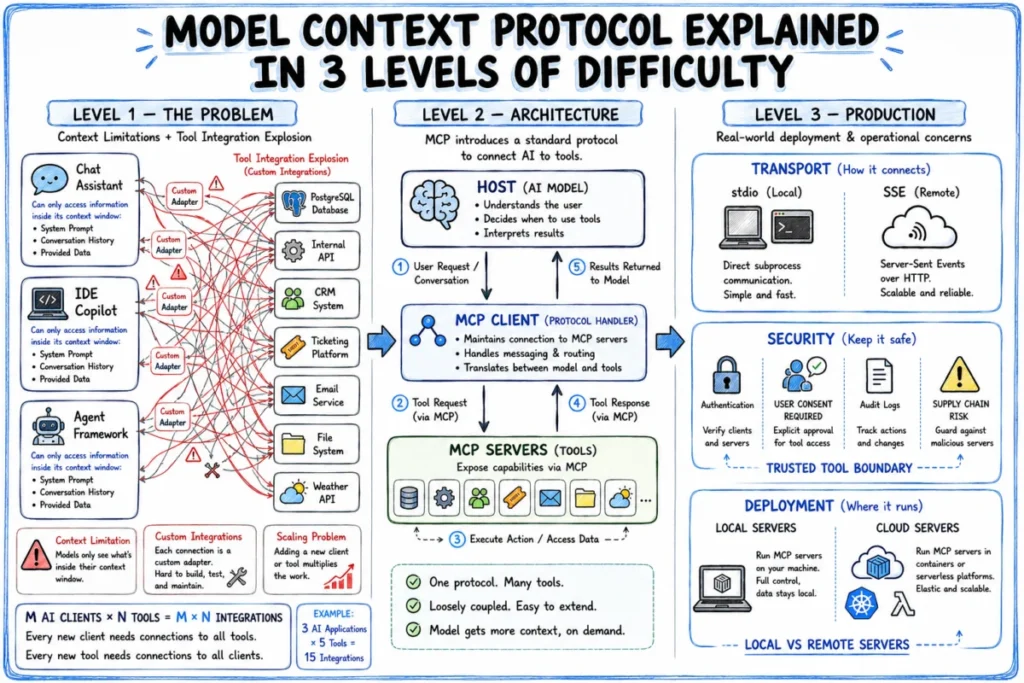
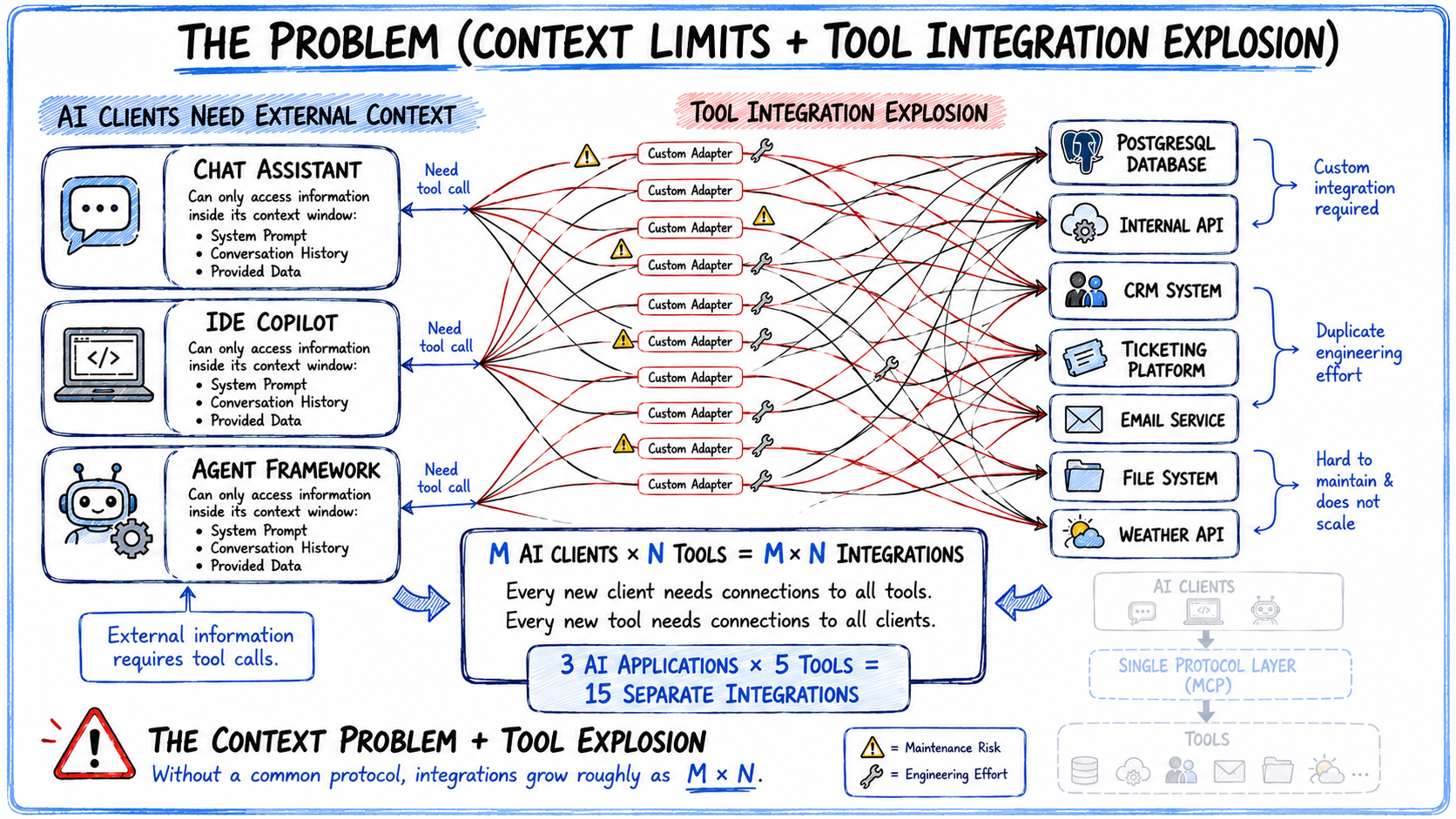
When a developer asks an LLM to interpret a real-time database, navigate a private file system, or summarize an email that arrived ten minutes ago, the model hits a wall. Bridging this gap has historically fallen on the shoulders of software engineers, who have been forced to build custom, fragile "glue code" for every new integration. This is the "M × N" problem—the nightmare of maintaining a matrix of custom adapters between every AI model and every enterprise service.
The Model Context Protocol (MCP), an open-source standard introduced by Anthropic, seeks to end this era of fragmentation. By providing a universal language for AI applications to interface with data sources, MCP is fundamentally shifting the development paradigm from bespoke engineering to plug-and-play interoperability.
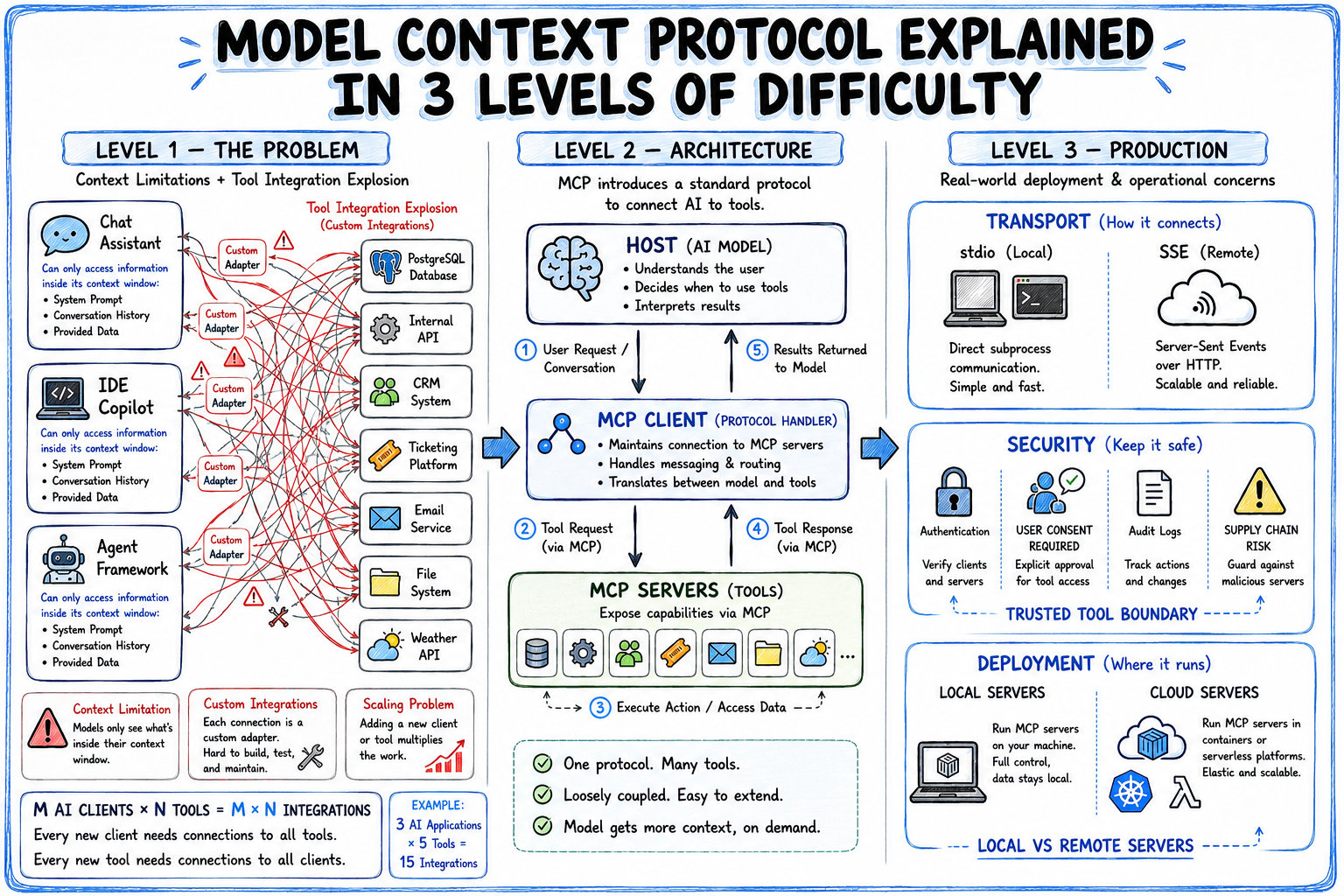
Level 1: The Anatomy of the Integration Crisis
To understand why MCP matters, one must first recognize the sheer inefficiency of the current AI integration landscape. Most modern AI applications leverage "function calling," a technique where an LLM identifies the need for external information and requests a tool to fetch it.
However, without a standardized protocol, every application developer must build unique connectors. If a company uses three AI assistants (e.g., a coding agent, a customer support bot, and a research tool) and requires them to interact with five internal data sources (PostgreSQL, Slack, GitHub, Jira, and a private file server), they are forced to maintain fifteen distinct integrations. Every time a new tool is introduced, every client must be updated. Every time a new AI model is adopted, the entire integration matrix must be re-engineered.
The Shift to a Composable Ecosystem
MCP solves this by decoupling the AI application (the "Client") from the data source (the "Server"). Under this model, a service—such as a PostgreSQL database—exposes itself as an MCP server once. Any MCP-compliant client, whether it is an AI-powered IDE, a terminal agent, or a web-based chatbot, can immediately interact with that database without needing custom-built adapters.
This shifts the integration complexity from M × N (every client-to-tool connection) to M + N (a single protocol implementation for each client and each server). The result is a composable ecosystem where developers spend less time writing plumbing and more time building features.
Level 2: Architecture and the Flow of Intent
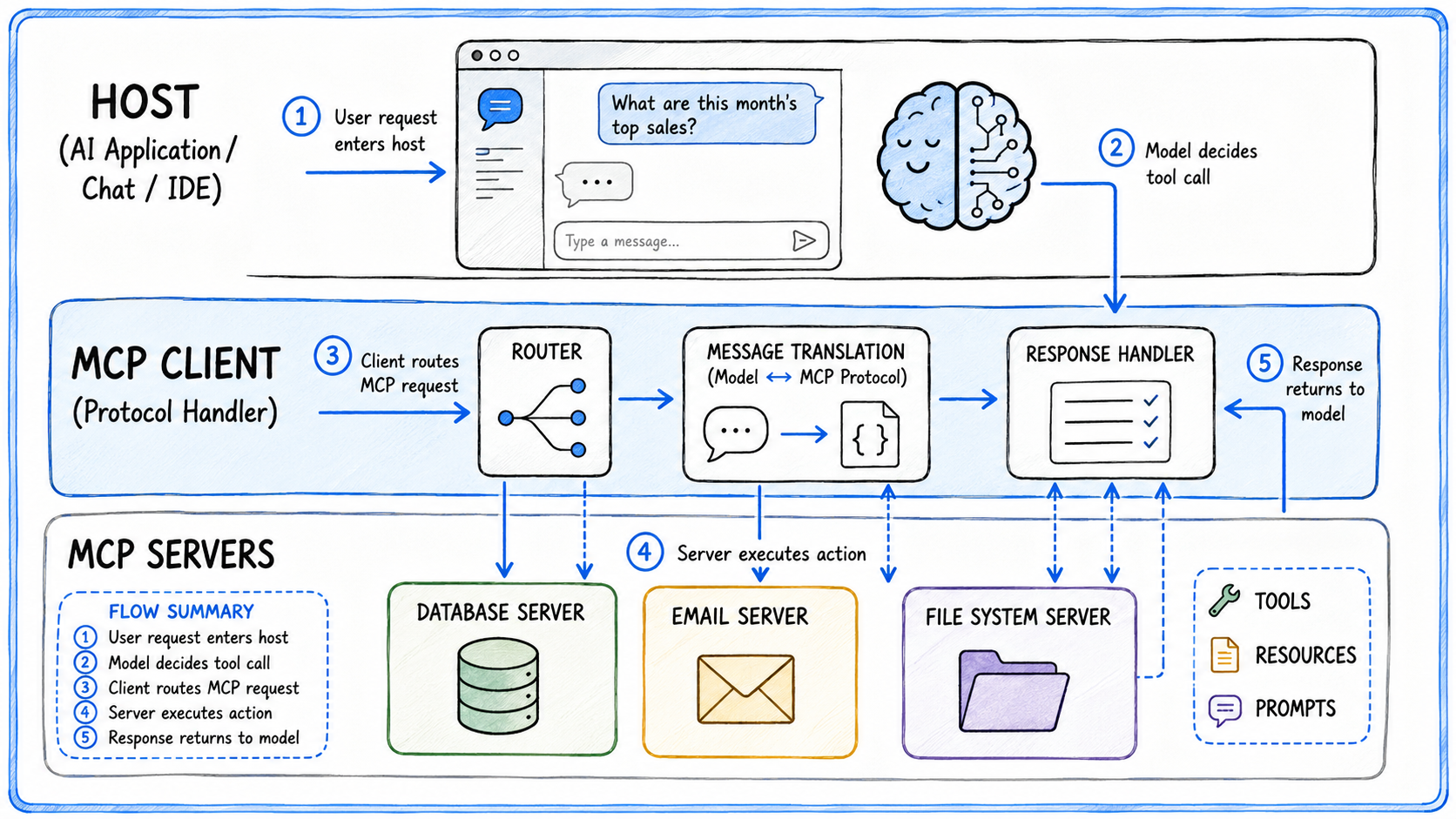
The MCP architecture is built upon a tripartite structure: the Host, the Client, and the Server. Each component plays a distinct role in ensuring the safe and reliable exchange of data.
The Component Roles
- The Host: This is the primary application—the interface the user interacts with. It houses the LLM, manages the user conversation, and acts as the orchestrator of intent.
- The Client: Acting as the "protocol engine," the client resides within the host. It handles the mechanics of the MCP specification, maintains a registry of available servers, translates the model’s abstract requests into standardized MCP calls, and routes them to the correct destination.
- The Server: This is the bridge to the external world. It defines its own capabilities—what tools it provides and what resources it can serve. The server hides the complexity of the underlying system, presenting only a clean, standardized interface to the client.
Tracing a Request
Consider a user request: "Fetch the Q2 revenue metrics from the database and draft a summary email to the finance team."
The model identifies two distinct tasks. The client checks its registry, identifying that database_query and email_draft are available via registered MCP servers. The model executes the database query; the server runs the SQL, formats the JSON response, and returns it. The model then uses that data to craft the email content and triggers the email server to send it. At no point does the model need to know the underlying API details of the database or the email client. The MCP protocol handles the translation, and the developer writes zero "glue code."
Core Capabilities: Tools, Resources, and Prompts
MCP servers are defined by three distinct capabilities:
- Tools: Executable functions that allow the AI to perform actions, such as writing to a database or triggering a CI/CD pipeline.
- Resources: Passive data streams, such as log files, documentation, or configuration data, which the AI can read but not alter.
- Prompts: Pre-defined interaction templates that help the AI understand how to interact with specific services effectively.
The distinction between tools and resources is a vital security feature. By separating passive reading from active modification, developers can apply granular access controls, ensuring that an AI agent cannot accidentally execute a destructive command in a production environment.
Level 3: Transport, Security, and Production Readiness
As MCP moves from developer prototypes to enterprise-grade production environments, three pillars become critical: transport mechanisms, security protocols, and deployment strategies.
The Dual-Layer Communication Model
MCP splits communication into two distinct layers:
- The Transport Layer: This defines how messages move between the client and the server. Whether through Stdio (standard input/output) for local connections or HTTP (Server-Sent Events) for remote network-based connections, the transport is modular.
- The Data Layer: This defines the actual content of the request. Because the data layer is decoupled from the transport, an application can switch from a local, high-speed connection to a secure, remote network connection without modifying a single line of the integration logic.
Addressing the Trust Problem
Opening a direct line between an LLM and an enterprise database introduces significant risks. The MCP security framework emphasizes a "Zero Trust" approach:
- Authentication and Authorization: Servers must validate tokens issued for the specific user session.
- Scope Limiting: Tools should operate with the principle of least privilege. An MCP server providing read-only access to a database should not have the credentials to drop tables.
- Human-in-the-Loop: For sensitive operations, MCP supports user-consent patterns, ensuring that the model cannot perform an action—like sending an email or deleting a file—without explicit authorization from the human user.
Deploying MCP Servers
The deployment of an MCP server depends heavily on the sensitivity of the data.
- Local Servers: For personal use or sensitive local files, servers often run as local processes, communicating via Stdio. This ensures that data never leaves the user’s machine.
- Remote/Cloud Servers: For team-based tools or enterprise services, MCP servers are typically deployed as microservices using platforms like Google Cloud Run or Kubernetes. This allows for horizontal scaling and centralized logging, though it requires rigorous network-level security and TLS encryption.
Implications: A New Era for AI-Native Software
The emergence of the Model Context Protocol signifies that the AI industry is entering a "post-infrastructure" phase. Much like how SQL became the universal language for databases and HTTP became the universal language for the web, MCP is positioning itself as the common language for the "AI-agentic" future.
Why This Matters for Developers
For the developer, the implication is simple: Composability. When a new AI model is released, you won’t need to rewrite your integrations. When a new SaaS tool becomes popular, it can publish an MCP server, and it will be immediately compatible with every agentic IDE, chat assistant, and autonomous worker in the ecosystem.
The Road Ahead
While the standard is still in its relative infancy, the support from major industry players suggests a rapid adoption curve. IDEs like Visual Studio Code are already beginning to integrate MCP support natively, allowing developers to bring their own tools into their coding environment with minimal friction.
As we look toward the future of software development, the "integration tax"—the endless hours spent mapping data fields and auth headers—is being paid off. By standardizing the interface between the "brain" (the LLM) and the "limbs" (the tools), MCP is providing the necessary infrastructure to turn AI from a simple chatbot into an active, capable, and highly integrated agent that lives at the heart of our digital workflows.
Resources for Further Exploration
- Official MCP Documentation: The definitive guide for building and deploying servers.
- MCP Registry: A community-driven index of pre-built servers for popular services like GitHub, Slack, and Postgres.
- Security Best Practices: Essential reading for anyone deploying MCP in a production, enterprise-grade environment.
The era of siloed AI is coming to an end. Through the Model Context Protocol, the future of AI is not just about being smart—it is about being connected.