Beyond the Hype: Decoding the Architectural Spectrum of Agentic AI
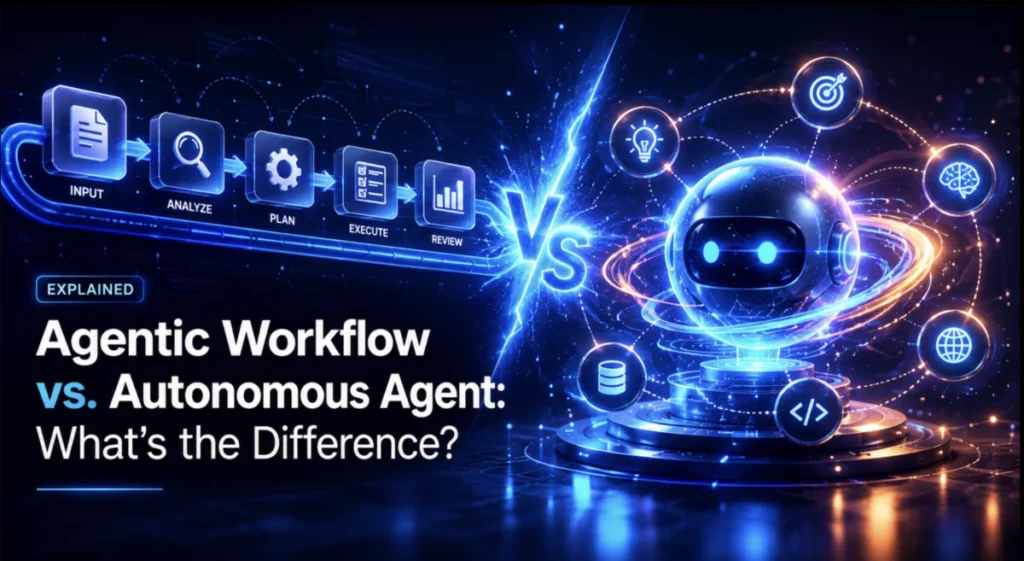
As generative AI transitions from a playground for experimentation to a cornerstone of enterprise operations, a critical vocabulary gap has emerged. Deloitte projects that by 2027, half of all companies leveraging generative AI will have deployed agentic pilots or production-grade systems. However, in the rush to adopt, the industry has begun to collapse distinct architectural concepts into the single, amorphous term "agentic."
Whether a system is a simple five-step pipeline or a self-directing swarm of LLMs, the term is currently applied indiscriminately. This conflation is more than a linguistic error; it is an architectural trap. Misidentifying a task’s requirements—treating a rigid, deterministic problem as an opportunity for open-ended autonomy, or conversely, forcing an ambiguous, creative challenge into a brittle, hardcoded pipeline—leads to system failure.
To navigate this landscape, we must move beyond the question of "Does this use an LLM?" and instead focus on the true differentiator: Who owns the control flow?
The Core Metric: Predictability vs. Autonomy
The true axis of modern AI architecture is not "AI versus non-AI," but rather the trade-off between predictability and autonomy.
In professional engineering circles, the debate centers on two questions: Is the process required to be repeatable, auditable, and explainable step-by-step? And, is the optimal path known in advance, or must the system discover it at runtime?
A system can be heavily reliant on an LLM for complex text generation while remaining entirely deterministic. Simultaneously, a system can be labeled "agentic" while possessing only a thin veneer of autonomy, constrained by rigid guardrails and a hard step limit. The signal is not the model call; it is the source of the next instruction.
1. Deterministic Workflows: The Foundation of Reliability
At the base of the spectrum lies the deterministic workflow. In these systems, every step is defined at design time by human engineers. The LLM serves as a component—a tool for classification, summarization, or extraction—but it does not dictate the architecture.
In a deterministic model, the path taken by input "A" will always be identical to the path taken by input "B," provided the orchestrating code remains unchanged. This is the gold standard for high-stakes environments like legal review or medical billing.
Architectural Implication: Because the route is hardcoded, the system is inherently auditable. If a failure occurs, an engineer can trace the exact line of code that directed the flow. However, this rigidity makes the system brittle. If an input deviates from the expected format or intent, the deterministic flow lacks the "intelligence" to pivot, often resulting in a crash or a non-sequitur output.
2. Orchestrated Workflows: The Illusion of Agency
The most common point of confusion arises in "orchestrated workflows." These systems appear autonomous because they make runtime decisions, but they remain strictly within the boundaries of human-defined logic.
In an orchestrated system, a developer creates a "branching menu." The LLM is tasked with analyzing the input and selecting which branch to trigger. Crucially, the LLM cannot create a new branch. If the human developer did not write a handler for "crypto-tax refunds," the model cannot invent one; it must default to an existing, pre-approved path.
Supporting Data: Google Cloud’s architectural documentation highlights this pattern as "dynamic orchestration." It is a powerful middle ground, offering a semblance of agility while maintaining the safety of human-written constraints. For many enterprises, this is the limit of where they should go, as it provides the benefits of LLM-driven routing without the risks of uncontrolled, non-deterministic behavior.
3. Reactive Agents: The ReAct Paradigm
True autonomy begins when we move to the "ReAct" (Reasoning + Acting) loop, first formalized by Yao et al. in 2022. Here, the system iterates through a cycle of thought, action, and observation.
In a reactive agent loop, the model determines both the sequence of steps and the tools required to complete the task. There is no if/else block written by a human that covers every scenario. Instead, the model consumes its own history of observations, decides on a logical next step, performs an action (such as a database query), observes the result, and iterates again.
The Shift in Control: The number of steps is not fixed. The order of operations is not fixed. The system is genuinely exploring a path at runtime. This provides the flexibility to solve complex, "unknown-unknown" problems. However, it also introduces the risk of the "infinite loop," where an agent, faced with an ambiguous situation, might cycle through tool calls until it exhausts its budget or hits a hard-coded step limit.
4. Autonomous Multi-Agent Systems: The Swarm Frontier
At the furthest end of the spectrum lies the multi-agent system. This is essentially a nested ReAct loop. Here, the orchestrator acts as a "manager," delegating sub-tasks to specialized "worker agents."
The manager doesn’t just call functions; it calls other reasoning systems. For example, a high-level manager agent might delegate a coding task to a "Developer Agent" and a research task to a "Researcher Agent." Each of these agents operates within its own private loop.
Implications of Complexity: This "swarm" architecture, as described by Google Cloud, is the most powerful and the most volatile. Because there is no central orchestrator providing strict boundaries for every interaction, these systems can generate highly creative, emergent solutions to problems that would baffle a single agent. Yet, they are also prone to "hallucinated collaboration," where agents might misinterpret each other’s output or descend into unhelpful feedback loops.
The Production Reality: Why Workflows Still Win
Despite the technological allure of autonomous swarms, 2025 production data indicates that workflows remain the dominant pattern for successful enterprise deployments. The reason is simple: Liability.
For industries under regulatory scrutiny, the "black box" nature of a fully autonomous multi-agent system is a non-starter. If an agent makes a decision that results in a financial loss or a violation of privacy law, the ability to trace the decision-making process is a legal requirement.
Mature organizations are adopting a Hybrid Pattern. They utilize an autonomous agent for high-level goal setting and routing, but once the agent identifies the specific task, it hands the execution off to a deterministic, validated pipeline. This provides the best of both worlds: the flexibility of AI-driven reasoning and the reliability of human-engineered, repeatable code.
Conclusion: The Architecture of Choice
The terms "agentic" and "autonomous" are not binary states; they are markers on a sliding scale. Engineers must resist the temptation to treat them as a ranking of quality. A deterministic workflow is not "worse" than a multi-agent system; it is simply better suited for tasks where the path is known and the cost of error is high.
As organizations continue to refine their AI strategies, the most successful systems will be those that are intentionally architected. By placing each module of a product at the appropriate point on the predictability-autonomy spectrum, companies can build systems that are as flexible as they are reliable.
The future of enterprise AI does not belong to the fully autonomous, self-directing swarm, nor to the rigid, brittle pipeline. It belongs to the hybrid architecture—systems that know when to think for themselves and when to follow a proven, human-defined path. The key to the next decade of AI development is not just building more powerful models, but mastering the art of controlled, purposeful delegation.