The Architecture of Intelligence: Mastering the Seven-Layer AI Agent Stack
In the rapidly evolving landscape of 2026, the promise of the AI agent—a digital assistant capable of autonomously researching, synthesizing, and executing complex workflows—has moved from the realm of science fiction to a business imperative. Imagine instructing an agent to analyze three primary competitors, scrape their latest pricing structures, distill the findings into a strategic report, and post it to a corporate Slack channel by 9:00 AM. In the modern enterprise, this isn’t just possible; it is increasingly expected.
However, the chasm between a prototype that works on a developer’s laptop and a robust production system is vast. According to recent projections from Gartner, 40% of enterprise applications will feature task-specific AI agents by the end of 2026, a meteoric rise from less than 5% in 2025. This near-vertical adoption curve demands that technical leads move beyond the hype surrounding "foundation models" to understand the full stack that makes these agents operational.
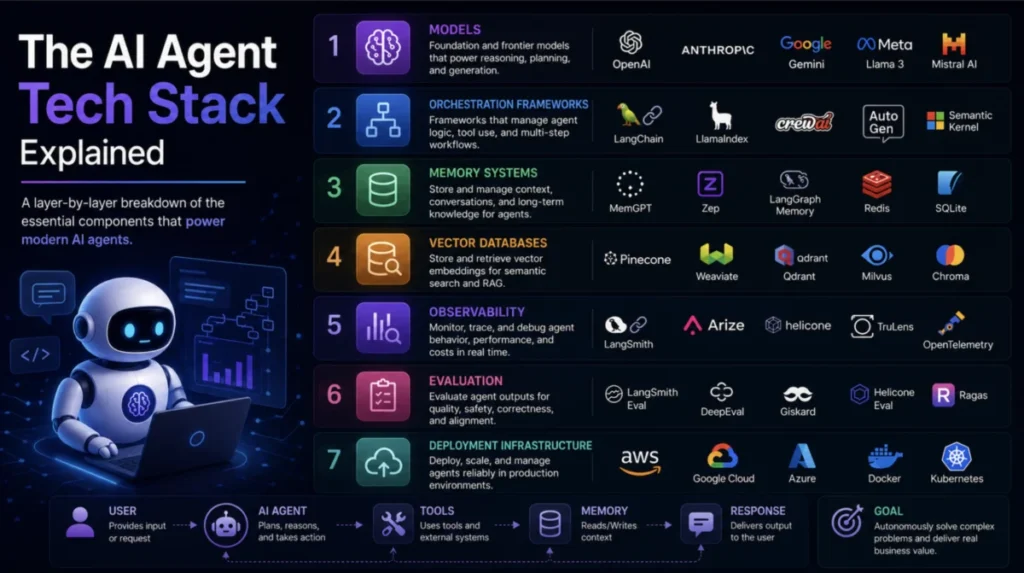
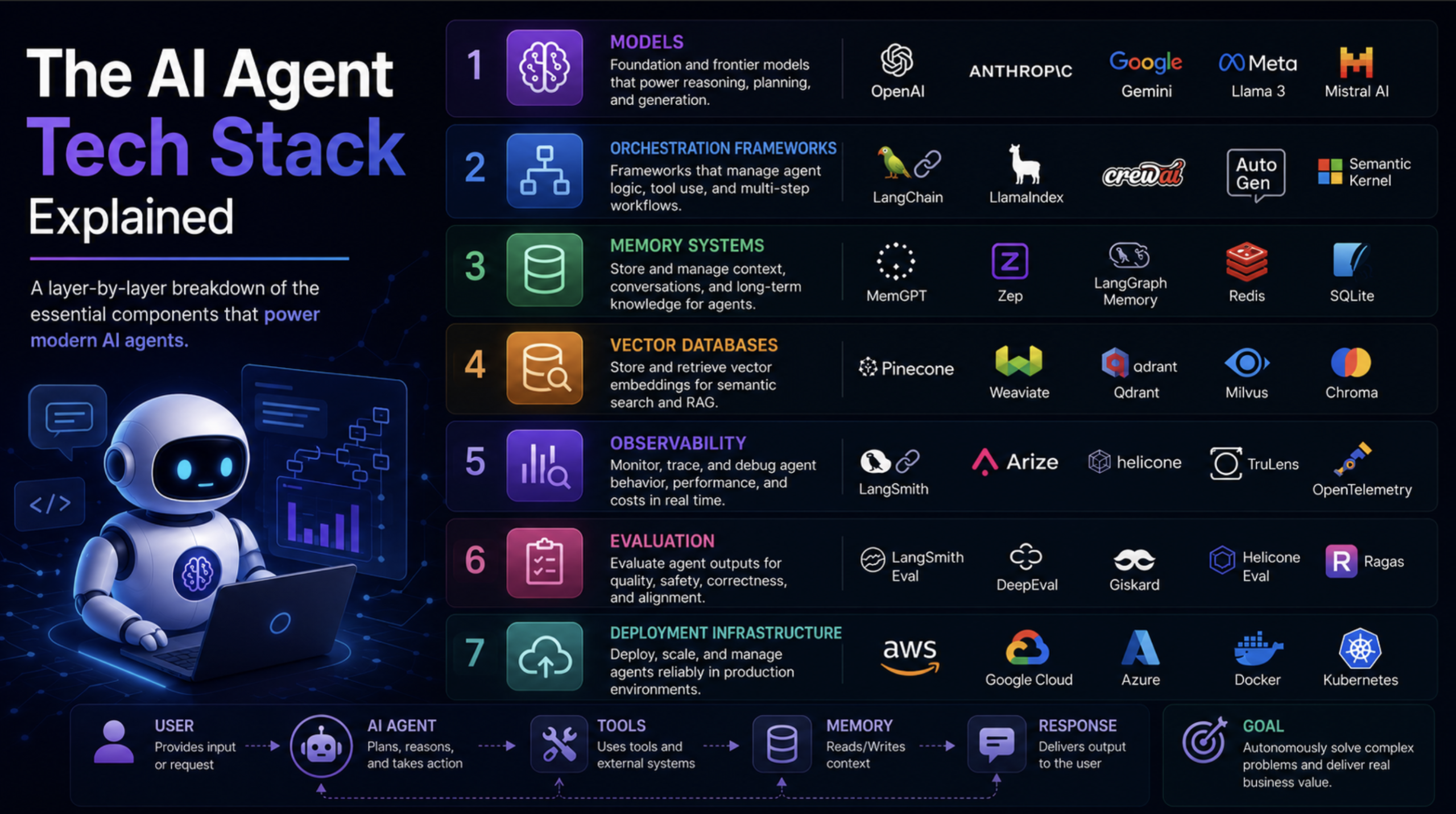
The Anatomy of an AI Agent: A Seven-Layer Framework
An AI agent is not a singular monolithic entity; it is a complex sequence of seven distinct technological layers. While the foundation model (the brain) captures the headlines, the six supporting layers determine the reliability, security, and scalability of the agent.
Layer 1: The Foundation Model – The Cognitive Core
The foundation model serves as the agent’s reasoning engine. Whether it is OpenAI’s GPT-5.5, Anthropic’s Claude Sonnet 4.6, or open-weight models like Meta’s Llama 4, the choice of model dictates the agent’s capability for logic and instruction following.
In 2026, the industry has moved past the binary distinction between "standard" and "reasoning" models. Leading providers have integrated dynamic "thinking" capabilities directly into their models, allowing developers to calibrate reasoning effort. For routine tasks, default settings remain efficient and cost-effective; for complex mathematical or strategic planning, dialing up the reasoning effort parameter is the modern standard for achieving correctness.
Layer 2: The Orchestration Framework – The Nervous System
If the model is the brain, the orchestration framework is the nervous system. Frameworks like LangGraph, AutoGen, and CrewAI manage the "ReAct" (Reasoning and Acting) loop—the continuous cycle of thought, action, observation, and adjustment. Most production failures, such as infinite loops or incorrect tool selection, occur here. Choosing the right framework depends on the task: LangGraph excels for stateful, single-agent runners, while CrewAI is optimized for multi-agent coordination.
Layer 3: Memory Systems – The Contextual Anchor
Statelessness is an LLM’s default state, which poses a fatal flaw for agents needing long-term continuity. Research by Atlan suggests that 95% of 2025’s enterprise AI pilots failed to deliver ROI due to poor context management.
Effective agents require four distinct types of memory:
- Working Memory: The immediate, in-session conversation history.
- Episodic Memory: A persistent log of past interactions and outcomes.
- Semantic Memory: Fact-based knowledge about the world or the organization.
- Procedural Memory: The stored "how-to" knowledge for using specific tools.
Layer 4: Vector Databases and Retrieval (RAG)
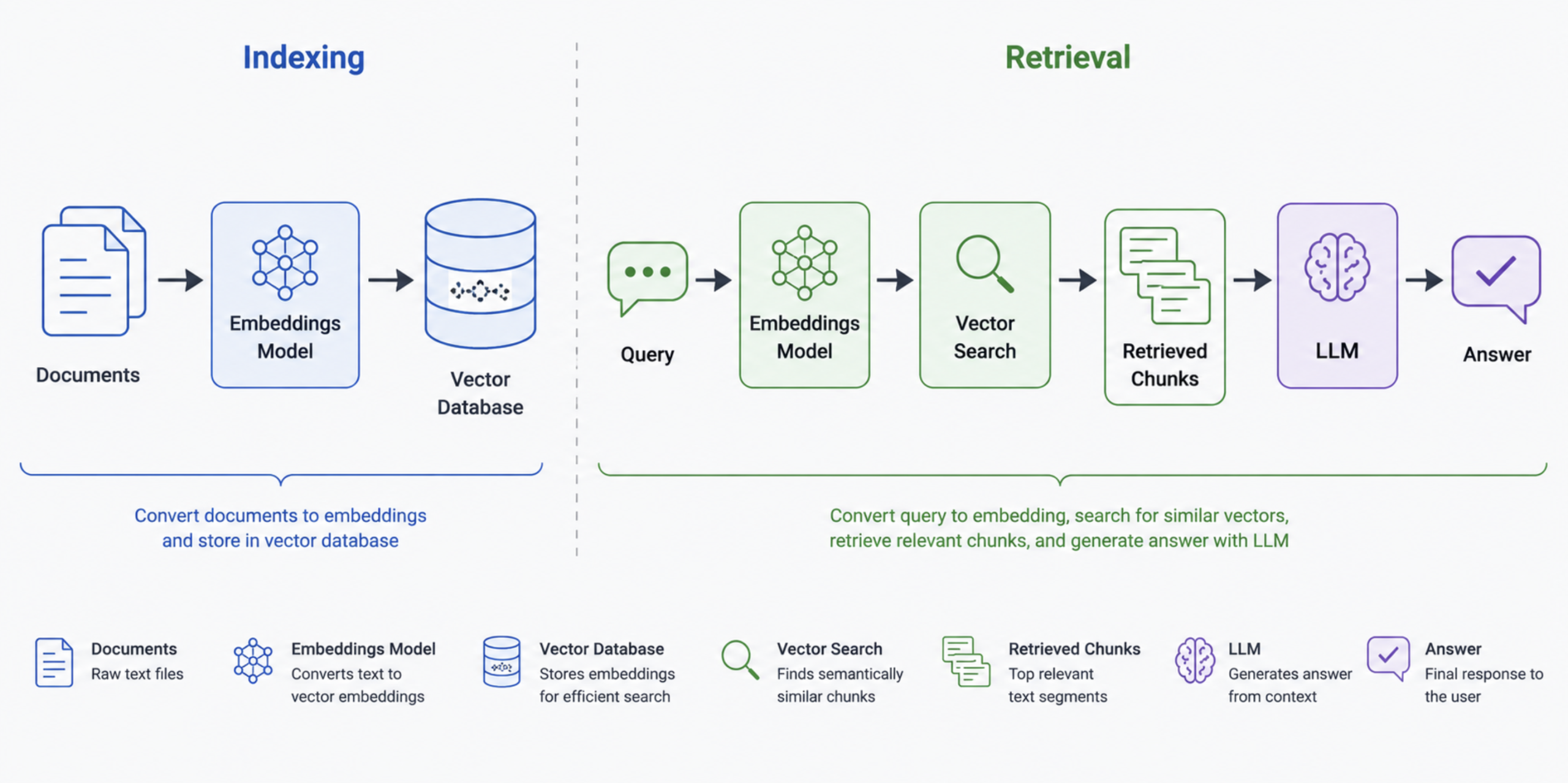
Foundation models are frozen in time, cut off from proprietary company data. Retrieval-Augmented Generation (RAG) solves this by converting internal knowledge into numerical embeddings stored in a vector database (e.g., Chroma, Pinecone, or pgvector). With the global vector database market now valued at over $3.2 billion, these systems act as the agent’s "long-term memory," ensuring that every answer is grounded in current, company-specific information.
Layer 5: Tools and External Integrations
An agent without tools is merely an expensive text generator. Tools—web search, code execution, file I/O, and API calls—allow agents to manipulate the world. The advent of the Model Context Protocol (MCP) in late 2024 has standardized how agents communicate with external systems, drastically reducing the "spaghetti code" previously required to connect diverse software tools.
Layer 6: Observability and Evaluation
LLMs are notorious for failing silently; they return a successful "HTTP 200" status code even when the content of their response is a hallucinated falsehood. Observability platforms like Langfuse and Arize Phoenix have become essential for monitoring semantic accuracy, faithfulness to retrieved data, and latency.
Layer 7: Deployment Infrastructure
The final layer, deployment, dictates how the agent survives in the wild. Containerization via Docker is the industry baseline. For high-latency, multi-step agents, moving from synchronous APIs (FastAPI) to asynchronous task queues (Celery/SQS) is necessary to ensure the system does not time out under load.
Chronology of Adoption and Market Shifts
The evolution of these layers has been rapid. 2024 was defined by the "Wild West" of raw LLM API calls. 2025 saw the rise of the RAG pipeline as the standard for enterprise accuracy. By 2026, the focus has shifted toward Agentic Governance—the systematic management of memory, tool permissions, and audit trails required for enterprise compliance.
The industry has moved from "Model-First" thinking to "System-First" thinking. In 2025, the primary challenge was getting a model to reason. In 2026, the primary challenge is managing the cost of tokens and the reliability of multi-step tool execution.
Supporting Data: Why the Stack Matters
Data from recent enterprise deployments underscores the importance of the full stack:
- Failure Rates: 40% of current AI agent projects are forecasted for cancellation by 2027, primarily due to "integration fragility"—where the orchestration layer cannot handle the complexity of the tools assigned to it.
- Cost Efficiency: Organizations utilizing caching and request batching at the infrastructure layer have reported a 60% reduction in API costs compared to those treating agents as simple, stateless chatbots.
- Accuracy: RAG-based implementations have demonstrated an 85% reduction in "hallucination incidents" compared to base foundation models, highlighting why Layer 4 is the most critical investment for knowledge-heavy industries.
Official Industry Perspectives
Technical leads at major cloud providers emphasize that the "buy vs. build" decision is shifting. AWS’s AgentCore and Google’s Vertex AI Agent Builder represent the industry’s attempt to commoditize the lower layers of the stack.
"The goal," says one industry architect, "is to allow developers to focus on the business logic of the agent rather than the plumbing of the memory or the vector database." However, enterprises with strict data residency requirements continue to favor self-hosted stacks using pgvector and open-weight models, prioritizing control over the convenience of managed cloud services.
Implications for the Future of Work
The rise of the seven-layer stack has profound implications for the software engineering profession. The role of the "Prompt Engineer" is being subsumed by the "Agent Architect"—a professional who understands not just how to talk to a model, but how to design memory structures, manage tool schemas, and monitor the health of an autonomous system.
Furthermore, the integration of these agents into the enterprise means that security teams must now treat "tool schemas" and "memory stores" as attack surfaces. A poorly described tool description can be manipulated via prompt injection, potentially allowing an agent to perform unauthorized actions. Consequently, the observability layer (Layer 6) is increasingly being used for security auditing, not just performance tuning.
Conclusion
The foundation model is the part of the stack that captures the imagination, but the remaining six layers are the machinery that transforms that imagination into utility. An agent fails at the orchestration layer when its logic loop breaks; it fails at the memory layer when it becomes amnesic; it fails at the retrieval layer when it loses its grounding; and it fails at the deployment layer when it cannot scale.
Gartner’s warning regarding the high risk of project cancellation is a call to maturity. Successful enterprises will be those that stop treating agents as magical "black boxes" and start treating them as software systems that require architecture, monitoring, and disciplined engineering. By mastering every layer of the stack, developers can build agents that move beyond the demo phase and into the essential infrastructure of the future.