The Great Gig Debate: Karnataka’s Welfare Law Faces Landmark Constitutional Test
In a development that could reshape the economic foundations of India’s rapidly expanding gig economy, the Karnataka High Court has refused to grant an interim stay on the Karnataka Platform-Based Gig Workers (Social Security and Welfare) Act, 2025. In a decisive move earlier this week, Justice M. Nagaprasanna directed major platform aggregators to deposit their disputed welfare contributions into the court registry, signaling that the state’s legislative mandate will hold weight while the constitutional challenge proceeds.
The ruling is far from a final verdict, but it serves as a powerful opening statement in a high-stakes legal battle. The core of the dispute pits the fiscal interests of India’s most prominent tech unicorns against a state-led attempt to provide a social safety net for millions of delivery partners and drivers. As the court prepares for its next hearing on August 14, the tension between state-level innovation and national regulatory uniformity has never been more palpable.
The Core Conflict: A Question of Jurisdictional Supremacy
At the heart of the litigation is a fundamental question of constitutional law: Does the state of Karnataka have the authority to legislate on gig worker welfare when the Union government has already enacted the Code on Social Security, 2020?
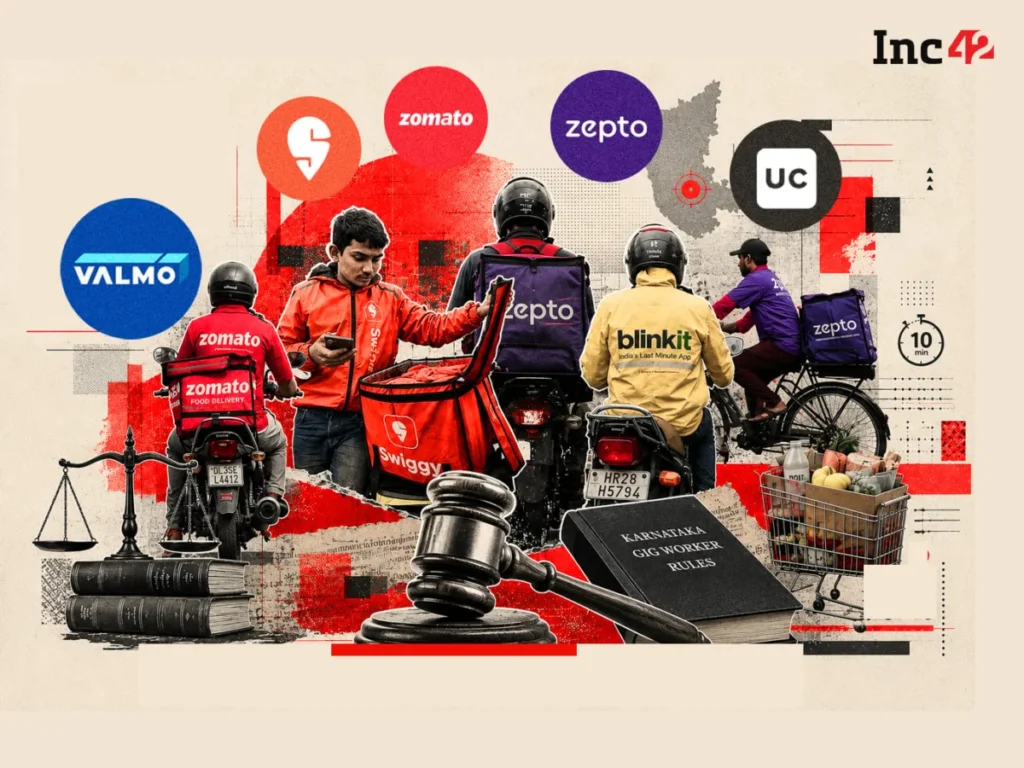
A consortium of industry giants—including Swiggy, Zepto, Urban Company, and the logistics arm of Meesho (Valmo), represented by the Internet and Mobile Association of India (IAMAI)—argues that the state law is "repugnant" to the central legislation. Under the doctrine of "occupied field," the petitioners contend that because Parliament has already recognized gig workers in the 2020 Code, the state of Karnataka is encroaching upon a domain that lies exclusively within the Centre’s purview.
However, the Karnataka High Court has hinted at a more nuanced interpretation. During the proceedings, Justice Nagaprasanna posed a critical question to the petitioners: If the central law serves as a foundation, is it not the state’s prerogative to "improve upon the welfare" of its citizens? The court’s refusal to stay the law, accompanied by the observation that "the amount is not being demanded by the state as a charity," underscores the judiciary’s view that the welfare contribution is a statutory obligation, not a discretionary levy.
Chronology: From Consultation to Courtroom
The road to this legal impasse began with months of intensive stakeholder consultations, where the state government sought to address the precarious nature of gig work.
- 2020–2023: The Union government passes the Code on Social Security, providing a legal framework for gig workers but failing to operationalize specific welfare schemes.
- Late 2024: The Karnataka Assembly passes the Platform-Based Gig Workers (Social Security and Welfare) Bill, aiming to fill the vacuum left by the Centre.
- Early 2025: The Karnataka government officially constitutes the Welfare Board and issues notification for a welfare contribution. Compliance notices are sent to platform aggregators.
- Mid-2025: IAMAI and major platforms move the Karnataka High Court, challenging the Act, the Rules, and the Board’s constitution.
- July 2025: The High Court directs platforms to deposit the second quarter’s welfare contribution with the court registry, refusing to stay the implementation of the law.
- August 14, 2025: The next major hearing is scheduled, with the state government mandated to file its statement of objections by July 30.
The Financial Tug-of-War: Profitability vs. Protection
For the platform aggregators, the dispute is existential. Operating on notoriously thin margins, companies like Swiggy and Zepto argue that the 1% to 5% transaction-based levy is an unsustainable burden. Senior advocate Dhyan Chinnappa, representing the platforms, drew a vivid parallel to Amazon’s early years, emphasizing that aggregators often operate at a loss for over a decade while scaling their infrastructure. He argued that forcing companies to deposit cash into the court registry, rather than accepting a bank guarantee, places an unnecessary strain on their profit-and-loss statements.
Yet, the state and various labor advocates view this through a different lens. Alok Prasanna Kumar of the Vidhi Centre for Legal Policy—who was instrumental in the drafting of the Act—characterizes the resistance as a business-centric refusal to accept the true cost of their labor model. "You cannot say, ‘I will run a profitable business by exploiting workers and violating all the laws and depriving people of basic human dignity,’" he remarked.

The court appears largely sympathetic to this perspective. By questioning, "Don’t these delivery boys deserve something like this?" Justice Nagaprasanna has signaled that the moral imperative of worker protection may carry significant weight alongside the purely legal arguments regarding constitutional jurisdiction.
Analyzing the Regulatory Vacuum
The central issue is not just the 1% levy, but the "policy vacuum" that necessitated the state’s intervention. While the Code on Social Security, 2020 was a landmark piece of legislation that theoretically brought gig workers into the formal fold, the lack of operational schemes has left workers in a state of limbo.
Legal experts suggest that Karnataka’s move is a proactive effort to prevent a "lost generation" of gig workers who have no access to health, maternity, or disability benefits. Mayank Arora, a partner at Chambers of Bharat Chugh, notes that the dispute only escalated when the state moved from the abstract realm of legislation to the concrete reality of implementation.
The fear among the industry is not just the Karnataka law, but the "domino effect." If Karnataka succeeds, other states—such as Telangana, which is already exploring similar frameworks—might follow suit. For a national player, this could result in a fragmented regulatory landscape where every state has a different welfare board, different contribution rates, and different compliance requirements, drastically increasing the "cost of doing business."
Implications for the Future of Work
The final ruling of the Karnataka High Court will likely serve as a blueprint for India’s labor policy for the next decade. There are three primary potential outcomes:
- The "Occupied Field" Victory: If the court strikes down the law, it will affirm the primacy of the Central government, forcing states to wait for the Union to roll out a nationwide scheme. This would likely delay worker benefits for years.
- The "Coexistence" Model: If the court upholds the law as a "supplement" to the Central code, it will empower states to act as laboratories for social security, potentially leading to higher welfare standards across the country.
- The Legislative Override: The ruling may force the Central government to fast-track its own welfare schemes to prevent a patchwork of state-level regulations from stifling the ease of doing business.
Conclusion: The Balancing Act
As the case progresses, the broader implications remain clear: India is struggling to reconcile the "flexibility" of the modern gig economy with the "security" of the traditional welfare state. The platforms argue that their model is built on efficiency and low costs; the state argues that those costs cannot be subsidized by the poverty of the workforce.
While the platforms await their day in court, the delivery partners and ride-hailing drivers, who form the backbone of this debate, remain in the background, waiting to see if their labor will finally be recognized with the social protections they have long been denied. The August 14 hearing will be more than just a legal procedure—it will be a defining moment in the history of India’s labor laws, determining whether the gig economy will continue to operate as a frontier of innovation or be brought into the mainstream of social responsibility.
The judiciary is now tasked with a delicate, high-wire act: ensuring that the wheels of commerce do not stop turning, while ensuring that the people who keep those wheels moving are not left behind.