Bridging the Gap: How ‘Prop For That’ is Revolutionizing CSS-JavaScript Interoperability
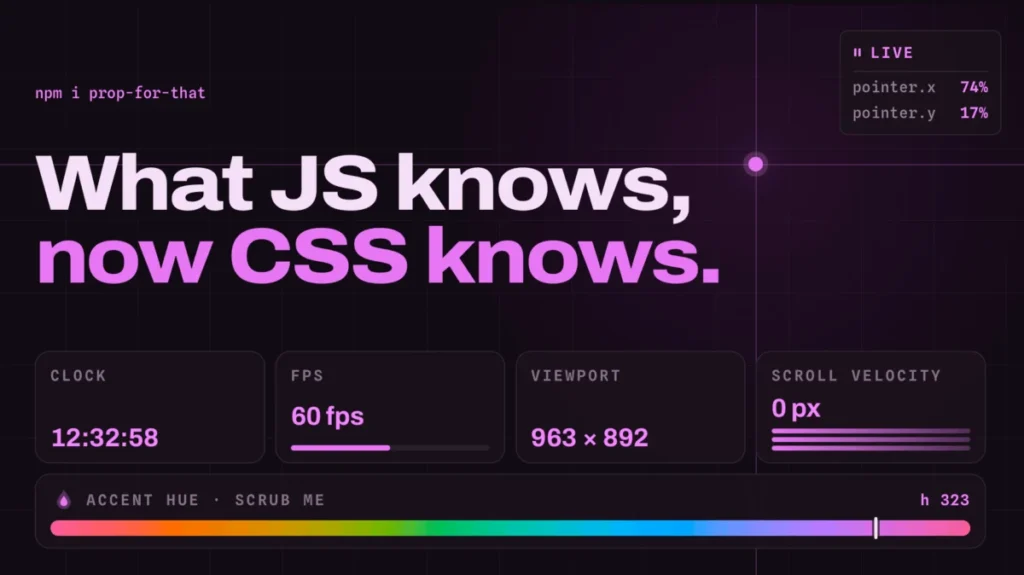
The web development landscape has long been defined by a clear, often frustrating, boundary: the wall between declarative CSS and imperative JavaScript. While CSS provides the visual backbone of the web, it has historically lacked the ability to natively interpret dynamic, real-time data—such as cursor coordinates, scroll velocity, or system-level time states—without significant, performance-heavy boilerplate JavaScript.
Enter Adam Argyle, a developer and advocate known for pushing the boundaries of CSS architecture. Following the success of Open Props, a library that standardized preconfigured CSS variables, Argyle has launched his latest project: Prop For That. This library promises to bridge the gap between browser events and style sheets, enabling developers to map live, state-based data directly into CSS variables. By leveraging a declarative approach to data attributes, Prop For That seeks to simplify how we build interactive, reactive UIs.
The Main Facts: What is ‘Prop For That’?
At its core, Prop For That is a utility-first library designed to act as a bridge between the browser’s dynamic event listeners and CSS custom properties (variables).
Traditionally, if a developer wanted to move an element based on the user’s mouse position, they would need to write a JavaScript function that listens for a mousemove event, calculates the coordinates, and manually updates a style property on a DOM element. This process is not only verbose but often leads to "layout thrashing" if not managed with requestAnimationFrame or similar optimizations.
Prop For That abstracts this complexity. By adding a simple data attribute to an HTML element—such as data-props-for="pointer"—the library automatically hooks into the necessary browser APIs. It then injects real-time data into CSS variables (e.g., --live-pointer-x and --live-pointer-y), which developers can consume directly in their stylesheets using standard var() syntax.
Key Capabilities:
- Pointer Tracking: Real-time X and Y coordinates of the mouse or touch input.
- Scroll Velocity: Monitoring how fast a user scrolls, allowing for motion-based effects.
- Progress Tracking: Measuring elements as they enter or traverse the viewport.
- Form State Synchronization: Bridging interactive form inputs with CSS-driven feedback loops.
- Temporal Awareness: Accessing system time for clock-based or time-of-day-aware styling.
Chronology: From CSS Variables to Reactive Styling
To understand the significance of this development, one must look at the evolution of CSS over the last decade.
2015–2018: The Rise of Custom Properties
When CSS Custom Properties (CSS variables) first gained widespread browser support, they were primarily used for theming—managing primary colors, spacing, and font sizes globally. The industry saw this as a massive win for maintainability, but it remained largely static.
2019–2021: The "JS-to-CSS" Era
Developers began experimenting with updating these variables via JavaScript. As noted by industry experts like Chris Coyier, the ability to pass a JavaScript calculation into a CSS variable opened the door for complex UI patterns that were previously locked away in SVG or Canvas. However, this required every developer to write their own "glue code."
2022–2023: The Advent of Open Props
Adam Argyle’s Open Props library brought a design system approach to CSS variables, providing developers with a massive set of "design tokens" out of the box. It established a precedent: CSS variables are the most powerful tool for cross-file consistency.
2024: The Launch of ‘Prop For That’
Recognizing that the "glue code" for dynamic interactions was still a major friction point, Argyle developed Prop For That. By moving the event-listening logic into a lightweight library, he has effectively commodified the most complex aspects of interactive web design, turning them into a simple declarative configuration.
Supporting Data: Why Declarative Matters
The shift toward declarative programming—where you define what you want to happen rather than how to execute it step-by-step—is a core tenet of modern web frameworks. Prop For That brings this philosophy to the styling layer.
Performance Efficiency
By centralizing the event listeners within the library, Prop For That utilizes internal optimizations that the average developer might overlook. For example, the library handles the cleanup of event listeners automatically when an element is removed from the DOM, preventing memory leaks.
The Code Comparison
Consider the traditional approach to tracking a mouse pointer:
// Traditional approach
const mover = document.querySelector('.mover');
window.addEventListener('mousemove', (e) =>
  mover.style.setProperty('--x', e.clientX);
  mover.style.setProperty('--y', e.clientY);
);
Contrast this with the Prop For That implementation:
<div class="mover" data-props-for="pointer"></div>.mover
transform: translate(calc(var(--live-pointer-x) * 1px), calc(var(--live-pointer-y) * 1px));
The reduction in boilerplate code is significant. By removing the imperative JavaScript, the developer reduces the surface area for bugs and makes the codebase easier to read for designers who may be more comfortable in CSS than in complex JavaScript logic.
Official Responses and Industry Outlook
The developer community has reacted with significant enthusiasm, particularly regarding the library’s focus on "invisible" interactivity. In professional circles, the consensus is that Prop For That doesn’t just make things easier; it makes advanced interactivity accessible to developers who previously felt the barrier to entry (complex JS math) was too high.
Addressing Performance Concerns
One critique often leveled at JS-to-CSS libraries is performance. Critics argue that forcing the browser to recalculate styles based on frequent JavaScript updates can cause frame drops. However, Argyle has been transparent about the implementation of plugins in the library, which allows developers to choose only the tracking they need. By modularizing the listeners (e.g., only loading the pointer-local plugin if pointer tracking is required), the library avoids the "bloat" common in many monolithic frameworks.
The Future of CSS-JS Synergy
While some purists argue that CSS should remain entirely independent of JavaScript, the reality of modern UI/UX design is that the "live" web requires data-driven styling. Prop For That represents a middle ground: it keeps the heavy lifting of data-sniffing in JavaScript while ensuring the styling remains strictly in the domain of CSS.
Implications: A New Era for UI Design
The introduction of Prop For That has several profound implications for the future of front-end development.
1. Democratizing Complex UI
Interactive effects that were once the sole domain of specialized "creative developers" are now available to any front-end dev who understands basic CSS. This will likely lead to a surge in interactive, high-fidelity web experiences across the board.
2. Streamlining Prototyping
Designers and developers often use prototyping tools like Framer or Figma to visualize interactions. Prop For That brings that level of fluid, real-time interactivity directly into production-ready code, closing the gap between the design prototype and the shipped product.
3. Redefining "Separation of Concerns"
For years, we were taught to keep CSS, HTML, and JS in silos. Prop For That challenges this by using HTML as the orchestration layer (the data-props-for attribute) to link the three. This suggests that the future of web architecture isn’t about separating these languages, but rather finding cleaner, more declarative ways to make them communicate.
4. Accessibility and Resilience
Because the library works by injecting CSS variables, if the JavaScript fails to load, the UI doesn’t break—it simply falls back to the default CSS values. This makes the approach inherently more resilient than frameworks that rely on JavaScript to render the entire DOM.
Conclusion
Adam Argyle’s Prop For That is more than just a library; it is a manifestation of where the modern web is heading. As we move away from complex, imperative logic and toward systems that are declarative and predictable, tools that bridge the gap between "what the browser knows" and "what the page looks like" will become indispensable.
For developers looking to inject life into their static pages, the path is now clearer than ever. By delegating the heavy lifting of event tracking to a standardized library, the creative possibilities are effectively limitless. Whether it is tracking a scroll-progress bar, creating interactive hover effects, or building complex, time-based layouts, Prop For That provides the infrastructure needed to focus on the one thing that matters most: the user experience.
As the library continues to grow, it will be fascinating to see how the community extends it. With an open-source model and a clear, extensible plugin architecture, we can expect to see more "live" properties hitting our browsers in the coming months, fundamentally changing how we define the look and feel of the web.