Beyond the Prototype: Choosing Your LLM Orchestration Strategy in 2026
The early days of the LLM gold rush were defined by the rapid adoption of “all-in-one” frameworks. In 2024, if you were building an AI application, you were almost certainly using LangChain. It was the industry standard, the "Swiss Army knife" that promised to solve everything from simple prompt engineering to complex agentic reasoning.
However, as we move through 2026, the landscape has matured. Developers are no longer asking, "Which framework should I use?" They are asking, "Which layer of abstraction actually earns its keep?" With LLM API spending hitting $8.4 billion in mid-2025—up from $3.5 billion just a year prior—the cost of abstraction has become a primary boardroom concern. Choosing the wrong framework doesn’t just impact your code; it impacts your operational budget and your ability to debug production systems at scale.
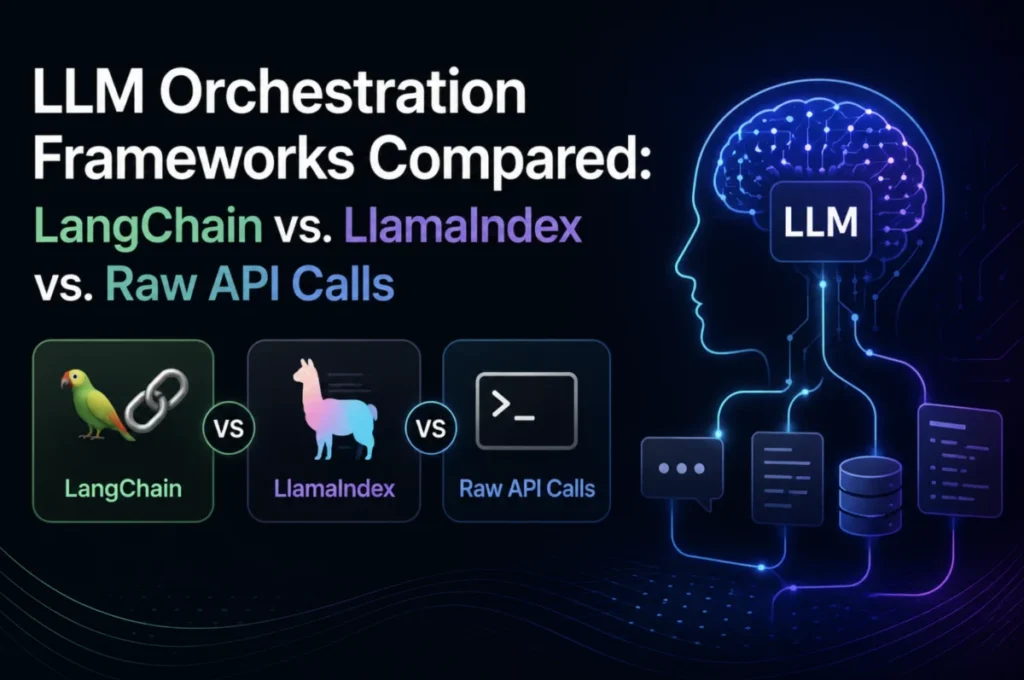
This article examines the three primary paths for modern LLM development: the orchestration power of LangChain/LangGraph, the retrieval specialization of LlamaIndex, and the growing trend of "raw-first" development using native SDKs.
The Architectural Shift: A New Reality
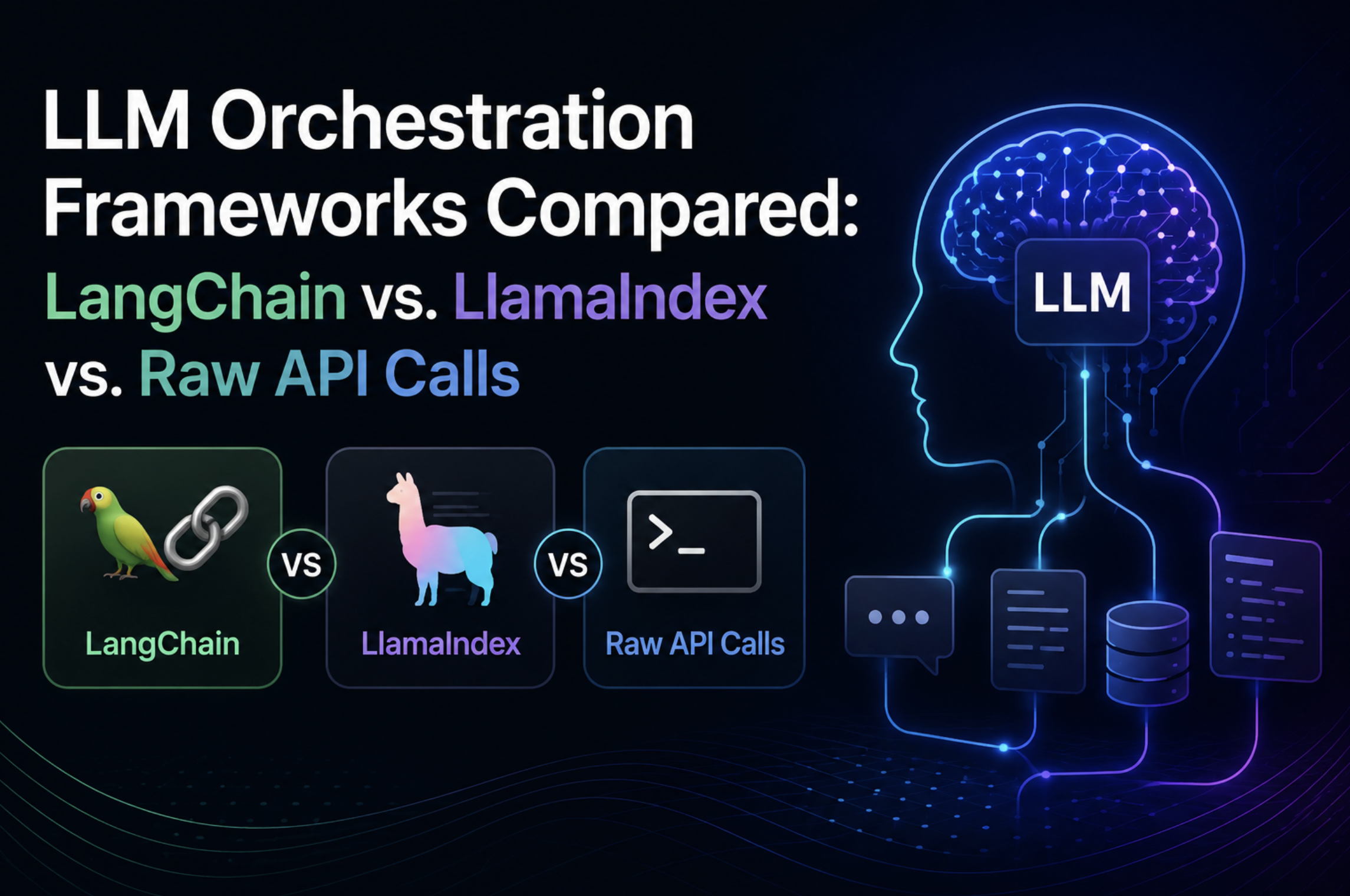
The fundamental mistake many developers make is viewing these three options as direct competitors. In reality, they solve different layers of the stack.
- Raw API Calls are a stance on minimalism, prioritizing speed and transparency.
- LlamaIndex is a data-retrieval toolkit, optimized for the "RAG" (Retrieval-Augmented Generation) pipeline.
- LangChain is an orchestration toolkit designed for complex, stateful workflows.
Many of the most robust production systems today do not pick just one. Instead, they use a hybrid approach: raw SDKs for simple, high-throughput tasks; LlamaIndex for indexing and retrieval; and LangGraph for managing stateful, multi-turn agentic reasoning.
Chronology: From Wild West to Professional Infrastructure
The Era of "Framework Everywhere" (2023–2024)
In the early days, vendor APIs were inconsistent. OpenAI’s SDK was in flux, and Anthropic’s interface felt entirely different. Developers flocked to LangChain because it provided a unified abstraction layer. If you wanted to swap GPT-4 for Claude 3, you changed one line of code in a LangChain chain. It was a golden age of rapid prototyping, but it came with a hidden cost: "framework bloat."
The Rise of Specialized Toolkits (2025)
As RAG pipelines became the industry standard, generic frameworks struggled with the nuances of high-performance retrieval. LlamaIndex carved out a massive niche by focusing solely on data ingestion, chunking, and retrieval optimization. They proved that for document-heavy applications, specialized primitives perform better than general-purpose ones.
The "Back to Basics" Movement (2026)
By late 2025 and into 2026, the major model providers (OpenAI, Anthropic, Google) stabilized their SDKs. Features like tool-calling, structured JSON outputs, and built-in streaming became native. Consequently, many teams began questioning whether they needed a 50-frame-deep stack trace just to run a prompt. The trend of migrating from heavy frameworks to thin, custom wrappers has become the hallmark of performance-focused engineering teams.
Deep Dive: Comparing the Three Paths
1. LangChain and LangGraph: The Orchestration Layer
LangChain remains the leader in assembling complexity. If your application involves multiple steps, conditional routing, or agents that must reason, reflect, and act, LangChain provides the scaffolding.
The introduction of LangGraph (stable at v1.0 since October 2025) was a game-changer. It models workflows as directed graphs. Unlike traditional linear chains, LangGraph allows for cycles, meaning an agent can loop, self-correct, and maintain state via persistent checkpointers (SQLite, PostgreSQL, or Redis).
- The Pro: Unmatched ability to handle long-running, stateful agentic workflows.
- The Con: High framework overhead (~14ms per step) and complex debugging. Stack traces often span 40 frames, making production incidents difficult to diagnose.
2. LlamaIndex: The Retrieval Layer
LlamaIndex is the specialist. If your core problem is, "How do I get the model to answer accurately from my private documents?" you should start here.
LlamaIndex treats retrieval as a first-class primitive. Its hierarchical chunking and auto-merging retrieval algorithms are significantly more efficient than what can be built by hand or with generic tools. Benchmarks suggest LlamaIndex indexes documents 2.5x faster than LangChain and requires 30–40% less code for equivalent RAG pipelines.
- The Pro: Exceptional performance for document retrieval and knowledge-base synthesis.
- The Con: Less mature on the general agentic side compared to LangGraph.
3. Raw API Calls: The Minimal Path
There is a growing sentiment that for 80% of use cases, frameworks are an unnecessary abstraction. By using the raw OpenAI or Anthropic SDKs, you gain maximum transparency.
Teams that switch to raw SDKs often report a 40–60% reduction in code volume. Because there is no "magic" happening behind the scenes, debugging becomes a matter of reading your own code rather than deciphering a framework’s internal logic.
- The Pro: Fastest performance, zero framework overhead, and total control.
- The Con: You are responsible for implementing everything—retries, token counting, and state management.
Supporting Data: The Cost of Abstraction
To understand why this choice matters, consider the performance metrics collected across recent industry benchmarks.
| Metric | Raw API | LlamaIndex | LangGraph |
|---|---|---|---|
| Framework Overhead | ~0ms | ~6ms | ~14ms |
| Debug Transparency | High | Medium | Low |
| Lines of Code (RAG) | ~20 | ~15 | ~35 |
The data indicates a clear trade-off: As you add framework features, you add latency and debugging complexity. For high-throughput pipelines processing thousands of requests per minute, a 14ms framework overhead is not just a nuisance—it is a significant operational tax.
Official Perspectives and Industry Implications
Leading AI engineers emphasize that the choice is rarely binary. "We use LangGraph for our autonomous research agents," says a lead engineer at a major FinTech firm, "but we rely on raw SDKs for our real-time customer support chat. Using a framework for a simple request-response model is like using a sledgehammer to crack a nut."
The industry is moving toward a "Just-in-Time" architecture. In this model:
- Start with raw SDKs to prove the concept.
- Add LlamaIndex only when retrieval complexity exceeds your manual implementation capabilities.
- Add LangGraph only when you need complex, stateful, multi-turn agentic loops.
The "Lock-in" Fallacy
A major fear in 2024 was framework lock-in. However, as the ecosystem has matured, most components have become interoperable. You can use LlamaIndex to retrieve context and pass that data into a chain built with LangGraph. The "stack" is now modular.
Decision Framework: What Should You Do Tomorrow?
If you are standing at the architectural crossroads, use this decision framework:
- Is your application a simple chatbot or a data-retrieval task? If yes, start with Raw SDKs. Don’t pay the framework tax until you have to.
- Is your core challenge managing thousands of documents with complex search requirements? Adopt LlamaIndex. The time-to-market advantage and the efficiency of its indexing algorithms are worth the dependency.
- Is your application an autonomous agent that must perform actions, use tools, and remember state over hours? Use LangGraph. The persistence and state management features provided by the library are too complex to build reliably on your own.
Final Thoughts
The "right" choice is the one that minimizes your technical debt. In 2026, the most successful engineering teams are those that prioritize clarity over convenience. If you can solve your problem in 20 lines of raw code, do it. If you need a sophisticated RAG pipeline, use the best-in-class retrieval tool. If you are building a complex agent, use the most stable orchestration framework.
Don’t let the marketing of these frameworks convince you that you need them before you actually feel the pain they were designed to alleviate. Start small, build only the layers you need, and keep your production systems as transparent as possible. In the long run, your debuggers—and your budget—will thank you.