Beyond the Context Window: Architecting True Memory for AI Agents
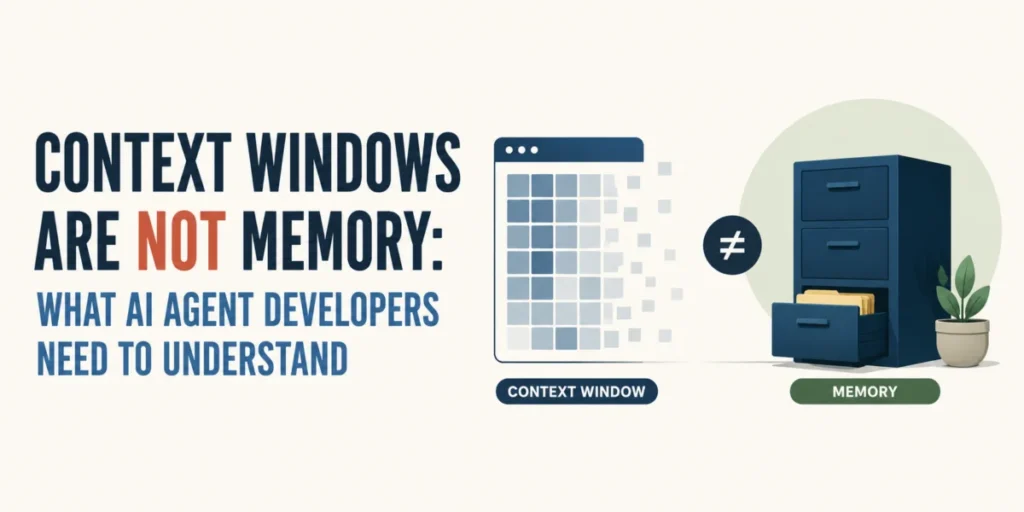
In the rapidly evolving landscape of Large Language Models (LLMs), a dangerous misconception has taken root among developers: the belief that a massive context window is synonymous with functional agent memory. When AI laboratories announce models capable of processing 2-million-token context windows, the immediate instinct for many is to treat the prompt as a catch-all repository for data. They envision a world where the entire codebase, historical documentation, and user preferences can be "shoved" into the prompt, effectively solving the "memory" problem.
However, architectural reality is far more nuanced. To treat a massive context window as memory is akin to purchasing an enormous, 25-foot-wide office desk because you are too disorganized to acquire a filing cabinet. Yes, you can spread all your documents across the surface for a moment, but when the workday ends, the cleaning staff arrives, and the entire desk is wiped clean. Understanding the distinction between ephemeral context and persistent memory is the defining challenge for the next generation of AI agent developers.
The Architectural Fallacy: Context is Not Memory
At its core, a language model is a stateless engine. Regardless of how many tokens it can ingest, every single API call initiates from "step zero." The model does not "remember" the previous interaction in the way a human or a database does; it simply re-reads the entirety of the provided context in a matter of milliseconds to calculate the next probable token.
The Snowballing Effect
When an agent is tasked with maintaining a conversation history of over 200,000 tokens, it is not recalling the past; it is re-processing the entire universe of the conversation from scratch for every single interaction. This strategy introduces significant, often fatal, technical traps:
- Latency Inflation: Every new prompt forces the system to re-ingest the entire history, causing response times to balloon as the conversation grows.
- Cost Prohibitions: Token-based pricing models mean that repeating the same 200,000 tokens for every follow-up question leads to exponential cost increases.
- The "Lost in the Middle" Phenomenon: Research indicates that models often suffer from performance degradation when critical information is buried in the middle of a massive context window, leading to inaccurate or hallucinated outputs.
Consider a simple coding assistant. If a user defines a variable in "Step 1" and asks a question about it in "Step 47," the system must re-send all 46 intervening turns just to establish the context of that original variable. This is the definition of inefficient architectural scaling.
The Cognitive Stack: A Multi-Layered Approach
To build robust, reliable AI agents, developers must move beyond the "big desk" fallacy and embrace a multi-layered cognitive stack. This involves distinguishing between different types of data management: retrieval, compression, and summarization.
Retrieval: The Library of Just-In-Time Data
Retrieval-Augmented Generation (RAG) acts as the office bookshelf. It allows the agent to fetch static, existing data relevant to a specific task exactly when it is needed. Instead of forcing the model to hold all information at once, RAG pulls the "Top-K" most relevant document chunks into the scratchpad.
However, developers must be wary of naive RAG implementations. Vector similarity—the mathematical engine behind most RAG systems—does not always correlate with semantic truth. If a user tells their scheduling agent to "move the meeting to Friday" and later says "cancel Thursday," a vector search might retrieve both instructions. A naive system would feed both to the model, leaving it to guess the current reality. A professional-grade agent must include a reconciliation layer—a piece of logic that checks timestamps or state tags to resolve contradictions before the data ever reaches the LLM.
Compression: Bandwidth Optimization
Compression is the digital equivalent of an ZIP archive. In an agent’s stack, this involves algorithmic token reduction. By stripping stop-words, utilizing specialized compression models (like LLMLingua), or employing prompt caching, developers can maintain the integrity of the information while significantly shrinking its footprint on the "desk."
This is a critical bandwidth optimization technique. If you need to analyze a 15,000-token JSON payload, compressing it to 5,000 tokens ensures the model has enough "cognitive headroom" left in its context window to perform reasoning tasks rather than just parsing raw data.
Summarization: The Irreversible Abstraction
Unlike compression, which is lossless (or near-lossless), summarization is a one-way trip. It replaces raw data with an abstraction. Because this process is irreversible, the best practice is to implement a "forked storage" pattern.
In this model, raw transcripts are archived in cost-effective cold storage (such as Amazon S3 or a SQL database), while only the synthesized summary is passed into the active prompt. This ensures that if the agent ever requires the granular detail lost in the summary, it has a retrieval path back to the original source material.
Memory Persistence as a State Machine
The ultimate maturity for an AI agent is the transition from a passive respondent to an active database administrator. Instead of relying on the context window to hold "memory," the agent should be taught to interact with a state machine—a persistent, external data structure like a knowledge graph or a Redis instance.
The Query-Commit Discipline
To implement this, developers should adopt a strict loop:
- Query: At the start of every turn, the agent queries the state machine for relevant facts (e.g., "What is the status of the user’s dog?").
- Generate: The model processes the user request, informed by the retrieved state.
- Commit: At the end of the turn, if the conversation has produced new, persistent information, the agent triggers a tool-call to update the state machine.
This removes the burden of "remembering" from the model’s transient memory and places it into a reliable, structured database. Whether it is tracking a dog’s name change or a project milestone, the agent acts as the steward of its own history.
Implications for Future Development
As we look toward the future of agentic AI, the implications of these findings are clear. Developers who treat the context window as a dumping ground will inevitably hit performance ceilings, face skyrocketing API costs, and deliver agents that are prone to confusion.
The industry is moving toward a more disciplined, modular architecture. The "Big Context" trend provided a useful temporary boost for prototyping, but it is not the foundation upon which scalable, enterprise-grade agents will be built.
Key Takeaways for Developers:
- Context is for Reasoning: Use the context window for what it does best—analyzing, synthesizing, and reasoning in the present moment.
- Externalize Memory: Treat external databases, knowledge graphs, and vector stores as the true home for long-term memory.
- Implement Reconciliation Logic: Never assume the most recent data is the "truth" without checking timestamps or source validity.
- Architect for Persistence: Design agents that can proactively update their own state, moving them from conversational bots to autonomous systems.
In conclusion, the goal of an AI developer should not be to build a larger desk. Instead, it should be to provide the agent with a sharp pencil, an organized filing cabinet, and the instructions on how to use them both effectively. By decoupling short-term reasoning from long-term memory, we can build agents that are not only smarter but significantly more reliable and efficient.