Beyond the Tactic: Why Modern Marketing Must Pivot from "Doing More" to "Driving Signal"
For many marketing professionals, the phrase "do more with less" is a source of profound professional fatigue. In an era where budgets are increasingly scrutinized and pipeline targets continue their upward trajectory, the traditional response—to double down on output—has become a recipe for burnout rather than success.
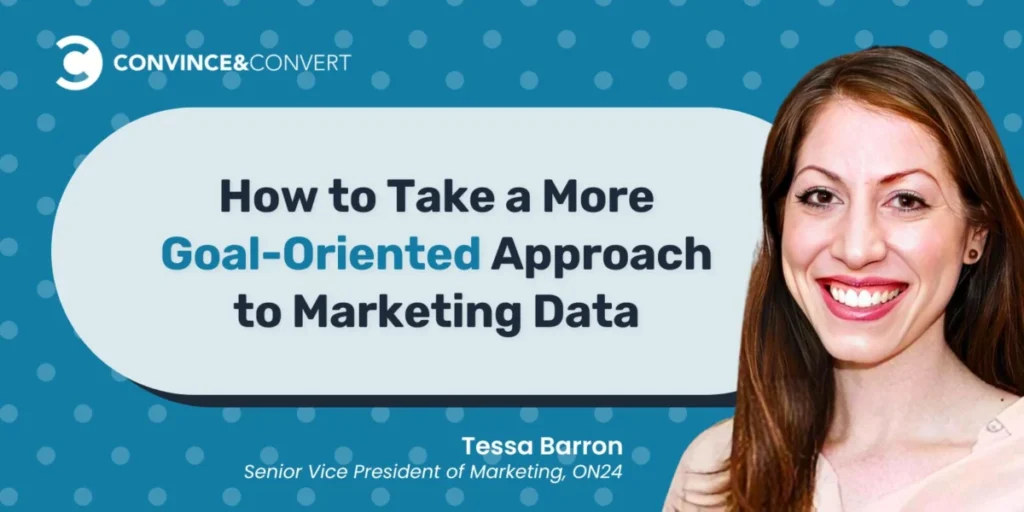
However, Tessa Barron, formerly the Senior Vice President of Marketing at ON24, argues that the solution to this impasse is not to increase the volume of activity, but to fundamentally alter the marketing architecture. In a recent appearance on the Data-Driven Decisions podcast, Barron dismantled the conventional "tactic-first" approach, proposing instead a rigorous, goal-oriented framework that prioritizes actionable intelligence over mere content production.
The Strategic Shift: From Tactic-Obsessed to Goal-Oriented
The post-pandemic landscape has rendered many legacy marketing strategies obsolete. Yet, according to Barron, there is a dangerous inertia in the industry. Many teams continue to rely on the same "tried-and-tested" playbooks—webinars, whitepapers, and blog posts—that they utilized three or four years ago.
"We as marketers have to check in with ourselves and ask: Are we still doing what we were doing three years ago?" Barron poses. If the answer is yes, she warns, then the assumption that increasing the frequency of these activities will yield better results is a fallacy. This is the "tactic-first" trap.
The Anatomy of the Pivot
Instead of planning a quarterly roadmap based on output (e.g., "We will produce four webinars in Q1"), marketing leaders must anchor their strategies in outcome. A goal-oriented objective looks more like: "In Q1, we need to achieve a 10% uplift in pipeline conversion or reach a specific segment of high-intent accounts."
By framing the strategy around a business objective, the choice of tactic becomes a secondary, evidence-based decision rather than a default habit. If the goal is to increase the conversion rate of first meetings by 10%, the marketer is then forced to ask: What content actually educates the prospect sufficiently to shorten their decision-making cycle? If the answer is deep-dive technical education, then a webinar is the right tool. If the answer is social proof, perhaps a client testimonial video is superior. The tactic follows the goal, not the other way around.
Uncovering Key Signals: Cutting Through the Data Noise
We live in an age of data saturation. Modern marketing stacks provide a deluge of metrics, yet many organizations suffer from "analysis paralysis." Barron suggests that the key to navigating this noise is to stop obsessing over broad analytics and start hunting for "signals."
A "signal," in this context, is any specific data point or behavioral trigger that indicates a buyer is moving closer to a conversion. Once these signals are identified, marketing teams can design "traps"—deliberate, interactive touchpoints—that force these signals to the surface.
Real-World Application: The Power of Intent
ON24, a platform built on interactivity, provides a laboratory for this methodology. By utilizing polls, Q&A sessions, and surveys within their webinars, they turn passive consumption into active lead qualification. Barron cites two compelling industry examples:
- The Cloud Infrastructure Case: A technology firm aiming to regain market share identified that prospects using a specific cloud provider were 10 times more likely to convert. Rather than targeting prospects blindly, they embedded a simple, direct question into their webinar registration or live stream: "Which cloud provider do you currently use?" This immediately bifurcated their audience, allowing sales to prioritize those high-probability prospects.
- The Pharmaceutical Case: In a specialized healthcare vertical, a firm needed to reach doctors treating patients with specific, high-risk needs. During a medical education webinar, they asked attendees to rate the risk level of their current patient base. Those who self-identified as having a "high-risk" patient cohort were immediately flagged as top-tier prospects for targeted follow-up.
These examples illustrate that the most effective data capture is not about collecting more data; it is about collecting the right data that directly informs the sales process.
The Symbiosis of Sales and Marketing
One of the most critical implications of Barron’s framework is the necessity of an unbreakable feedback loop between marketing and sales. Too often, marketing departments operate in a vacuum, designing content based on what they think prospects want to know, rather than what sales teams know prospects are struggling with.
Breaking Down the Silos
Barron posits that the most valuable information resides with the sales team—the individuals who interact with the customer’s pain points, hesitations, and objections every day.
- Aligning on Qualifications: Marketers should consult with sales to understand exactly what makes a lead "qualified." What are the specific questions sales asks to determine if a prospect is ready to move to the next stage?
- The "Net" vs. The "Catch": Barron offers a sobering perspective on the division of labor: "Marketers are creating signals and developing a net to catch people who might turn into pipeline. But it’s the salespeople, those on the front lines, who create the pipeline."
This distinction is vital. Marketing’s role is to provide the clearest possible picture of the prospect before the salesperson ever picks up the phone. When marketing understands the "why" behind a sale, they can craft messaging that preemptively answers customer doubts, effectively warming the lead before the handoff occurs.
Implications for Organizational Strategy
The transition to a signal-driven, goal-oriented model has broad implications for how marketing departments are managed and evaluated.
1. Refinement of the "Middle Mile"
Often, the biggest drop-offs occur not at the top of the funnel (lead generation) or the bottom (the final sale), but in the "middle mile"—the nurturing phase. Barron emphasizes that these are the areas often overlooked. Outdated lead forms, generic follow-up emails, or lack of tailored content can kill conversion rates. By focusing on these incremental steps, marketing teams can "turn the dials" of success more effectively than by simply flooding the top of the funnel with more leads.
2. Communicating Value to Stakeholders
A recurring challenge for CMOs is communicating marketing’s ROI to stakeholders who are not immersed in the day-to-day tactics. Barron advocates for radical simplicity. Instead of presenting complex dashboards, marketers should present "impact stories." If a strategy—supported by a specific budget—resulted in a 5% increase in pipeline conversion, that is the headline.
When the entire organization is aligned on a data strategy that prioritizes business results over activity metrics, the internal friction between sales, marketing, and leadership tends to evaporate.
A Call to Intentionality
The "do more with less" mandate is not a death knell for marketing; it is a catalyst for maturity. The era of the "spray and pray" tactic is ending, replaced by an era of precision, signaling, and deep alignment with sales.
By moving away from the reflexive urge to execute more tactics and toward a disciplined approach of capturing signals that matter, marketers can reclaim their time and their influence. As Tessa Barron demonstrates, the path to growth is not through an endless expansion of effort, but through a radical, data-backed narrowing of focus.
In the final analysis, the most successful marketing teams of the next decade will be those that realize their job is not to fill the top of the funnel with noise, but to provide the clear, actionable intelligence that turns a prospect into a partner.
For those looking to deepen their understanding of these strategies, the full insights from Tessa Barron can be found on the Data-Driven Decisions podcast series, which provides a comprehensive look at the intersection of data, strategy, and modern sales alignment.