The Great Pivot: BigBasket’s Strategic Retreat and the Quest for Profitability
For over a decade, BigBasket stood as the undisputed titan of India’s online grocery sector. It was a pioneer that transformed how urban households shopped, trading the chaotic aisles of local kirana stores for the precision of scheduled deliveries and deep supply chain integration. However, the ground has shifted beneath the company. As the era of "quick commerce" reshapes consumer behavior, the Tata-backed giant is undergoing a profound metamorphosis.
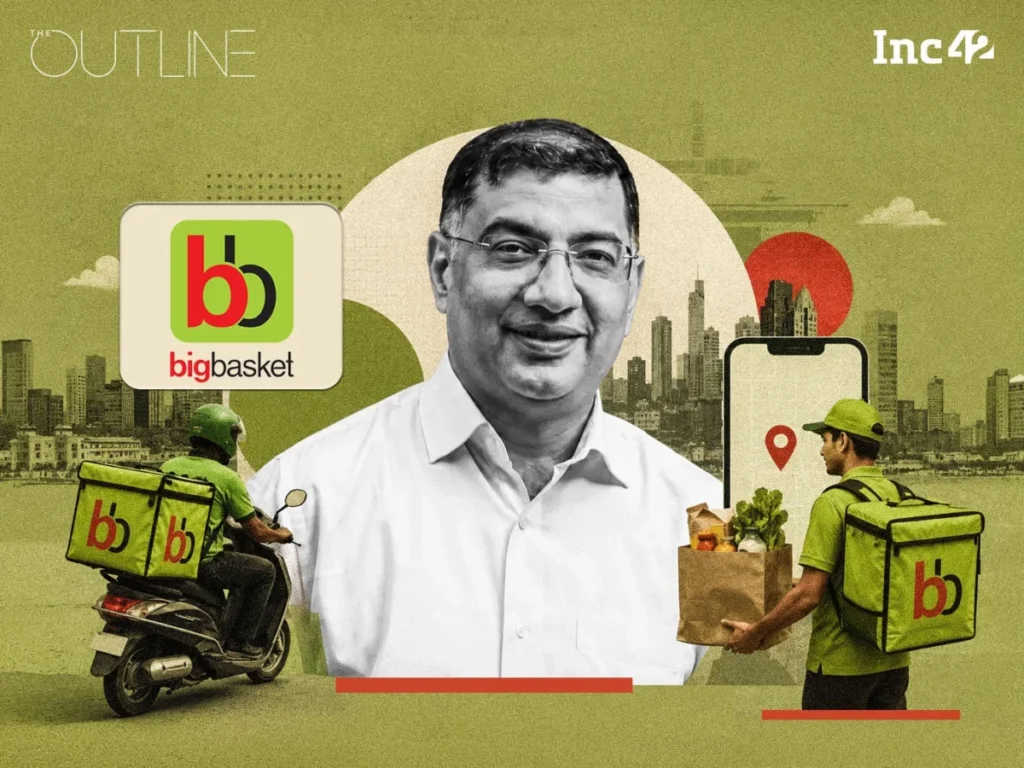
Following the departure of co-founder Hari Menon—who led the company for 15 years—BigBasket is pivoting from an era of aggressive geographic expansion to one of austere fiscal discipline. Under its new CEO, Amit Nanda, the company is recalibrating its operational footprint, signaling a departure from the "scale-at-all-costs" mindset that has characterized the Indian e-commerce wars.
The Chronology of a Shift: From Scheduled to Instant
To understand the current state of BigBasket, one must look at the evolution of the Indian digital grocery market.
- 2011–2018: The Era of the Large Basket. BigBasket built its foundation on the model of planned, weekly consumption. The company focused on high-margin, high-volume orders, leveraging an integrated network of warehouses and private labels like Fresho and BB Royal.
- 2020–2022: The Quick Commerce Disruption. The pandemic accelerated the demand for instant gratification. Startups like Zepto and Blinkit emerged, focusing on sub-15-minute delivery. Consumer habits shifted from "weekly planning" to "on-demand impulse."
- 2023–2024: The Response. BigBasket launched BB Now to enter the quick commerce fray, rapidly scaling to nearly 700 dark stores. However, it struggled to match the cash-burn capabilities of its venture-backed rivals.
- 2025–2026: The Tata Mandate. With losses mounting and a strategic need for efficiency, BigBasket began a quiet restructuring. Reports emerged in late 2025 regarding a potential contraction of its operating cities, coinciding with a leadership transition from the founding team to professional management.
The Economics of a Hard Pivot
The core of the issue lies in the unit economics of the "10-minute" economy. Unlike the traditional scheduled delivery model, which allows for route optimization and higher average order values (AOV), quick commerce relies on extreme density.
BigBasket’s transition has been hampered by a legacy structure that was never optimized for the hyper-local speed required by modern consumers. While rivals were burning billions to acquire users through aggressive discounting and massive dark store density, BigBasket was operating under the umbrella of the Tata Group, which—while deep-pocketed—demanded a higher degree of financial prudence.
Financial Performance: A Strained Balance Sheet
The financial data paints a sobering picture of the challenges facing the new leadership:
- Net Losses: The parent company, Supermarket Grocery Supplies, reported a 42% surge in consolidated net losses to ₹2,006.8 Cr for FY25.
- Revenue Stagnation: Operating revenue saw a contraction of 2%, dropping to ₹9,866.7 Cr.
- Segmental Pressure: The consumer business bore the brunt of the volatility, with losses widening by 47% to ₹1,851 Cr.
These numbers illustrate the "scissors effect": rising operational costs required to keep pace with the instant-delivery market, coupled with a stagnating revenue base as customers migrated to platforms that offered faster, albeit more expensive, delivery windows.
Official Stance and Market Reality
BigBasket has formally denied reports suggesting a drastic reduction in its city count. In a statement provided to the media, the company remarked: "The city count figures are drawn from a speculative report that BigBasket never confirmed or commented on. This has already been refuted, and it doesn’t reflect the current on-ground reality."
However, industry analysts maintain that the internal reality is one of "pruning." An industry insider noted: "What’s happening at BigBasket is not just a regular cost-cutting exercise. The company is fundamentally rethinking its model. They are shifting from a ‘pan-India presence’ objective to a ‘profit-per-cluster’ objective."

This implies that even if the company continues to operate in its current cities, the service levels, infrastructure density, and promotional budgets are being redirected toward high-density urban clusters where the unit economics are inherently favorable.
The Nanda Doctrine: Professionalism Over Founders
The appointment of Amit Nanda, a former Amazon executive, is a symbolic and strategic inflection point. Hari Menon, who once famously admitted his initial skepticism toward quick commerce, represented the "pioneer" phase of the business. Nanda, conversely, represents the "optimization" phase.
Nanda’s mandate from Tata Digital is clear: restore profitability and stabilize the ship. This involves:
- Consolidating Infrastructure: Moving away from underperforming markets to focus on densely populated metros where dark store throughput can be maximized.
- Portfolio Rationalization: Leveraging the Tata ecosystem, including Croma for electronics and Tata Consumer products, to drive higher order frequency and basket sizes.
- Capital Discipline: Shifting away from the "burn-to-grow" model that has defined the last few years of the quick commerce race.
The Broader Tata Digital Context
The restructuring at BigBasket is not an isolated event; it is a symptom of a broader strategic shift within Tata Digital. The group, which infused nearly ₹3,000 Cr into the unit earlier this year, is clearly signaling that the period of unchecked expansion is over.
With Tata Digital’s combined portfolio—including Tata Cliq and other consumer ventures—projected to remain in the red for at least three more years, the group is under immense pressure to show a path to sustainability. Cumulative losses are estimated to hit ₹9,000 Cr, forcing Tata Sons to reassess where each rupee is deployed.
Implications: Can BigBasket Survive the Retreat?
The critical question is whether a "strategic retreat" is a viable path to victory. By pulling back from smaller markets, BigBasket risks ceding its early-mover advantage and market share to the likes of Blinkit, Zepto, and Swiggy Instamart, who are currently locked in an expansion arms race.
- The Competitor Landscape: Blinkit alone operates over 2,200 dark stores, holding a dominant position in the quick commerce space. Combined with the expansion efforts of Flipkart and Amazon, the market is becoming increasingly crowded.
- The Brand Moat: BigBasket’s primary asset remains its brand recall and its deep private-label ecosystem. If it can successfully reposition itself as the "premium, reliable" choice for large, planned grocery hauls, it may find a profitable niche that the hyper-fast, snack-heavy rivals cannot easily occupy.
Conclusion: A Delicate Balancing Act
BigBasket is currently walking a tightrope. It must evolve its service model to satisfy the impatient modern consumer while maintaining the financial discipline demanded by its parent company. The transition from a founder-led "dream" to a professionally managed "business" is rarely seamless, and the coming fiscal year will be the ultimate test of the Nanda playbook.
If the strategy succeeds, BigBasket will emerge as a leaner, more resilient player capable of weathering the volatility of the Indian e-commerce market. If it fails, the company risks becoming a cautionary tale of a pioneer that was simply too slow to adapt to the speed of the future. As the industry watches, the "BigBasket Retreat" might well be the most significant strategic maneuver in the history of Indian e-retail.