Beyond the Spotlight: Neha and the Resolute Stand of the Cockroach Janta Party
Introduction: The Unlikely Heroine of Jantar Mantar
When the Cockroach Janta Party (CJP) first descended upon Delhi’s historic Jantar Mantar on June 20, the sweltering heat of the national capital seemed designed to break any spirit. While the media spotlight remained fixed on the movement’s founder, Abhijeet Dipke—an internet sensation whose viral rise captured the public imagination—a quieter, more steely determination was brewing on the sidelines. Standing to Dipke’s left, adorned with the iconic "AISA" badge on her kurta, was a woman who would soon emerge as the backbone of the protest: Neha, the 29-year-old national president of the All India Students’ Association (AISA).
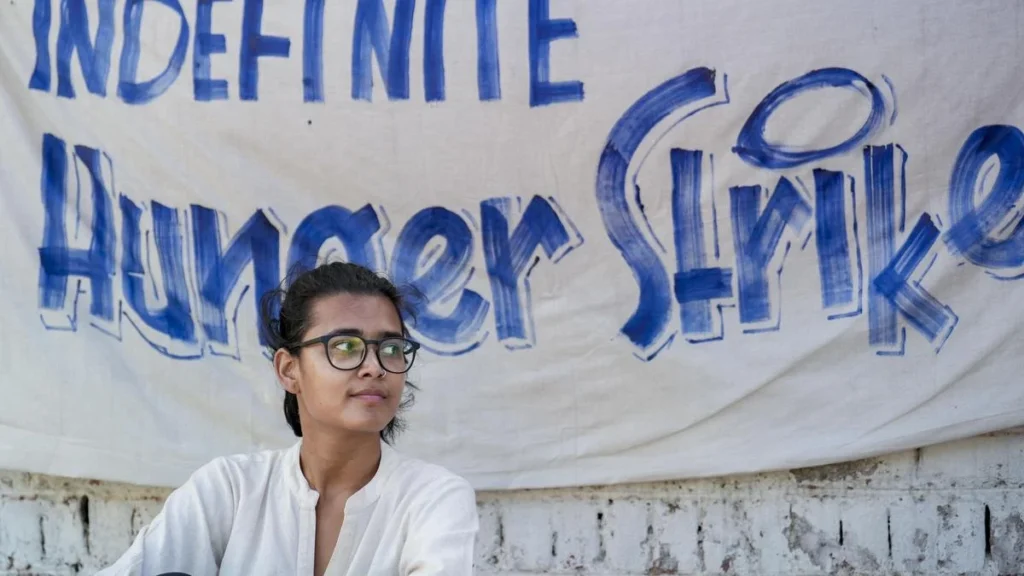
As the weeks have dragged on and the initial novelty of the protest has faded into the grind of endurance, the focus has shifted. What began as a flash-in-the-pan political moment has transformed into a test of human willpower. Today, Neha stands as the last woman remaining in a grueling, indefinite hunger strike that has entered its 22nd day, serving as the defiant face of a movement that refuses to be silenced by the relentless Delhi sun or the administrative pressures of the state.
A Chronology of Resistance
The timeline of the current movement at Jantar Mantar is a study in attrition.
- June 20: The Cockroach Janta Party (CJP) launches its protest at Jantar Mantar, drawing significant crowds and online support.
- June 28: Neha, alongside five other AISA members and activist Sonam Wangchuk, begins an indefinite hunger strike.
- Early July: As the scorching summer continues, three of Neha’s colleagues are forced to withdraw from the hunger strike due to severe health complications.
- July 18: In a controversial move, Delhi Police forcibly remove Sonam Wangchuk from the protest site, creating a power vacuum and a sense of isolation for the remaining protestors.
- July 19: Neha enters her 22nd day of fasting. She remains in a makeshift tent with two male colleagues, both of whom require physical assistance to walk.
The evolution of this protest from a vibrant gathering to a somber, high-stakes standoff marks a shift in the nature of student-led movements in India. The persistence of the remaining hunger strikers has turned a site of political posturing into a site of profound physical sacrifice.
From the Barracks to the Barricades: The Making of a Leader
To understand Neha’s resolve, one must look at her trajectory. Hailing from Uttarakhand, she grew up in the disciplined environment of an Army family. Moving frequently across the country as her father served the nation, she developed a nomadic adaptability that would later define her political career.
Coming from a non-political background, her immersion in activism was a gradual, organic process. During her undergraduate studies at the University of Delhi, she discovered the power of the stage. Joining the theatre group ‘Sangwari’—a troupe heavily populated by AISA members—provided her with more than just a creative outlet.
"The good thing about theatre is that it tells you about politics in the languages that we speak, the songs that we sing, and our body language," she reflects.
This theatrical background has become her greatest political asset. Associates note that she possesses a unique, charismatic ability to connect with diverse crowds. Unlike many of her peers who might become easily agitated or reactive under pressure, Neha employs a sophisticated command of rhetoric. She understands the cadence of a speech—when to raise her voice to demand attention, when to pause to allow an idea to sink in, and how to modulate her tone to maintain an audience’s engagement.
Her rise within the Left-leaning student movement has been consistent:
- 2021: Elected secretary of the Delhi unit of AISA.
- December 2024: Elected as the national president of AISA, the student wing of the CPI(ML) Liberation.
Throughout her tenure, she has been a fixture in major civil society movements, including the anti-CAA protests and the historic farmers’ agitation of 2020-21. Her current stand is not an isolated incident but the culmination of years of institutional organizing.
The Ideological Core: Challenging the ‘Politics of Hatred’
When asked about the synergy between the AISA and the CJP—an alliance that has surprised many political observers—Neha frames it as a logical progression of long-term activism.
"Student organizations, specifically of the Left, have built this movement from the ground up, bit by bit, through memorandums and protests over the years," she explains. She views the emergence of the CJP as a catalyst for a larger, dormant sentiment among the youth.
For Neha, the fight is not just about specific policy demands; it is a battle for the "conscience of the people." She characterizes the ruling Bharatiya Janata Party’s (BJP) governance as a sustained project of "politics of hatred." According to her, the goal of the current protest is to remind the citizenry of their democratic legacy.
"Making people remember that this is our legacy and not the divisive politics that the BJP has trained us to do—that is important. That is the learning we take from here," she asserts.
Supporting Data and Administrative Hurdles
The logistical reality of the Jantar Mantar protest is grim. Medical teams have repeatedly warned of the risks associated with a 22-day fast. The three remaining hunger strikers—Neha and two colleagues—are suffering from significant physical deterioration. They now require support just to navigate the short distance from their tent to the main stage.
This is not the first time Neha has faced the state’s apparatus. In the summer of 2024, she led protests at the same site, demanding the resignation of Education Minister Dharmendra Phradan in the wake of widespread paper leaks. That protest, which also involved a hunger strike, ended in a mass detention of students near the Metro station. The current administration’s strategy of attrition—waiting for protesters to grow weak or removing key figures like Sonam Wangchuk—appears to be a deliberate attempt to drain the movement’s momentum without engaging in a formal dialogue.
Implications: The Future of Student-Led Activism
The involvement of a national president of a major student organization in such a high-risk protest suggests a shift in how the Left views modern political alliances. By aligning with the CJP, AISA is attempting to bridge the gap between niche, ideologically driven campus politics and the broader, viral-friendly, digital-era protest movements.
However, the implications of this protest extend far beyond the campus walls. If the hunger strike continues, it risks becoming a flashpoint for civil unrest. The government’s continued silence and the forced removal of protest leaders have only served to galvanize the remaining core.
As Neha remains in her tent, physically weakened but ideologically resolute, she embodies a growing frustration among India’s youth. The question that remains is whether this movement can move beyond the "right place at the right time" sentiment and build the sustainable political architecture required to challenge the current national discourse.
For now, the focus is on the next 24 hours. As Neha approaches her third week of total fasting, the eyes of the student community, the political establishment, and the civil society at large are fixed on that small, makeshift tent at Jantar Mantar. The protest is no longer just about the Cockroach Janta Party; it is a question of how much the state is willing to let a young leader suffer before it is forced to come to the table.