Strengthening the Thin Blue Line: Telangana’s Bold Roadmap for Police Reform and Personnel Welfare
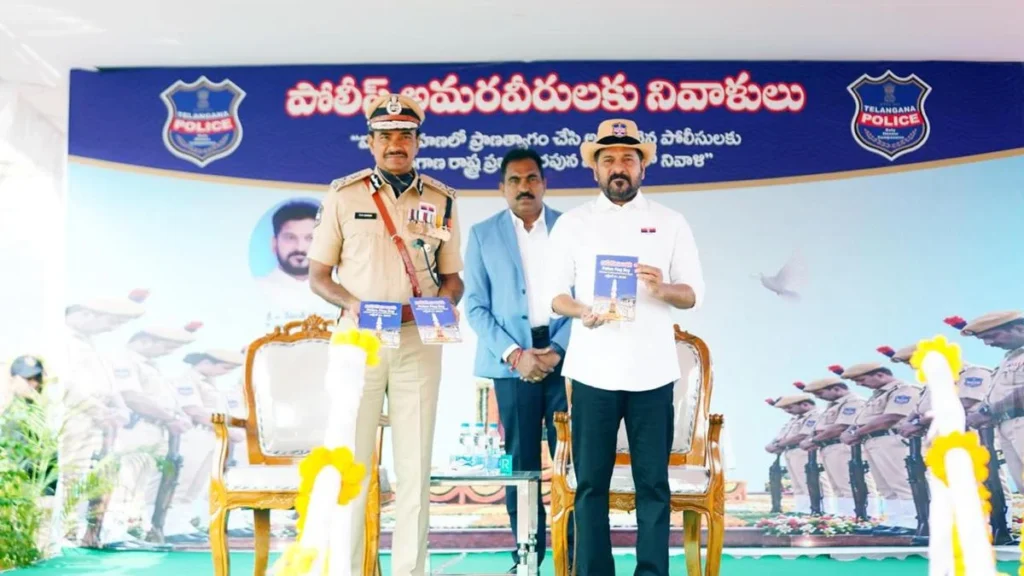
HYDERABAD – In a significant move to bolster the state’s security apparatus and honor the ultimate sacrifices made by those in uniform, Telangana Chief Minister A. Revanth Reddy announced a comprehensive roadmap on Wednesday to fill all existing vacancies within the Police Department by 2028. Speaking at the solemn Police Commemoration Day parade held at the Goshamahal Police Stadium, the Chief Minister underscored that the backbone of the state’s developmental progress is a robust, well-resourced, and highly motivated law enforcement agency.
The event, which serves as a poignant reminder of the dangers inherent in police service, saw the Chief Minister, alongside Director General of Police (DGP) C.V. Anand, pay floral tributes at the Police Martyrs’ Memorial. The occasion was marked by a sense of duty and reflection, setting the stage for a series of policy announcements aimed at both modernizing the force and ensuring the financial security of the families of fallen officers.
The Roadmap to 2028: Addressing the Personnel Gap
The Chief Minister’s announcement marks a strategic shift in how the state manages its security infrastructure. With the goal of achieving a full-strength force by 2028, the government has moved beyond rhetoric into concrete recruitment cycles.
A Two-Pronged Recruitment Strategy
The government has already initiated a massive recruitment drive. As part of this, 112 Deputy Superintendents of Police (DSPs) have recently been appointed—a move the Chief Minister described as "unprecedented" in the state’s history. However, the ambition does not stop there. Mr. Reddy confirmed that the administrative machinery has been directed to initiate the recruitment of another 5,000 personnel. This is in addition to the ongoing recruitment processes that have already seen record-breaking application numbers, signaling a high level of interest among the youth to serve the state.
Modernization vs. The Humane Touch
While the state is aggressively pursuing technological upgrades—integrating AI, advanced forensics, and cyber-monitoring tools to combat sophisticated crime—Mr. Reddy issued a nuanced caution. He emphasized that the integration of technology must never come at the expense of the "humane approach."
"Modern policing is essential to tackle the changing nature of crime," the Chief Minister stated. "But a police officer is first and foremost a public servant. The empathy and the human connection with the citizenry remain the most effective tools in maintaining order and winning public trust."
Chronology of Commitment: A Shift in Welfare Policy
The government’s decision to overhaul the ex-gratia structure for personnel who die in the line of duty represents a major policy pivot. For years, the compensation packages for fallen officers had remained stagnant, failing to keep pace with inflation or the increasing risks associated with modern policing.
The New Financial Safety Net
Under the new directive, which the Chief Minister has tasked DGP C.V. Anand to implement immediately, the compensation tiers have been significantly bolstered. The objective is to provide a "dignified safety net" for families who have lost their primary breadwinners.
| Rank | Previous Compensation | New Compensation |
|---|---|---|
| Home Guards | ₹5 Lakh | ₹10 Lakh |
| Constables | ₹40 Lakh | ₹1 Crore |
| Head Constables/ASIs | ₹45 Lakh | ₹1 Crore |
| Sub-Inspectors | ₹45 Lakh | ₹1.25 Crore |
| Inspectors | ₹50 Lakh | ₹1.25 Crore |
| DSPs/Addl. SPs | ₹50 Lakh | ₹1.50 Crore |
| SPs/IPS Officers | ₹1 Crore | ₹2 Crore |
This massive upward revision is seen as a morale booster for the rank and file, sending a clear signal that the state government is willing to invest heavily in the well-being of its security personnel.
Honoring the Fallen: Remembering the Sacrifice
The atmosphere at the Goshamahal Police Stadium was somber as the state paid homage to the 154 police personnel who lost their lives across India during the past year. The Chief Minister specifically recognized the bravery of Telangana’s own, including Assistant Sub-Inspector D. Devi Singh, constables Empalli Pramod Kumar and Seelam Kamalakar, and Gajula Soumya of the Excise Department.

Their service and sacrifice were cited as the foundational pillars upon which the state’s peace is built. By highlighting these individuals, the Chief Minister underscored that the statistics of "law and order" are ultimately comprised of human lives and individual courage.
Social Inclusion and the Evolving Policing Paradigm
A standout feature of the Chief Minister’s address was his focus on social inclusivity within the police force. He specifically highlighted the integration of transgender individuals into the traffic police department as assistants.
"This is not just a job opportunity; it is a movement toward dignity and self-respect," Mr. Reddy noted. By diversifying the workforce, the Telangana Police is attempting to reflect the society it serves, thereby bridging the gap between marginalized communities and law enforcement.
A Call for Collective Responsibility
Addressing the issue of crimes against women, the Chief Minister offered a sober assessment: "Ensuring safety is not solely the responsibility of the police. It is a societal obligation." He urged citizens to play an active, proactive role in crime prevention, suggesting that technology and police presence can only be effective when paired with an aware and vigilant public.
DGP’s Assessment: The Frontline Reality
Director General of Police C.V. Anand provided a strategic overview of the challenges that the Telangana Police faces as it looks toward the future. He categorized these into several high-priority domains:
- Cybercrime: With the rapid digitization of the economy, cyber-fraud has emerged as the most prolific threat to the average citizen.
- Narcotics Trafficking: The DGP highlighted the growing challenge of synthetic drugs, which threaten to destabilize the social fabric of urban centers.
- Organized Crime: The transition from traditional crime to sophisticated organized syndicates requires a shift in how the state manages intelligence and surveillance.
- Public Health and Safety: The DGP included "food adulteration" as a major challenge, noting that the police must now work in closer tandem with health and civil supply departments to protect the public.
"Our personnel are fighting a war on multiple fronts," DGP Anand said. "From the traditional challenges of Naxalism and terrorism to the modern, invisible threats of the digital age, we must continuously upgrade our skills. The criminal of today is using the same technology we are using to catch them; we must simply be better, faster, and more ethical."
Implications: Building a Resilient State
The announcements made on this year’s Police Commemoration Day suggest a long-term strategy for Telangana. By prioritizing recruitment, the state is addressing the issue of "overworked personnel," which has long been a concern for police unions and human rights observers. When police officers are adequately staffed, their response times improve, their mental health is better protected, and their ability to engage with the community increases.
Furthermore, the significant increase in ex-gratia payments serves as a testament to the government’s commitment to the families of those who make the ultimate sacrifice. It removes a layer of existential anxiety from those currently serving in the field, knowing that should the worst happen, their families will be financially secured.
As Telangana enters the latter half of the decade, the integration of these policies will be closely watched. The success of the "2028 Roadmap" will depend not just on the hiring of 5,000 new personnel, but on the training, ethical grounding, and technological readiness of the force as it adapts to an increasingly complex security landscape.
In conclusion, the message from the Goshamahal Police Stadium was clear: The state government views the Police Department as the essential guardian of development. By investing in its people, technology, and social inclusivity, Telangana is positioning itself to handle the volatile challenges of the future while maintaining the core values of public service and professional integrity.