Revolutionizing Data Intelligence: Amazon S3 Introduces High-Scale Object Annotations
In an era where artificial intelligence and autonomous workflows dictate the pace of digital transformation, the way organizations manage data context has become a critical bottleneck. Today, Amazon Web Services (AWS) has announced a significant evolution for its foundational storage service: Amazon S3 Annotations. This new capability allows users to attach large-scale, mutable, and queryable metadata directly to their objects, effectively bridging the gap between raw data storage and intelligent, agent-driven data discovery.
Main Facts: A New Frontier for Object Metadata
The introduction of S3 Annotations marks a departure from traditional, limited metadata constraints. Historically, S3 users were confined to system-defined properties, lightweight user-defined headers, or basic object tags. While sufficient for simple inventory management, these methods failed to accommodate the needs of modern AI-driven architectures.
The Technical Leap
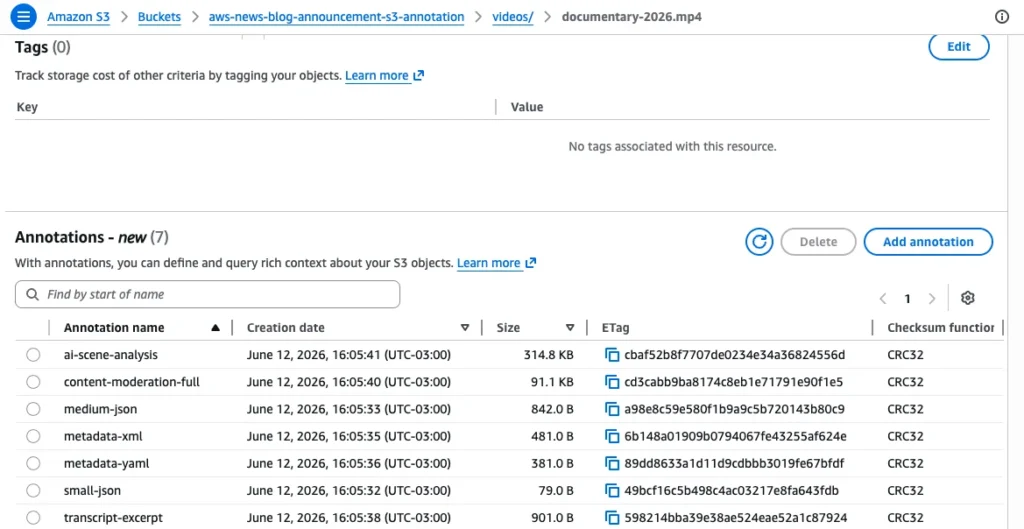
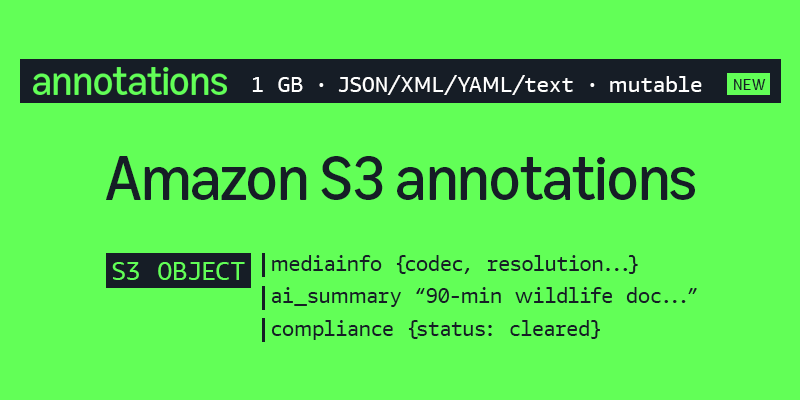
With the new annotation capability, users can now attach up to 1,000 distinct annotations to a single object. Each annotation can reach a size of 1 MB, allowing for a total of 1 GB of rich, descriptive context per object. These annotations support flexible formats, including JSON, XML, YAML, and plain text, providing developers with the structural freedom required for complex data schemas.
Perhaps most importantly, these annotations are mutable. Unlike previous metadata types that were often "set-and-forget," annotations can be updated, modified, or deleted without the need to rewrite or move the underlying object. This fluidity ensures that as an object’s business context evolves—such as a video file transitioning from "raw footage" to "final cut with AI-generated transcript"—the associated metadata remains accurate and current.
Chronology: The Evolution of S3 Metadata
To understand the significance of this launch, one must look at the progression of storage management within the AWS ecosystem.
- The Era of Basic Metadata: Initially, S3 provided only system-defined metadata (such as file size and storage class) and a 2 KB limit for user-defined metadata. These were static, immutable, and served purely for basic object identification.
- The Rise of Tagging: As organizations grew, the need for operational control led to the introduction of S3 Object Tags. These allowed for cost allocation, lifecycle management, and access control, but remained strictly limited in capacity (10 tags per object) and complexity.
- The External Database Era: As data lakes expanded to petabytes, organizations found that native S3 metadata couldn’t hold the context required for AI. Companies began building "sidecar" databases or external cataloging systems to track this information. This approach introduced significant complexity: synchronization lag, increased costs for database management, and the risk of metadata-data drift.
- The Present (2026): With the launch of S3 Annotations, the "sidecar" model is becoming obsolete for many use cases. By moving the metadata into the storage layer itself, AWS has enabled a unified, simplified architecture where the data and its context are inseparable.
Supporting Data: Comparative Metadata Capabilities
The following table highlights why S3 Annotations represent a paradigm shift in how metadata is handled at scale:
| Capability | Max Size | Mutable? | Best Use Case |
|---|---|---|---|
| System Metadata | Fixed | No | Properties (Size, Class) |
| User Metadata | 2 KB | No | Small key-value pairs |
| Object Tags | 10 tags | Yes | Lifecycle/Access control |
| S3 Annotations | 1 GB | Yes | Rich business context/AI data |
This leap from 2 KB to 1 GB is not merely incremental; it is transformative. It allows for the storage of complex AI outputs—such as multi-page transcripts, technical engineering specifications, or detailed content classifications—directly within the S3 bucket.
Official Responses and Strategic Implications
The motivation behind this launch is clear: the rise of agentic AI. As organizations build autonomous agents designed to ingest, process, and act upon massive data sets, the traditional method of querying external databases for metadata has become a major latency and cost driver.
Enabling the Autonomous Enterprise
"Organizations are building AI agents that need to understand and act on data without human intervention," notes Daniel Abib, the lead architect behind the update. "To support these workflows, metadata must evolve alongside the data, scale to petabytes, and remain queryable without the performance penalty of secondary storage systems."
By enabling S3 Metadata Annotation Tables, AWS is leveraging the power of Apache Iceberg. Once enabled, annotations are automatically indexed into a fully managed table that can be queried via Amazon Athena. This integration is a game-changer for data engineers: they no longer need to maintain synchronization pipelines between their S3 objects and an external analytics database.
The Role of the S3 Tables MCP Server
The integration with the S3 Tables Model Context Protocol (MCP) server is perhaps the most forward-looking aspect of this release. It allows AI models—whether running in SageMaker Unified Studio or local IDEs—to interface with S3 data using natural language. For example, a user can ask an agent to "Find all PG-rated movies with Spanish subtitles uploaded in 2023." The agent can now query the S3 annotation table directly, retrieving the exact object identifiers in seconds, rather than scanning petabytes of raw media.
Implications for Industry Verticals
The impact of this technology will be felt across several high-data industries:

1. Media and Entertainment
Media companies manage massive libraries of high-resolution assets. Previously, tracking technical metadata (like codec, bitrate, and frame rate) alongside editorial metadata (like scene summaries or AI-generated sentiment analysis) required a complex, external digital asset management (DAM) system. With S3 Annotations, this information lives with the file. A production house can update an object’s metadata as it passes through various stages of post-production without ever touching the actual video file.
2. Healthcare and Life Sciences
In medical imaging, a single study may consist of thousands of files. Annotating these files with patient-anonymized context, diagnostic reports, or clinical trial markers allows for instantaneous searchability. Researchers can query the annotation tables to find all images related to a specific medical condition across a ten-year archive, significantly accelerating the pace of medical discovery.
3. Financial Services
For compliance and audit purposes, financial firms must keep detailed records of transaction logs and legal documents. Annotations allow for the attachment of regulatory context—such as "GDPR-sensitive" or "Audit-required"—directly to the object. If regulatory requirements change, the annotation can be updated to reflect the new compliance status without needing to re-process the underlying data.
Implementation: A Developer’s Perspective
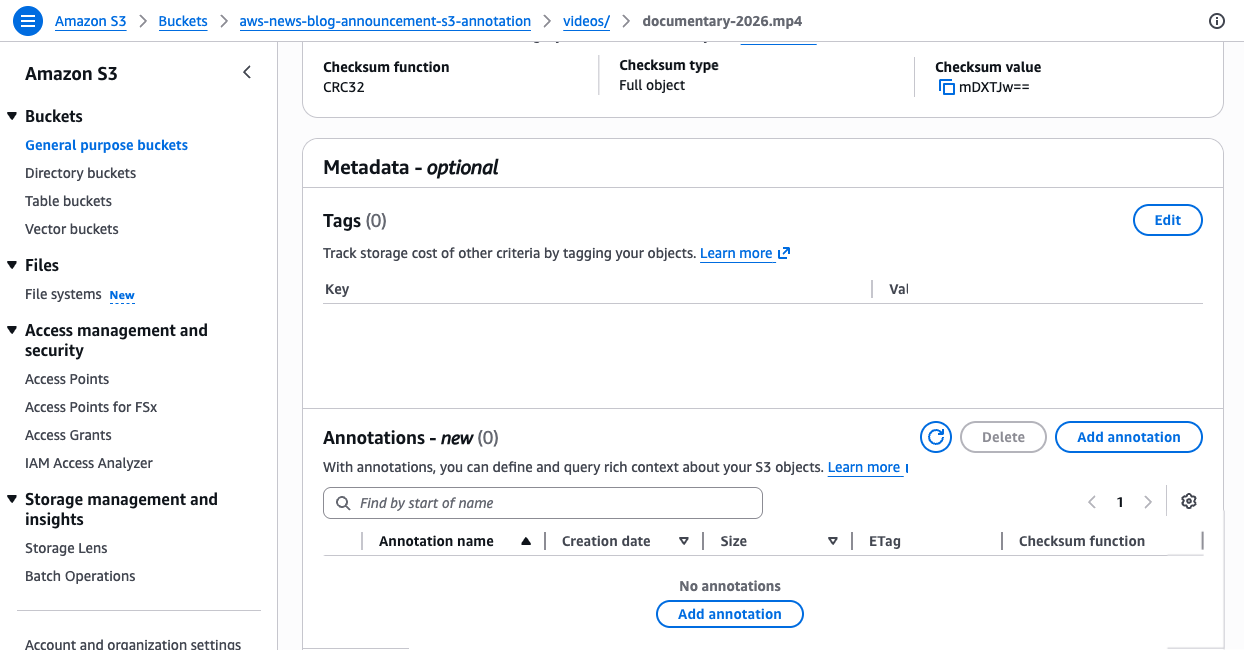
The implementation of S3 Annotations is designed to be seamless for existing AWS users. Through the AWS CLI or SDK, developers can attach annotations using the PutObjectAnnotation API.
The flexibility of the API allows for independent workflows. For instance, a security team can attach a security-classification annotation, while a marketing team simultaneously attaches a campaign-id annotation to the same asset. Because these are indexed by name, they do not interfere with one another, fostering a collaborative, multi-tenant data environment.
Furthermore, the automation of the backfill process for existing buckets ensures that legacy data is not left behind. When an organization enables annotation tables on a mature bucket, S3 handles the heavy lifting of indexing existing metadata in the background, allowing the transition to be transparent to end-users.
Looking Ahead: The Future of Metadata
The launch of S3 Annotations is a clear signal from AWS that the "Storage Layer" is becoming an "Intelligence Layer." By providing the infrastructure to store, manage, and query massive amounts of metadata at scale, AWS is effectively enabling the next generation of data-centric AI applications.
As developers begin to integrate these capabilities, the reliance on fragmented, disconnected storage architectures will likely diminish. The future of data management is one where the context is as accessible as the content itself. For the enterprise, this means less time spent managing metadata infrastructure and more time spent deriving value from the vast, petabyte-scale data lakes that define the modern digital landscape.
For those ready to get started, the feature is now available in all AWS regions, including China. With robust support for Apache Iceberg and seamless integration into the broader AWS analytics suite, S3 Annotations represent not just a feature update, but a fundamental shift in how we conceive of digital object storage in the age of AI.