The Complexity of Returns: Navigating the European E-commerce Landscape
In the modern digital economy, the transaction is no longer concluded when the "Buy Now" button is clicked. For the contemporary e-commerce merchant, the true test of operational efficiency, customer loyalty, and long-term profitability begins the moment a product is returned. In Europe, where consumer protection laws are robust and shopping habits are increasingly sophisticated, returns have evolved from a logistical inconvenience into a central pillar of the retail experience.
As online shopping continues to penetrate every corner of the European market, the "return culture" has matured, presenting a paradox for retailers: how to maintain a frictionless return policy—which is essential for conversion—without eroding profit margins or incurring unsustainable environmental costs.
An Overview of the European Return Landscape
E-commerce returns are now an inextricable component of the European commercial fabric. While the fundamental nature of the return process is universal, its execution and impact vary significantly across borders. Understanding this landscape requires an examination of consumer behavior, sectoral nuances, and the mounting pressure on retailers to reconcile profitability with the expectations of a discerning customer base.
The Statistical Reality: A Continental Snapshot
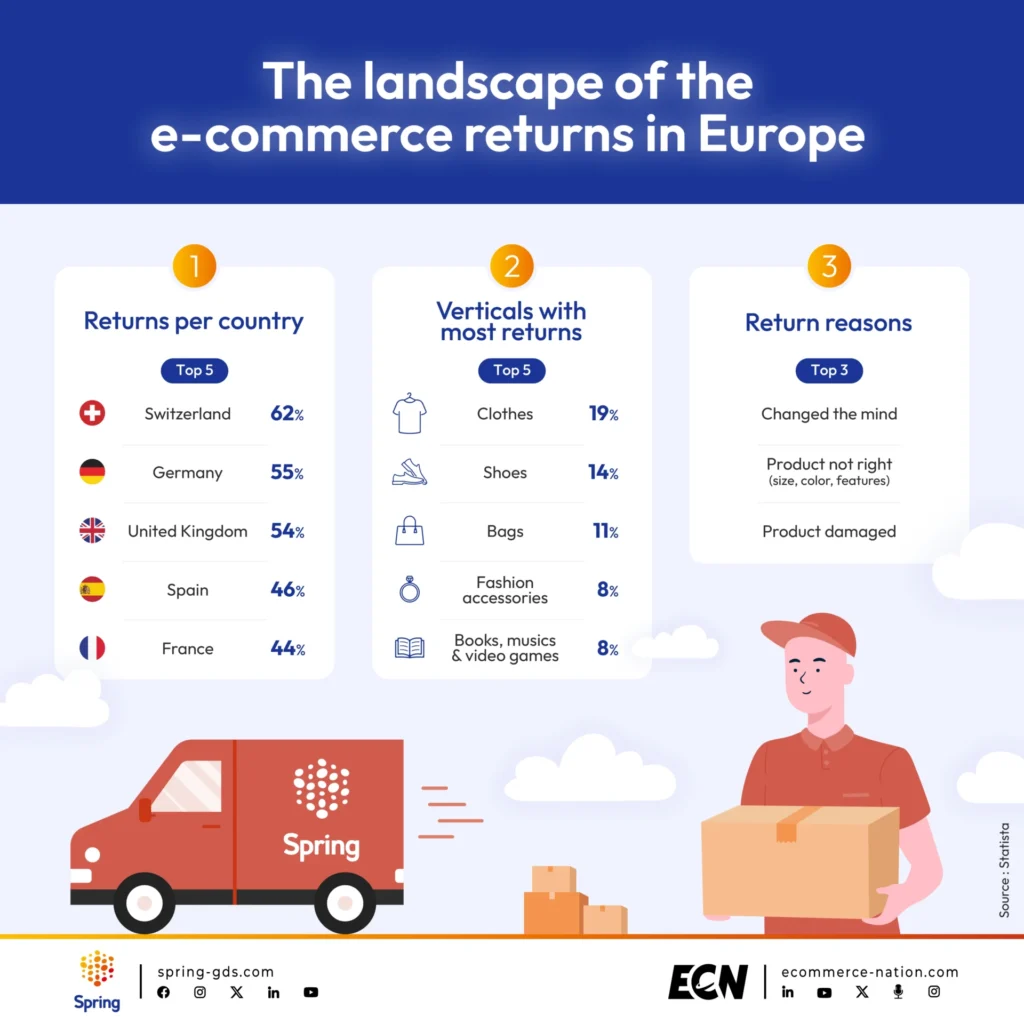
The European market is characterized by high return rates, which generally hover between 30% and 40% of total online purchases. However, these figures are not monolithic. They fluctuate based on geography, cultural shopping habits, and the specific category of goods sold.
According to recent data from Statista, Switzerland leads the European market in return frequency, with 62% of online buyers returning at least one item. Germany and the United Kingdom follow closely, with return rates of 55% and 54%, respectively. This data underscores a distinct "return-friendly" culture in Northern and Western Europe, where consumers have come to view the ability to return items as a fundamental right rather than a convenience.
The Impact on Profitability and Customer Trust
For businesses, the cost of a return is multifaceted. It involves the direct expense of reverse logistics, the labor costs associated with inspection and restocking, and the inevitable revenue loss when items must be liquidated or sold at a discount. In response, several major retailers have begun to pivot, moving away from "free returns" models toward charging fees for return shipping.
However, this transition is fraught with risk. In an era where customer experience is the primary competitive differentiator, a cumbersome or expensive return process can alienate shoppers. When managed effectively, however, a transparent and efficient return process acts as a powerful retention tool. It builds trust, signaling that the merchant stands behind their product quality and is committed to a fair purchasing journey.
Sectoral Vulnerability: Fashion vs. Electronics
The impact of returns is not distributed evenly across all industries. The fashion and apparel sectors remain the most heavily impacted, with return rates often exceeding 50% for online clothing purchases. This is largely driven by the inherent uncertainty of fit, color, and fabric quality when shopping without physical trial.
Conversely, electronics and household goods typically face lower, yet more complex, return challenges. While return rates for these categories may hover around 6% to 10%, the reasons for return—such as technical defects, compatibility issues, or user error—require specialized handling and often result in higher devaluation of the product, making them more costly per unit than a returned piece of clothing.
The Drivers of Returns: Why Consumers Send Goods Back
To mitigate the financial and logistical burden of returns, merchants must first diagnose the root cause. Modern consumer trends highlight several recurring reasons for the reversal of a sale:
- The "Bracketing" Phenomenon: Increasingly common, this practice involves consumers purchasing the same item in multiple sizes or colors with the express intent of keeping only one and returning the rest.
- Product Discrepancy: The "Expectation vs. Reality" gap is a major driver. If product imagery, descriptions, or sizing charts fail to accurately represent the item, returns are almost guaranteed.
- Damage and Defects: Logistics and handling issues during shipping continue to plague the supply chain, leading to returns that are essentially "dead on arrival."
- Buyer’s Remorse: The ease of online shopping can lead to impulsive purchases, which are often reconsidered once the item arrives at the doorstep.
The Multidimensional Challenges for Merchants
The shift toward a circular economy and the rising volume of returns have created a series of systemic challenges that require more than just a quick fix.
Logistical Complexity and Reverse Infrastructure
Traditional logistics are designed to move goods from A to B. Reverse logistics, however, requires a specialized infrastructure designed to process goods from B back to A—or to a liquidation center. This involves tracking, quality control, cleaning, and repackaging. For cross-border merchants, this complexity is magnified by the need to navigate different postal systems, carrier networks, and regional return hubs.
The Regulatory Minefield: A Fragmented Europe
Despite the Single Market, Europe remains a collection of distinct regulatory environments. Laws governing consumer rights, cooling-off periods (often 14 days under EU directive), and refund timelines can vary slightly, creating friction for pan-European retailers. Understanding the nuances of local tax laws, VAT reclamation on returned goods, and import/export documentation is critical to maintaining legal compliance and avoiding fines.
The Environmental Toll
The sustainability movement has cast a critical eye on the environmental footprint of returns. The "carbon cost" of shipping a single item back and forth is substantial, as is the waste generated by single-use packaging. Furthermore, the practice of destroying returned goods—often because it is cheaper than processing them—has come under intense scrutiny from regulators and environmentally conscious consumers alike.
Strategic Optimization: Turning Returns into a Competitive Advantage
Faced with these challenges, successful e-commerce players are moving beyond merely "managing" returns to "optimizing" them.
1. The Power of Data-Driven Insights
Data is the merchant’s most valuable asset in reducing return rates. By tracking return reasons at the SKU level, retailers can identify problematic products. If a specific dress has a 40% return rate due to "sizing," the solution is not to accept the loss, but to update the size guide with better measurements or customer feedback. Predictive analytics can also help merchants identify high-risk shoppers or predict seasonal return spikes, allowing for better resource allocation.
2. Technological Integration
Modern return management systems (RMS) have become essential. These platforms automate the authorization of returns, generate shipping labels instantly, and provide customers with a self-service portal. This reduces the burden on customer support teams while providing the retailer with real-time visibility into the return flow.
3. Sustainable Logistics
Ecological responsibility is no longer a "nice to have"; it is a market requirement. Merchants are increasingly opting for:
- Consolidated Returns: Encouraging customers to use drop-off points rather than individual courier pickups, which optimizes the carbon efficiency of the return journey.
- Eco-friendly Packaging: Using modular, reusable, or biodegradable packaging that stands up to the rigors of two-way shipping.
- Second-Life Programs: Rather than discarding returned items, leading brands are creating internal "refurbished" or "outlet" channels, effectively turning a returned product into a second revenue stream.
4. Refining the Policy for Profitability
Retailers must balance accessibility with deterrence. While a "no questions asked" policy is great for marketing, it invites abuse. Implementing dynamic return policies—such as offering free returns for loyalty members but charging a small fee for others—can help protect margins. Additionally, educating the consumer on the environmental impact of unnecessary returns can shift behavior without harming the brand’s reputation.
Conclusion: The Future of the Return Loop
The management of e-commerce returns in Europe has reached a critical juncture. As the market evolves, the merchants who thrive will be those who view returns not as a failure of the initial sale, but as a vital stage of the customer journey.
By integrating robust technology, leveraging data to drive product improvements, and committing to sustainable practices, retailers can transform the logistical headache of returns into a hallmark of reliability and customer service. In a saturated market, the ability to process a return with the same speed and efficiency as a purchase is the ultimate sign of a sophisticated, future-ready business. The goal is no longer to eliminate returns—which is an impossible feat—but to manage them with such precision that they become a seamless, value-neutral part of the modern shopping experience.