Telangana’s Industrial Ambitions: A Reality Check on Davos MoUs and the Future of State Investment
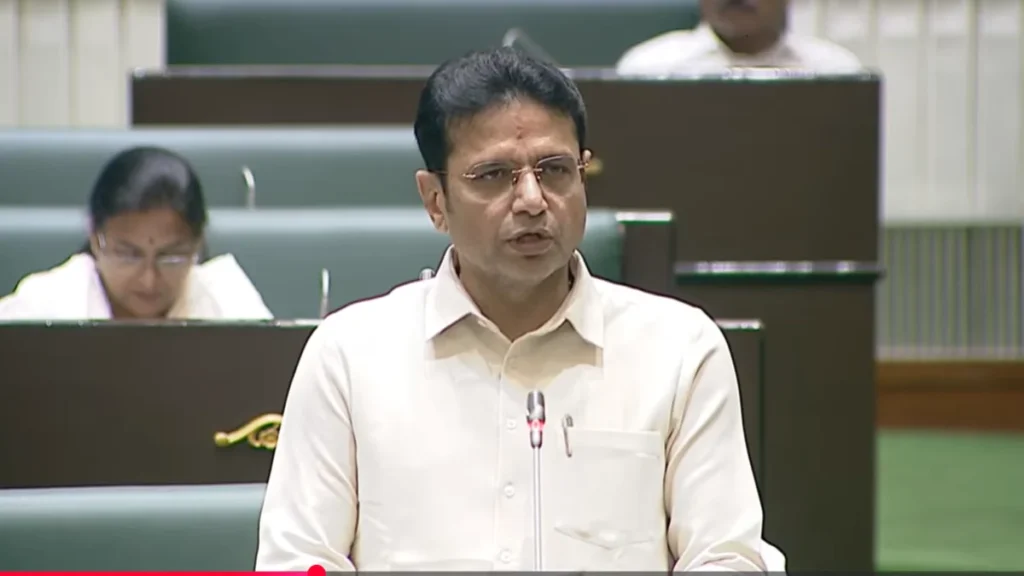
Hyderabad, September 11, 2026 — In a move characterized by transparency and pragmatic governance, Telangana’s Minister for Information Technology and Industries, D. Sridhar Babu, delivered a candid assessment of the state’s industrial roadmap during a session in the Legislative Assembly on Friday. Addressing concerns regarding the conversion rate of investment pledges, the Minister clarified that the journey from a Memorandum of Understanding (MoU) to a fully operational facility is a complex, multi-stage process that requires rigorous financial and infrastructural alignment.
The Reality of Investment Pledges: Beyond the Headlines
The discourse surrounding foreign direct investment (FDI) and domestic industrial expansion often relies on the headline-grabbing figures attached to MoUs signed at global summits. Over the past two years, the Telangana government has been aggressive in its outreach, particularly through its high-profile delegations to the World Economic Forum (WEF) in Davos. During these summits and the subsequent “Telangana Rising” initiatives, the state inked 108 MoUs with major global and domestic firms, representing a staggering cumulative investment potential of ₹5.86 lakh crore.
However, Minister Sridhar Babu’s statement serves as a necessary reality check for stakeholders and the public alike. He emphasized that an MoU is essentially an expression of intent rather than a binding legal guarantee of immediate capital deployment. "All the companies with which the State Government has signed MoUs may not set up their units here," the Minister stated, noting that the path to ‘financial closure’—the critical stage where projects secure the necessary funding—remains the primary hurdle.
Chronology of the Investment Drive
- 2024-2025 Davos Summits: The Telangana government, led by Chief Minister A. Revanth Reddy, launched an ambitious international roadshow to position the state as the premier destination for global capital.
- The Signing Surge: Through strategic engagement with Fortune 500 companies and tech giants, the state secured 108 MoUs, projecting massive industrial growth across sectors ranging from IT and manufacturing to green energy.
- Post-Summit Due Diligence: Over the last 18 months, the government transitioned from high-level negotiations to site inspections, regulatory approvals, and the vetting of financial stability for these prospective partners.
- September 2026 Assembly Review: The Minister’s address marks a transition into the implementation phase, where the focus shifts from "signed agreements" to "ground-level project execution."
The Ecosystem Mandate: What Global Corporations Demand
One of the most revealing aspects of the Minister’s address was his insight into the decision-making process of global conglomerates. When deciding where to anchor a multi-billion-dollar investment, corporations are not merely looking at tax incentives or land availability; they are evaluating the total quality-of-life ecosystem.
Mr. Sridhar Babu recounted a telling interaction between Chief Minister Revanth Reddy and the leadership of a top-tier global IT firm in Davos. The inquiries were not just about the availability of land or electricity, but about the social infrastructure: the presence of five-star hospitality for executive leadership, the quality of international schooling for the families of the workforce, and the reliability of world-class medical facilities.
"The firms seek a proper ecosystem," the Minister explained. "They are looking at profitability, which is intrinsically linked to their ability to attract and retain global talent." This suggests that Telangana’s future investment success depends as much on urban planning and social infrastructure as it does on industrial policy.
Addressing the Tier-II City Dilemma
The previous administration’s strategy of building IT towers in Tier-II cities came under fire during the Assembly session. Mr. Sridhar Babu characterized many of these structures as "real estate-driven" projects rather than industry-driven ones. Consequently, several of these facilities remain underutilized or vacant.

"The previous government used the concept of IT towers for promoting real estate," the Minister noted. To rectify this, the current administration is shifting its strategy. The focus is no longer on simply erecting buildings, but on securing "anchor companies"—large, established firms that can provide the initial volume of business required to make an IT tower viable.
The upcoming inauguration of the IT tower in Adilabad is a test case for this new approach. The government is actively courting support firms and ancillary service providers to ensure that these centers serve as hubs for genuine job creation rather than as isolated, empty infrastructure projects.
The Data Center Revolution and Resource Management
A significant portion of the Minister’s update focused on the burgeoning data center sector. As AI, cloud computing, and digital transformation sweep across the globe, the demand for high-capacity data centers has surged. Telangana has positioned itself as a lead candidate for this infrastructure, most notably through the HyperVault project—a subsidiary of TCS—which is initiating work on a 1-gigawatt data center with an estimated investment of ₹70,000 crore.
Implications of Data Center Growth:
- Employment Multipliers: While data centers are not as labor-intensive as traditional manufacturing plants in the long term, they offer significant employment during the 2–3 year construction phase. Furthermore, they catalyze the growth of local ancillary industries.
- Infrastructure Guzzlers: Mr. Sridhar Babu was candid about the challenges, admitting that these facilities are "guzzlers of power and water."
- Supply Chain Integration: The arrival of massive data centers has already triggered a secondary wave of investment. Companies specializing in server manufacturing and high-end hardware have begun inquiring about investment prospects within the state to be closer to their data-center clients.
Strategic Implications and Future Outlook
The Minister’s remarks signal a maturation of Telangana’s industrial policy. By moving away from the "vanity metrics" of total investment figures and focusing on the granular details of project viability, the government is signaling to the investor community that it values long-term partnerships over short-term PR wins.
The state’s strategy is now clearly delineated into three pillars:
- Global Capability Centers (GCCs): Strengthening the state’s dominance as a hub for multinational research and development.
- Data Center Infrastructure: Capitalizing on the state’s power surplus and geographical advantage to host the backbone of the digital economy.
- Sustainable Tier-II Growth: Ensuring that expansion into smaller towns is driven by industrial demand rather than speculative real estate development.
In conclusion, while the conversion of 108 MoUs into active units may not reach 100%, the government’s current focus on infrastructural readiness—ranging from power capacity to social amenities—suggests that those projects that do reach financial closure will be well-supported and sustainable. The road ahead for Telangana is one of disciplined, evidence-based industrialization, where the priority is to build an ecosystem that is not just attractive for investment today, but resilient enough to lead the technological advancements of tomorrow.