The Architectural Crossroads: Navigating the Trade-offs Between Single-Agent and Multi-Agent AI Systems
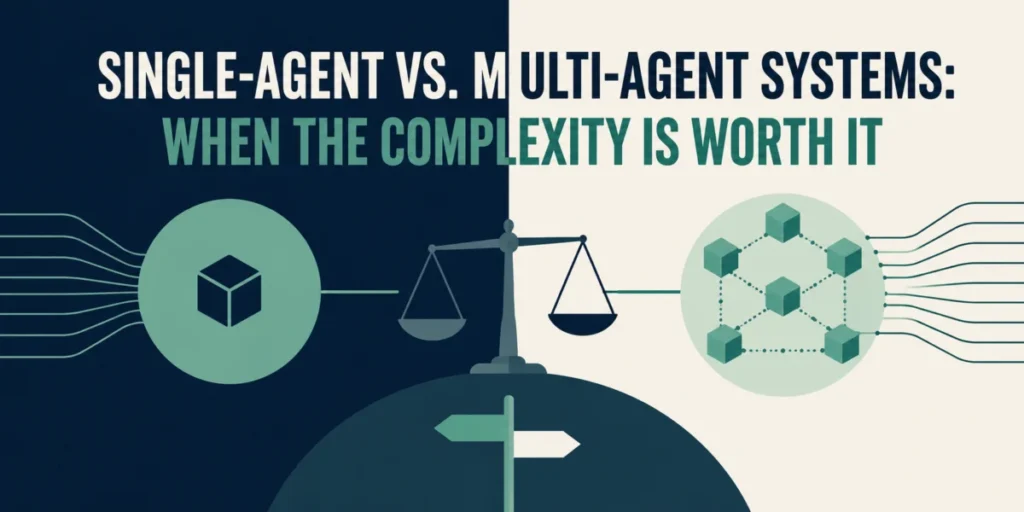
In the rapidly evolving landscape of artificial intelligence, developers and enterprises alike are facing a pivotal architectural decision: should a singular, high-capability agent shoulder the weight of an entire workflow, or should the workload be distributed among a team of specialized, autonomous agents?
As AI moves from experimental chatbot interfaces to robust backend infrastructure, this question has become the primary determinant of system performance, operational cost, and long-term maintainability. While the industry is currently enamored with the sophisticated capabilities of multi-agent systems, the drive toward complexity often precedes the exhaustion of simpler, more efficient alternatives. This article provides a comprehensive framework for navigating the AI architecture debate, ensuring that your technical choices are dictated by actual project requirements rather than the prevailing hype.
Defining the "Agentic" Standard
To understand the divergence between single and multi-agent systems, we must first establish what constitutes an "agentic" workflow. An agent represents a significant leap forward from standard Large Language Model (LLM) interactions. Whereas a traditional LLM operates on a request-response basis, an agentic system is defined by its autonomy.
An agentic system functions within a continuous loop of reasoning: it observes its environment, decides upon a sequence of actions, selects appropriate tools (such as web search, database queries, or API calls), and evaluates the outcomes to refine its next move. Whether a system employs one agent or a dozen, this fundamental "act-observe-reflect" cycle remains the core engine of performance. The architectural distinction lies purely in the orchestration—how the system manages state, allocates responsibilities, and handles the flow of information between actors.
The Case for the Single-Agent Architecture
A single-agent system positions one autonomous entity at the heart of the operation. This agent is equipped with a comprehensive toolkit and is tasked with executing a process from inception to completion.
Efficiency and Simplicity
The primary argument for the single-agent model is its operational elegance. By centralizing the logic, developers minimize latency, as there is no overhead associated with inter-agent communication or complex handoff protocols. From a financial perspective, single-agent systems are inherently more cost-effective; they minimize token consumption and reduce the number of redundant model calls that often plague distributed systems.
Debugging and Maintainability
Perhaps the most significant advantage of the single-agent model is the simplicity of debugging. When a system relies on a single decision-maker, developers have a linear conversation history and a singular trace to audit. If the agent fails, the root cause is typically confined to the prompt, the tool definitions, or the underlying model’s reasoning capabilities.
Think of the single agent as a highly skilled, versatile generalist. Just as a single talented project manager can handle an impressive volume of tasks before requiring a team, a well-prompted agent can manage data extraction, report generation, and customer service triage with surprising dexterity. Organizations often discover that their requirements do not actually necessitate the added overhead of a multi-agent framework.
The Complexity Tax of Multi-Agent Systems
When a project outgrows the capacity of a single generalist, architects often look to multi-agent systems—a model where specialized agents operate in concert, often managed by an orchestrator. However, this transition introduces what industry experts call the "complexity tax."
The Hidden Costs of Orchestration
Multi-agent systems suffer from compounding latency. When Agent A must complete a task before passing the output to Agent B, the total execution time is the sum of every sequential step. Furthermore, every additional agent increases the total token count significantly.
Operational Failure Modes
The risk of failure grows exponentially with the number of agents. In a multi-agent environment, a small error in the output of the first agent can propagate through the entire pipeline, compounding into a catastrophic failure by the final stage. Additionally, agents can become trapped in unproductive "infinite loops," where they repeatedly attempt to correct one another’s output without ever reaching a resolution, leading to runaway costs and stalled processes.
Managing state and context across these agents is also a non-trivial challenge. Ensuring that Agent C understands the nuances of what Agent A and B have already attempted requires sophisticated memory management, which can quickly turn a lean project into a bloated, difficult-to-maintain codebase.
When the Complexity Is Worth It: A Four-Point Framework
The transition to a multi-agent architecture should not be a default choice, but a strategic move reserved for specific operational scenarios. A multi-agent approach is justified when your system encounters one of the following four conditions:
1. The Requirement for Adversarial or Critic Workflows
LLMs suffer from a blind spot in self-evaluation; they are often poor critics of their own creative output. A multi-agent setup enables an "Actor-Critic" pattern. By separating the creation of content from the verification of that content, the system can perform objective quality assurance. This is particularly vital in code generation or medical research, where a second, independent agent can challenge the assumptions of the first, significantly reducing hallucination rates and technical errors.
2. Tool-Set Overload and Context Degradation
When a single agent is provided with an exhaustive list of tools, its performance often degrades. The model becomes prone to "tool-calling fatigue," where it struggles to select the correct tool or misinterprets the syntax required for complex API interactions. Specializing agents by tool-set—where one agent handles data retrieval and another handles visualization—simplifies the decision surface, leading to higher accuracy and more robust performance.
3. Exploiting Parallel Execution
Sequential processing is the silent killer of productivity. If a task involves independent sub-tasks—such as summarizing three different financial reports—a single agent must process them one by one. A multi-agent system can spin up three parallel agents to perform these tasks simultaneously, reducing the total time to completion by a factor of three.
4. Behavioral Persona and Safety Isolation
In scenarios where a single workflow requires drastic shifts in tone or safety protocols, multi-agent systems offer a clear solution. For instance, an agent interacting with a customer requires high empathy and strict, user-facing safety guardrails. An agent performing background analytical tasks requires a more clinical, data-driven approach. Instead of forcing a single model to toggle between these contradictory personas, separate agents with dedicated system prompts ensure consistent, reliable behavior at every step.
Implications for Future Development
As the AI ecosystem matures, the choice between single and multi-agent systems will increasingly be dictated by the "Human Heuristic."
If a human worker completing the task would need to change software, consult a different department, or drastically shift their mindset, that is a strong indicator that a multi-agent approach is appropriate. Conversely, if a proficient human could sit at a single desk with one browser tab open and complete the work without needing to "change hats," a single-agent system is likely the most efficient path forward.
Summary Comparison Table
| Metric | Single-Agent | Multi-Agent |
|---|---|---|
| Latency | Low/Linear | Higher (compounded by handoffs) |
| Operational Cost | Minimal | Higher (multi-token consumption) |
| Debugging | Straightforward | Complex (multi-turn, multi-state logs) |
| Primary Use Case | Linear, focused tasks | Parallel, critic-based, specialized tasks |
| Failure Risk | Localized | Propagative across agents |
Conclusion: Start Simple, Scale Deliberately
The most successful AI deployments follow a philosophy of "emergent complexity." Start with a single-agent architecture. Allow the system to work until you encounter a specific, recurring point of failure. If the agent struggles to critique its own work, introduce a critic agent. If it becomes confused by its own toolset, specialize the agents. If the process is too slow, introduce parallelization.
By building in response to observed limitations rather than anticipated ones, you ensure that your system remains as lean as possible while only adding complexity where it provides measurable value. In the world of AI architecture, the simplest solution that satisfies the requirement is almost always the best one.