The 2026 Small Business AI Reality Check: 5 Eye-Opening Findings From the Front Lines of Modern Marketing
By Global Business Insights Desk
Published: Autumn 2026
Main Facts
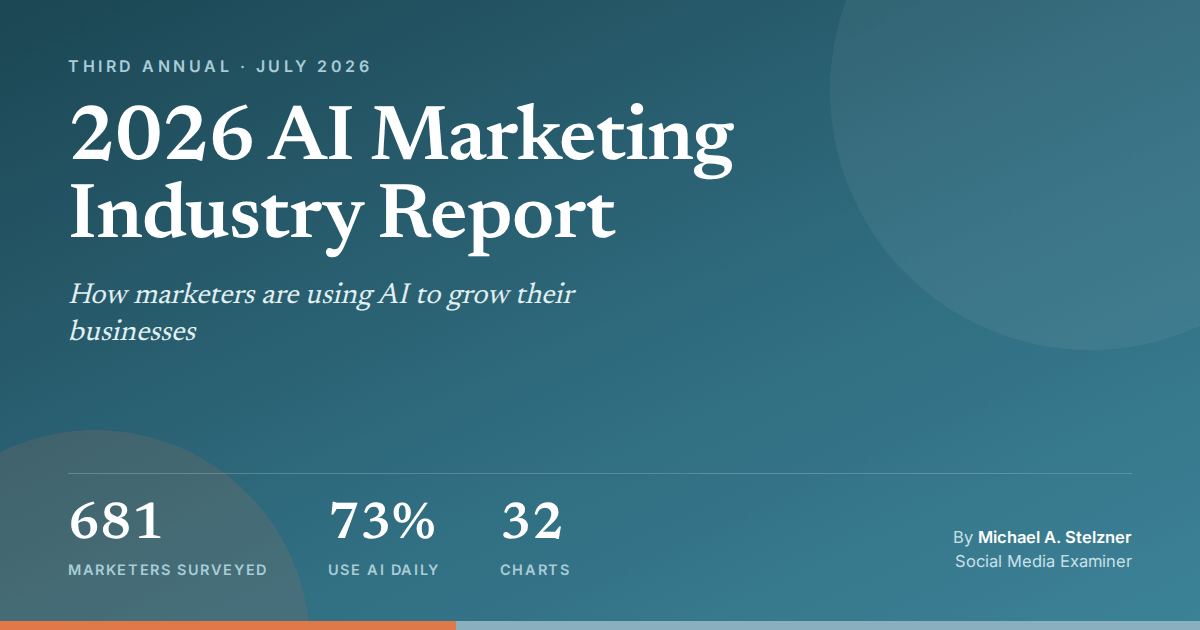
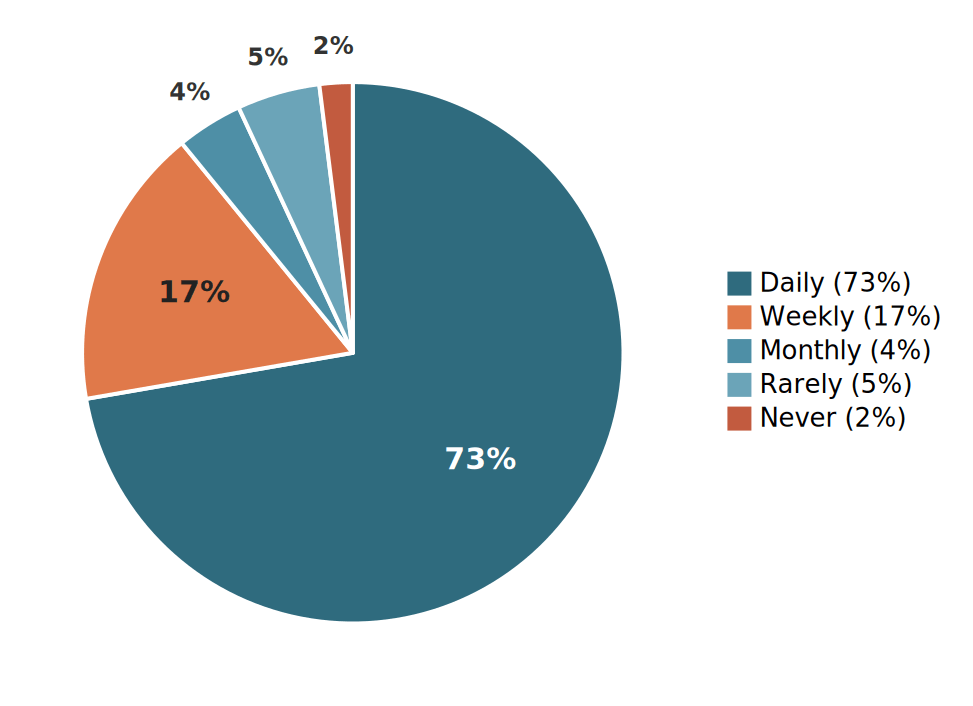
Artificial intelligence has officially crossed the threshold from an experimental novelty into the core operational bedrock of modern commerce. According to the comprehensive 2026 AI Marketing Industry Report released by Social Media Examiner, daily AI utilization among marketing professionals has skyrocketed from roughly one-third of the workforce two years ago to nearly three out of four today.
Crucially, this sweeping technological evolution is not being driven by deep-pocketed conglomerates or massive enterprise training programs. Approximately 60% of survey respondents hail from lean organizations operating with 10 or fewer employees. The data reveals that small business owners and micro-entrepreneurs are leading the charge through individual experimentation, self-funding, and hands-on adaptation.
While the report underscores an unprecedented surge in daily task execution—touching everything from copywriting to customer service workflows—it also highlights significant operational gaps. Most notably, a stark discrepancy persists between perceived productivity gains and quantifiable measurement, alongside massive untapped opportunities in emerging sectors like AI-generated video and autonomous AI agents.
Chronology: The Rapid Acceleration of AI Adoption
To understand where small business marketing stands today, it is vital to examine the breakneck speed at which artificial intelligence has infiltrated everyday workflows over the past 24 to 36 months.
- The 2024 Baseline: In the foundational era of widespread generative AI accessibility, usage was heavily fragmented. Approximately 37% of marketers reported interacting with AI tools on a daily basis. At the same time, roughly 23% of professionals admitted that they rarely or never touched the technology, viewing it with a mixture of skepticism, hesitation, or bewilderment. Corporate-mandated training was virtually non-existent, leaving tools to individual pioneers.
- The 2025 Transition Phase: Throughout the following year, the landscape shifted dramatically. Free-tier models began to phase out or introduce restrictive paywalls, forcing a cultural pivot. Professionals moved past simple text generation, experimenting heavily with image creation platforms—which nearly doubled in adoption during this window—and testing early iterations of workflow automation.
- The 2026 Normalization (Present Day): Today, daily usage has surged to 73%, while an overwhelming 90% of marketers utilize AI at least on a weekly basis. The segment of non-users has shriveled to a mere 7%. More importantly, momentum shows no signs of plateauing: 84% of surveyed professionals report that their overall AI usage increased over the past year, and 78% anticipate even greater integration moving forward.
Supporting Data: By the Numbers
The 2026 AI Marketing Industry Report features 32 detailed charts tracking year-over-year adjustments across platforms, budgets, and operational strategies. Several statistical pillars define the current landscape:
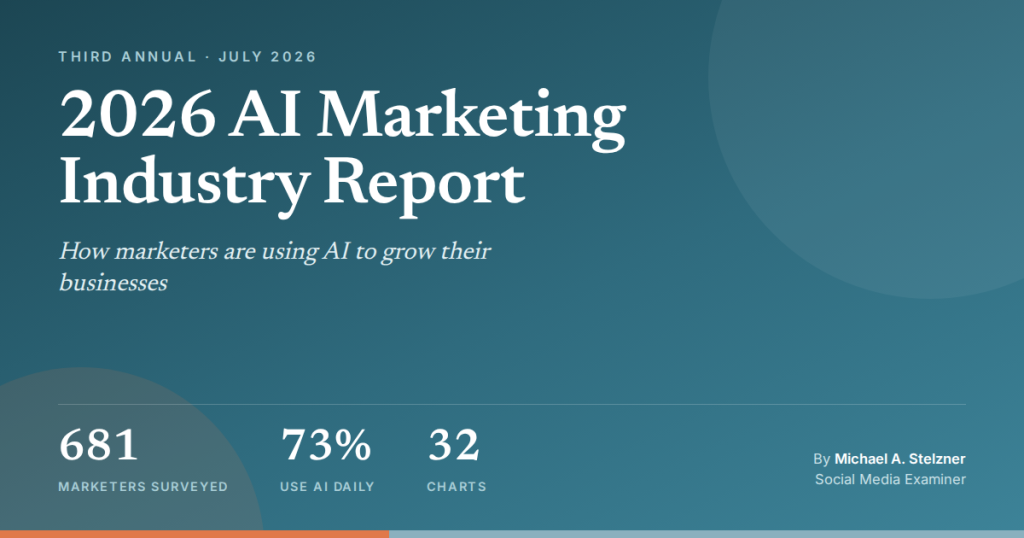
- 73%: The percentage of marketers who now utilize artificial intelligence on a daily basis, up from 37% two years ago.
- 90%: Total weekly users of AI tools, leaving only 7% who rarely or never engage with the technology.
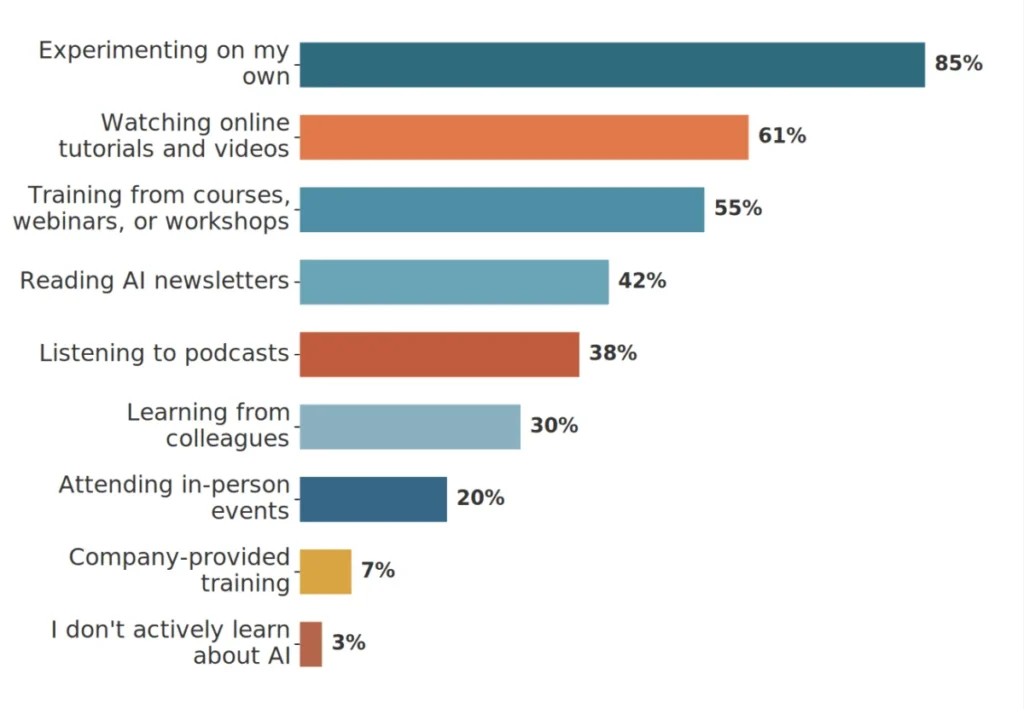
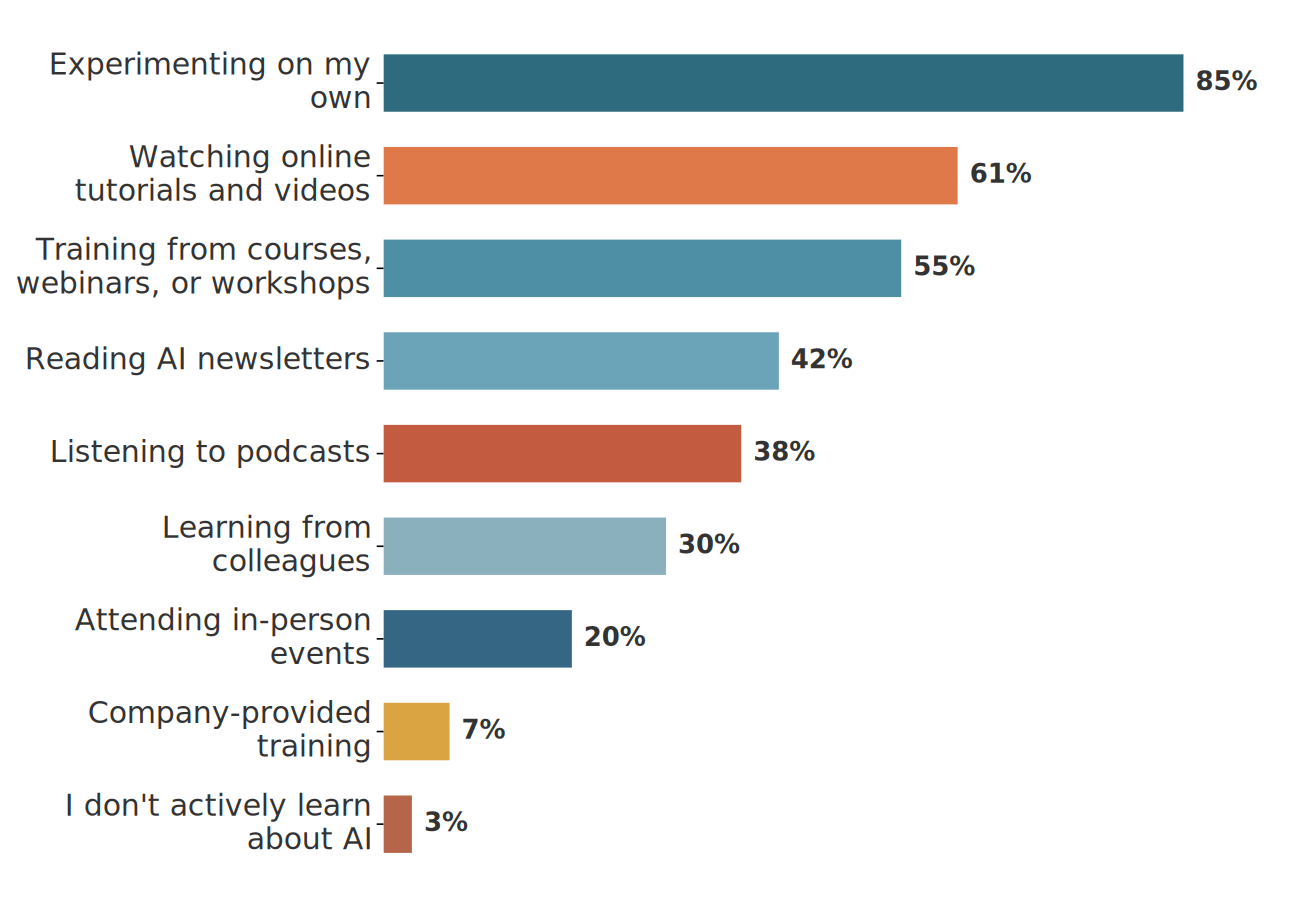
- 85% vs. 7%: The divide in how professionals acquire AI skills. Eighty-five percent learn through self-directed experimentation, whereas a mere 7% receive formal, company-provided training.
- 53%: The proportion of marketers dipping into their own personal funds to pay for premium AI subscriptions and tools, reflecting a broader 85% overall payment rate.
- 55%: The percentage of respondents identifying "me" as the primary driver of AI adoption within their corporate or entrepreneurial structure.
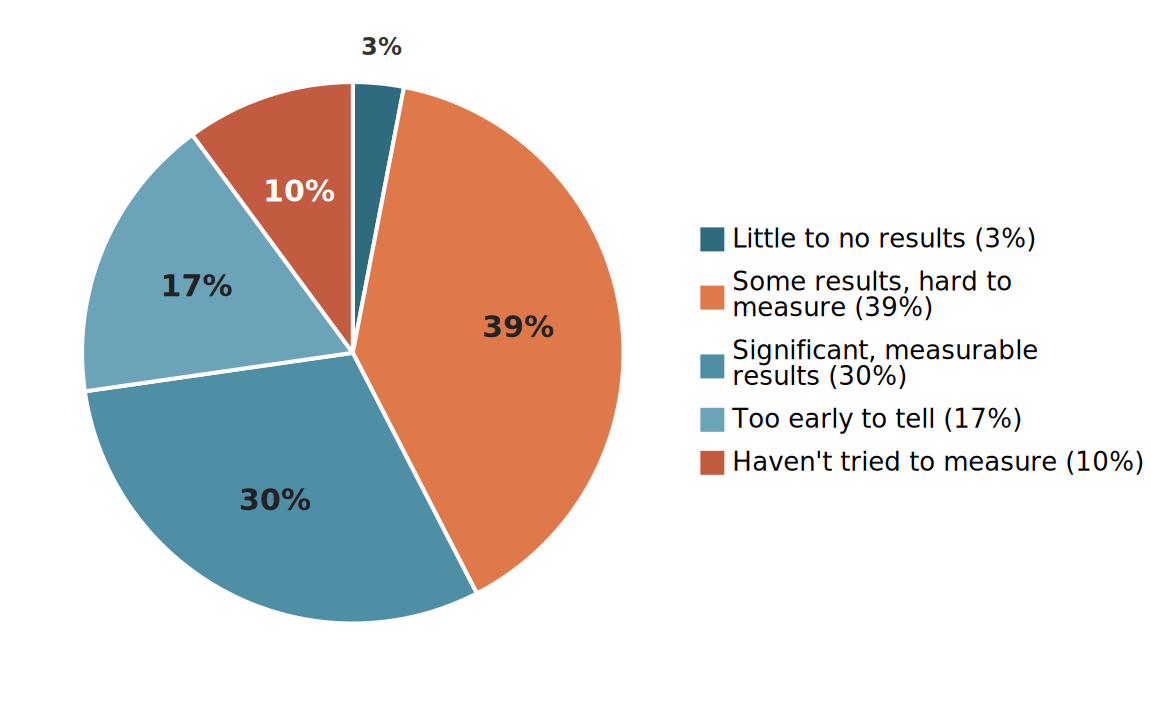
- 86% vs. 30%: While 86% of marketers firmly agree that AI saves time and boosts productivity, only 30% can point to concrete, measurable metrics to substantiate those claims.
- 37% vs. 74%: The utilization gap in video content. While 95% use AI for text, only 37% use it for video creation—even though 74% cite AI video as the #1 content skill they want to master.
- 79%: The combined percentage of marketers either currently deploying AI agents (11%), actively experimenting with them (24%), or planning to adopt them in the near future (44%).
Official Insights and Industry Response
The research was spearheaded by Michael Stelzner, founder of Social Media Examiner, who designed the study to strip away mainstream media hype and uncover practical realities for lean teams.
"We surveyed marketers to find out how they’re actually using AI. Not the hype. Not the headlines. The real story," Stelzner noted when releasing the findings. "Since 60% of our respondents come from businesses with 10 or fewer people, this isn’t enterprise research. This is your world."
According to Stelzner and accompanying industry analysts, the prevailing narrative that small businesses are lagging behind technological curves is fundamentally flawed. In the realm of artificial intelligence, small teams are structurally advantaged by their lack of bureaucratic friction. While large enterprises grapple with lengthy compliance reviews, multi-tiered software procurement committees, and mandatory corporate training rollouts, small business owners simply log in, input their credit cards, and test the software themselves.
"The marketers who are furthest ahead didn’t get there through corporate training programs or massive budgets," Stelzner emphasized. "They got there the same way you would—by rolling up their sleeves and figuring it out."
Implications for Small Businesses
For entrepreneurs, solopreneurs, and leaders of small companies, these findings carry profound strategic implications. The report outlines several critical areas where business owners can capitalize on existing market gaps:
1. The Death of the "Free Tier" Era
As AI platforms mature, the days of relying exclusively on free, stripped-down models are disappearing. With 85% of professionals paying for tools—and over half paying out of pocket—small businesses must evaluate AI subscriptions as essential operational overhead rather than frivolous expenses. Treating these tools like standard utilities (such as high-speed internet or accounting software) is becoming a prerequisite for competitive survival.
2. Solving the Measurement Gap
Because 70% of marketers struggle to mathematically prove the ROI of their AI usage, a massive opportunity exists for data-driven operators. By implementing basic tracking mechanisms—such as logging hours saved per week on content production, tracking customer response times, or measuring output volume—small businesses can gain a distinct competitive advantage. Knowing why and where AI creates value prevents wasted expenditure and refines strategic focus.
3. Conquering the AI Video Frontier
While text generation has achieved saturation, AI video creation remains wide open. With a staggering 37-point gap between those using AI video (37%) and those wanting to learn it (74%), early movers who master basic AI video generation tools stand to capture outsized attention on platforms dominated by static imagery and text.
4. The Coming Wave of Autonomous Agents
Perhaps the most transformative horizon highlighted in the report is the rise of autonomous AI agents. Unlike standard chatbots that require constant human prompting for every single step, AI agents are designed to execute multi-step workflows independently—such as running complex email nurture sequences, monitoring live analytics dashboards, or managing initial customer intake inquiries.
For a small team of two or three people, deploying an AI agent is functionally equivalent to hiring an extra administrative or marketing assistant. With 79% of marketers either using or planning to adopt agents, early integration could redefine operational capacity for micro-businesses.
5. Closing Thoughts
The 2026 AI Marketing Industry Report delivers a reassuring message to independent business owners: you do not need a massive enterprise budget, a dedicated IT department, or formal corporate credentials to master artificial intelligence. The modern AI landscape is shaped by grit, curiosity, and practical experimentation. For those willing to roll up their sleeves, the tools are ready, the learning curve is surmountable, and the competitive advantage is yours for the taking.