Google Upgrades Open-Source Meridian Platform: A Major Leap Forward for Causal Measurement and Marketing Mix Modeling
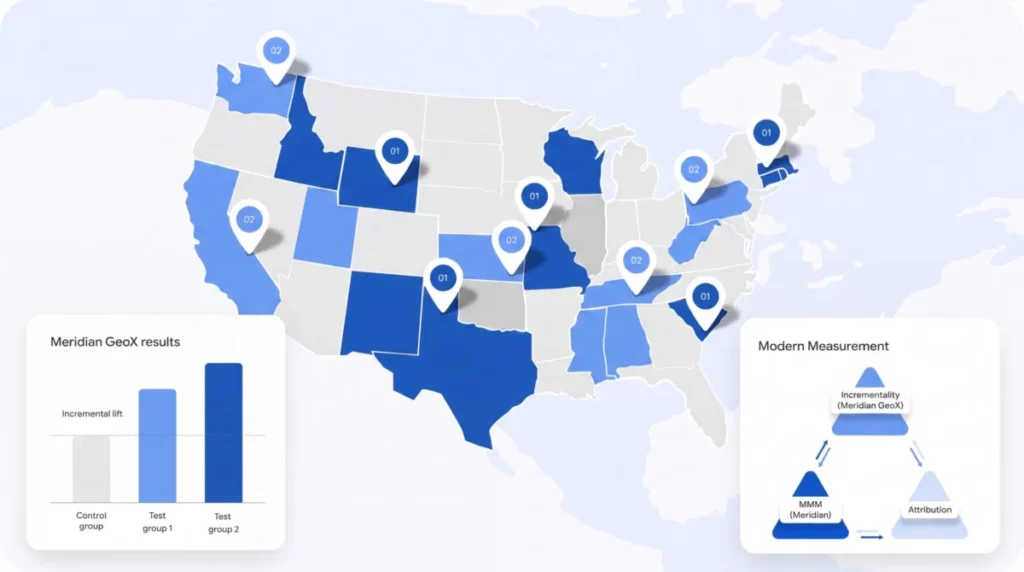
The search giant is rolling out a substantial update to Meridian, its open-source marketing mix modeling (MMM) tool. The focal point of this release is the global launch of Meridian GeoX, alongside new agentic modeling assistants and expanded brand-signal tracking designed to help advertisers evaluate long-term campaign effects.
1. Main Facts
Google has officially transitioned Meridian GeoX from its beta phase to general availability on a global scale. Originally previewed in May, GeoX is an open-source tool embedded within Meridian that enables marketers to conduct geographic incrementality experiments. By measuring performance variations across different physical regions, advertisers can estimate the true causal impact of their media spend—determining precisely what business outcomes occurred because of advertising investments rather than external factors.
In tandem with the GeoX rollout, Google is introducing several core enhancements to the broader Meridian framework:
- Agentic Model-Building Assistants: AI-driven tools that audit data quality, resolve errors, and offer real-time guidance during the complex process of constructing marketing mix models.
- Backend Performance Boosts: Architectural updates designed to execute analyses faster and more efficiently.
- Expanded Brand Signal Integration: The ability to incorporate longer-term brand metrics—such as Branded Google Query Volume—into models, helping brands gauge the delayed impact of upper-funnel efforts like television and out-of-home (OOH) advertising.
These updates arrive as marketers increasingly seek alternatives to traditional, platform-specific attribution models, which often fail to provide a holistic view of multi-channel performance in a privacy-centric digital landscape.
2. Chronology: The Evolution of Google’s Meridian
To understand the weight of these updates, it helps to examine the timeline of Google’s open-source measurement initiative:
- May 2024 (Initial Previews): Google first previews Meridian as a modern, open-source marketing mix model designed to provide transparent, customizable measurement for enterprise advertisers.
- May 2025 (GeoX Teaser): Google previews Meridian GeoX as an experimental framework for geographic incrementality testing, signaling a push to bridge the gap between top-down econometric modeling and bottom-up experimentation.
- September 2026 (Global General Availability): Google rolls out the global launch of Meridian GeoX, integrates agentic AI workflow tools, and introduces native support for Branded Google Query Volume to capture long-term brand equity effects.
3. Supporting Data & Technical Architecture
While Meridian itself remains a free, open-source software package with zero licensing fees, deploying it effectively requires substantial technical overhead.
Infrastructure and Data Requirements
- Compute-Intensive Modeling: Google explicitly recommends dedicated GPU resources to handle Meridian’s computational demands, especially when running iterative Markov chain Monte Carlo (MCMC) sampling or processing large datasets.
- GeoX Prerequisites: To successfully run Meridian GeoX, advertisers must provide clean, daily time-series data and ensure their target markets possess sufficient geographic variation. Designing reliable treatment and control regions requires careful experimentation design.
- Cross-Platform Compatibility: GeoX is platform-agnostic. Marketers can evaluate campaigns running across Meta, TikTok, Amazon, linear television, or Connected TV (CTV), rather than being locked into Google-specific media metrics.
Calibrating MMM with Causal Evidence
Traditional MMM relies entirely on historical econometric data to assign credit across channels. However, when multiple channels shift budgets simultaneously, or when macroeconomic factors intervene, model estimates can become distorted.
By injecting real-world causal data derived from GeoX experiments directly into Meridian, marketers give their models an empirical "anchor." This symbiotic relationship strengthens confidence intervals, making model outputs significantly more defensible during executive budget allocation reviews.
4. Official Responses and Industry Context
Industry analysts note that Google’s dual approach—combining open-source software freedom with advanced AI automation—addresses major pain points for enterprise analytics teams.
Speaking on the launch of these capabilities, industry stakeholders have emphasized the growing need for triangulation in digital advertising. In an ecosystem heavily impacted by signal loss, cookie deprecation, and stricter privacy regulations, relying on a single source of truth is no longer viable.

Google’s strategic framing of these updates highlights its commitment to causal measurement. By positioning GeoX as a validation engine for Meridian models, Google is addressing the classic critique of MMM: that it is a "black box" yielding results that are difficult to verify. The introduction of agentic tools also reflects a broader tech industry trend of embedding AI copilots into complex data science workflows to lower the technical barrier to entry.
5. Implications for Advertisers and Enterprise Brands
The deployment of these features carries significant operational and strategic implications for modern marketing organizations.
Bridging the Gap Between Data Science and Citing Executives
One of the most persistent hurdles in marketing analytics is translating complex statistical models into actionable business language. When a data science team recommends shifting millions of dollars from performance channels to brand building based on an MMM output, executive leadership often pushes back, demanding proof.
By pairing Meridian’s macro-insights with targeted GeoX incrementality tests, marketers gain dual validation. If a regional geographic test confirms what the broader model predicts, the narrative presented to the C-suite becomes vastly more compelling.
Navigating the Nuance of Brand Signals
The integration of Branded Google Query Volume allows brands to quantify the halo effect of top-of-funnel campaigns. When a consumer sees a billboard or streaming video ad, they rarely click an attribution link immediately; instead, they may search for the brand days later.
However, Google and its measurement partners caution against naive interpretations. Spikes in branded search queries can easily be conflated with:
- Seasonal shopping trends (e.g., holiday surges)
- Aggressive competitor activity
- PR and news coverage
- Short-term price promotions
Meridian’s upgraded modeling framework attempts to isolate these confounding variables, allowing the query volume signal to be weighed accurately alongside standard media inputs.
The Real Cost of Open-Source Tools
Despite being free to download, Meridian is far from a plug-and-play solution. Advertisers must carefully weigh the total cost of ownership, which encompasses:
- Human Capital: Specialized data scientists and marketing analytics engineers capable of managing Python/R environments, configuring priors, and interpreting Bayesian models.
- Media Costs: The financial investment required to manipulate media spend across specific geographic markets to create valid experimental treatment and control groups.
- Data Hygiene: Enterprise-grade data pipelines that aggregate clean, continuous metrics across disparate ad servers and sales databases.
Conclusion: Looking Ahead
Google’s latest updates to Meridian and the global launch of GeoX represent a maturation of open-source marketing mix modeling. By uniting econometric modeling, real-world causal experimentation, AI-assisted troubleshooting, and long-term brand equity tracking, Google is providing enterprise brands with a sophisticated toolkit to weather the post-cookie era.
As more companies adopt GeoX and test these agentic workflows, the industry will closely monitor how often real-world experiments validate algorithmic predictions—and how organizations handle the inevitable discrepancies when models and reality diverge. For large-scale advertisers with the necessary data infrastructure, these tools offer a path toward unprecedented clarity in media investment strategy.