Finance Ministry Opens Door to UPI Merchant Discount Rate: What the New Rules Mean for India’s Digital Payments Ecosystem
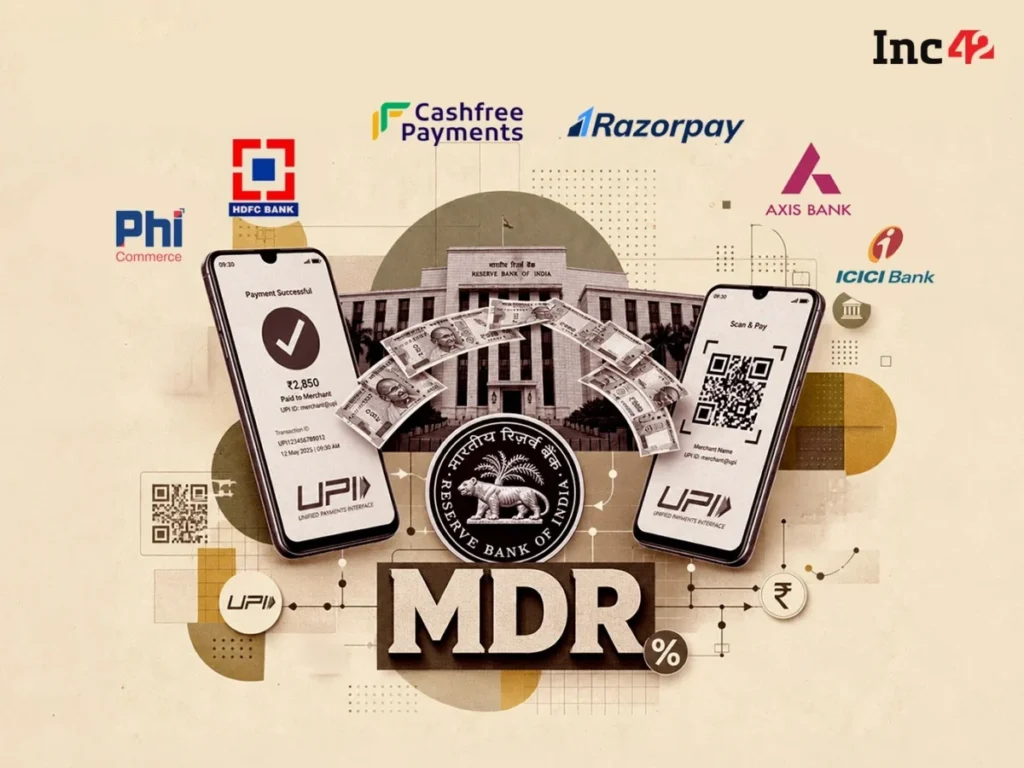
New Delhi: In a landmark regulatory shift that could permanently reshape the economics of India’s digital payments landscape, the Ministry of Finance has paved the way for the reintroduction of the Merchant Discount Rate (MDR) on high-value Unified Payments Interface (UPI) transactions.
Through a gazette notification issued on September 14, the central government formally amended the regulatory framework governing digital transactions. While small-ticket transactions and RuPay-powered debit cards remain fiercely protected under a zero-fee regime, the policy opens a lucrative, direct revenue stream for banks and fintech firms on transactions exceeding ₹2,000.
The move marks a definitive pivot from a purely subsidized, zero-MDR growth model to a sustainable monetization framework, sending ripples across India’s financial markets and setting the stage for structural changes across payment gateways, issuing banks, and third-party application providers (TPAPs).
1. Main Facts: Decoding the Government’s Gazette Notification
At the core of the finance ministry’s recent directive is a nuanced calibration of India’s digital payment rules rather than a blanket roll-back of the zero-fee policy.
According to the gazette notification dated September 14, the central government has explicitly exercised its powers under amended provisions of the Payment and Settlement Systems Act (PSSA), 2007. The ministry has directed banks and payment system providers to strictly refrain from imposing any direct or indirect charges on specific, mass-market electronic transactions.
Specifically, the notification dictates:
- Exempted Categories: No charges can be levied on debit cards powered by the indigenous RuPay network, irrespective of transaction size.
- The Threshold Rule: UPI transactions of up to ₹2,000 remain completely free for both payers and receivers.
- The Catch: By explicitly drawing the line at ₹2,000, the notification implicitly establishes that UPI transactions above this threshold are now legally open to merchant discounting, subject to further rule-making.
For years, the zero-MDR mandate applied as a blanket rule across all UPI payments, regardless of whether a transaction was a ₹50 chai purchase or a ₹50,000 high-value corporate transfer. The new notification creates a bifurcated system, shielding low-value retail micro-transactions while permitting monetization on larger commercial exchanges.
2. Chronology: How the Policy Shift Unfolded
The road to the reintroduction of MDR has been paved over several months of legislative deliberation, economic pressure, and parliamentary reviews:
- The 2020 Zero-MDR Baseline: To supercharge the adoption of digital payments in the wake of the pandemic, the Indian government mandated a zero-MDR regime on UPI and RuPay transactions. While this successfully democratized digital payments, it created a severe structural deficit for the institutions maintaining the infrastructure.
- Growing Fiscal Strain (2023–2025): As UPI volumes shattered records month after month, banks and fintech companies repeatedly raised alarms over the unsustainable costs of maintaining massive server capacities, fraud detection systems, and customer support networks without direct transaction revenue.
- Parliamentary Interventions: A parliamentary standing committee explicitly flagged that government budgetary subsidies were falling short of compensating banks and payment providers for infrastructure upkeep, forcing a policy rethink.
- The Taxation and Other Laws (Amendment) Bill, 2026: Parliament passed a critical amendment to Section 10A of the PSSA, 2007. Previously, Section 10A completely barred banks and system providers from imposing charges on all UPI transactions. The 2026 amendment empowered the Central government to selectively notify which electronic payment modes and thresholds could be exempted from this strict bar.
- The September 14 Gazette Notification: Utilizing its newly acquired legislative backing, the finance ministry issued the September 14 notification, officially drawing the ₹2,000 boundary and opening the door for the National Payments Corporation of India (NPCI) to craft a workable MDR framework.
3. Supporting Data: The Scale of UPI and Market Reactions
To understand why the reintroduction of MDR is such a monumental development, one must examine the staggering scale of India’s digital economy and the immediate financial market response.
The Volume Paradox
UPI has grown from a domestic novelty into the undisputed backbone of Indian commerce. In August alone, the payments infrastructure clocked an astonishing 2,451 crore (24.51 billion) transactions, representing a month-on-month growth of roughly 4%. The total monetary value processed during that single month touched a staggering ₹29.82 lakh crore.
Yet, this astronomical volume paradoxically strained the ecosystem. Because high-value transactions—ranging from rent payments and utility bills to luxury purchases—attracted zero merchant fees, processing institutions bore heavy operational expenses without proportionate top-line growth.
Wall Street and Dalal Street React
The moment reports surfaced that the government was preparing to roll out an MDR framework—rumored to be set at 40 basis points (bps), or 0.4% of the transaction value for UPI payments above ₹2,000—fintech and banking stocks experienced a sharp bullish rally.
- Pine Labs witnessed a massive surge, jumping 16.9% to close a recent trading session at ₹202.35 on the BSE.
- MobiKwik climbed over 8%, closing at ₹209.80.
- AvenuesAI registered a 6.1% bump to reach ₹16.31.
- Major listed players like Paytm also experienced positive momentum, rising 3.9% to touch ₹1,806.25, reflecting investor relief over incoming monetization pathways.
4. Official Responses and Institutional Dynamics
With the legal framework now established by the Ministry of Finance, the immediate operational responsibility has shifted to industry regulators and banking bodies.
The ball now firmly lies in the court of the UPI and Services Steering Committee, which operates under the aegis of the National Payments Corporation of India (NPCI). This committee is tasked with designing the specific MDR framework, establishing merchant categories, and finalizing the exact basis point rates for high-value UPI transactions.
According to industry insiders, the proposed revenue-sharing model is expected to heavily favor the foundational pillars of the banking system:
- Issuing Banks: Set to be the biggest beneficiaries, issuing banks could capture up to 40% of the total MDR pool, compensating them adequately for customer acquisition, account maintenance, and fraud mitigation.
- Third-Party Application Providers (TPAPs): Consumer-facing apps like PhonePe, Google Pay, and Paytm are expected to secure a designated slice of the remaining fee pool.
- Acquiring Banks: Banks that manage merchant point-of-sale systems and payment gateways will split the remaining balance, ensuring all participants in the transaction chain have skin in the game.
The NPCI is currently deep in consultations with stakeholder banks and fintech firms to iron out the micro-mechanics of the framework, with a comprehensive operational notification anticipated in the coming weeks.
5. Implications: What This Means for Merchants, Fintechs, and Consumers
The structural reintroduction of MDR on transactions over ₹2,000 carries profound multi-sectoral implications:
For Consumers: Business as Usual for Small Spends
For the average retail consumer, everyday micro-transactions—such as buying groceries, paying for public transport, or settling restaurant bills under ₹2,000—will remain entirely free and unaffected. This ensures that financial inclusion goals and grassroots digital adoption rates are not compromised. However, high-value peer-to-merchant (P2M) transfers may eventually see merchants factoring processing costs into goods and services, though competitive market pressures will likely keep direct consumer-facing surcharges at bay.
For Fintech Companies and TPAPs
For years, digital payment giants operated in a high-volume, low-margin (or margin-less) environment, surviving primarily on ancillary financial services like cross-selling mutual funds, insurance, and personal loans. The introduction of a direct MDR stream on high-value transactions transforms their core payments business from a cost center into a sustainable, cash-generating engine. This newfound financial viability is precisely why fintech equities rallied sharply following the news.
For Banks and Infrastructure Providers
Traditional banks, which shoulder the ultimate liability and infrastructural burden of clearing transactions, stand to regain vital profitability. The 40 bps framework—if finalized as projected—will provide banks with the predictable capital required to continuously upgrade cybersecurity architecture, prevent system outages, and expand robust digital banking infrastructure into semi-urban and rural geographies.
Macroeconomic Sustainability
Ultimately, the transition away from a pure zero-MDR model signals a maturing digital economy. Policymakers have recognized that while subsidies are vital for kick-starting financial revolutions, long-term operational resilience requires an equitable, self-sustaining commercial framework. By shielding the small consumer while enabling monetization for high-value commercial flows, India is striking a delicate balance between public good and private sector viability.
As the NPCI prepares to unveil the final operational guidelines in the coming weeks, India’s digital payments ecosystem stands on the threshold of a new, financially sustainable era.