The State of Blogging in 2025: Why Effort, Strategy, and New Channels Are Replacing Traffic-First Mindsets
Blogging has long been the cornerstone of B2B and B2C digital marketing strategies. For over a decade, it has served as the primary vehicle for search engine optimization (SEO), thought leadership, and customer education. However, as the digital landscape shifts—impacted by the rise of generative AI, changing search behaviors, and the fragmentation of audience attention—the "tried and true" methods of the past are beginning to falter.
The latest findings from Orbit Media’s 11th Annual Blogger Survey, an authoritative industry benchmark, suggest that we are entering a new era of content marketing. The era of "easy growth" is over, and the era of strategic, high-effort content has arrived.
The Main Facts: The "Four-Hour" Ceiling
Perhaps the most surprising revelation in this year’s data is the lack of a major shift in production time, despite the widespread adoption of artificial intelligence.

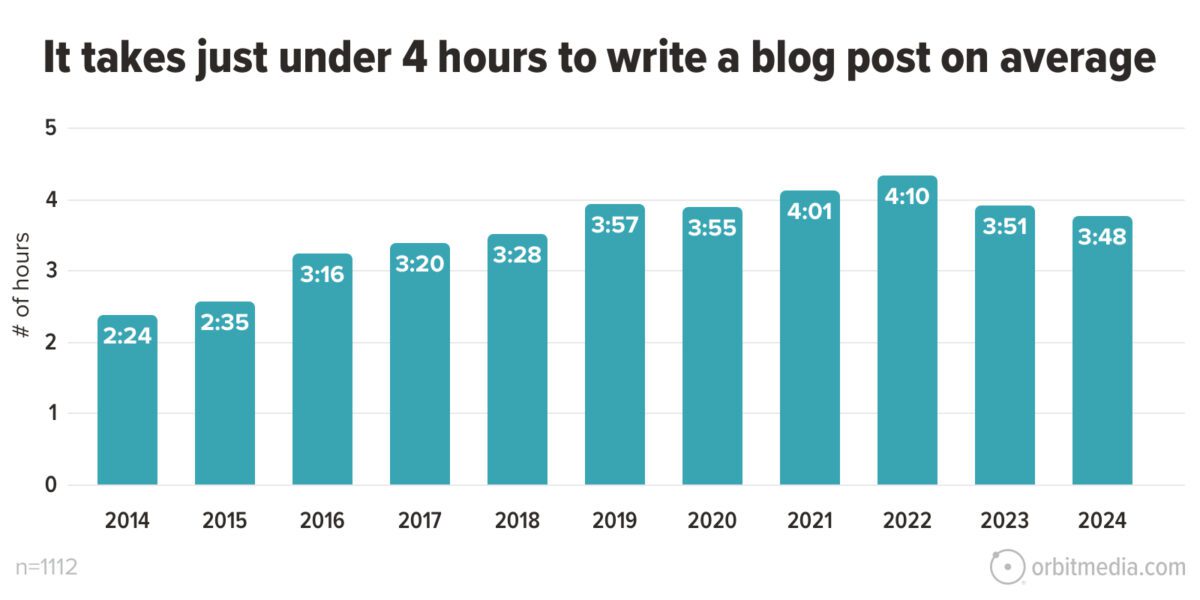
The survey reveals that the average blog post takes three hours and forty-eight minutes to produce. This figure is a mere three minutes less than what was reported the previous year. This stagnation is noteworthy because, between 2022 and 2024, AI adoption among bloggers skyrocketed from near-zero to 80%.
Why hasn’t AI significantly reduced the time it takes to create content? The data suggests that while AI is being used for brainstorming and drafting, the human element—strategic direction, factual verification, brand voice, and creative polishing—remains a time-intensive bottleneck. Simply put, AI has changed the process of writing, but it has not necessarily made the result easier to achieve if the goal is high-quality, high-performing content.
Chronology: A Decade of Data-Driven Evolution
For eleven years, Orbit Media has tracked the habits, successes, and failures of thousands of content marketers. Over this period, the industry has transitioned from a "quantity-first" approach (posting daily to "feed the algorithm") to a more nuanced, quality-driven strategy.
- Early Days: Success was easily measured by simple organic traffic spikes and keyword density.
- The Middle Era: Content saturation hit, and the "Skyscraper Technique" became the gold standard, leading to longer, more researched articles.
- The AI Pivot: We are currently in a transition where marketers are testing AI tools while grappling with declining organic traffic as Google shifts toward "zero-click" search results and AI-generated summaries.
The chronological trend is clear: as competition has increased, the "minimum bar" for entry has risen. Content that lacks original research, unique expert insights, or a distinct point of view is no longer gaining traction.
Supporting Data: What Drives "Strong Results"?
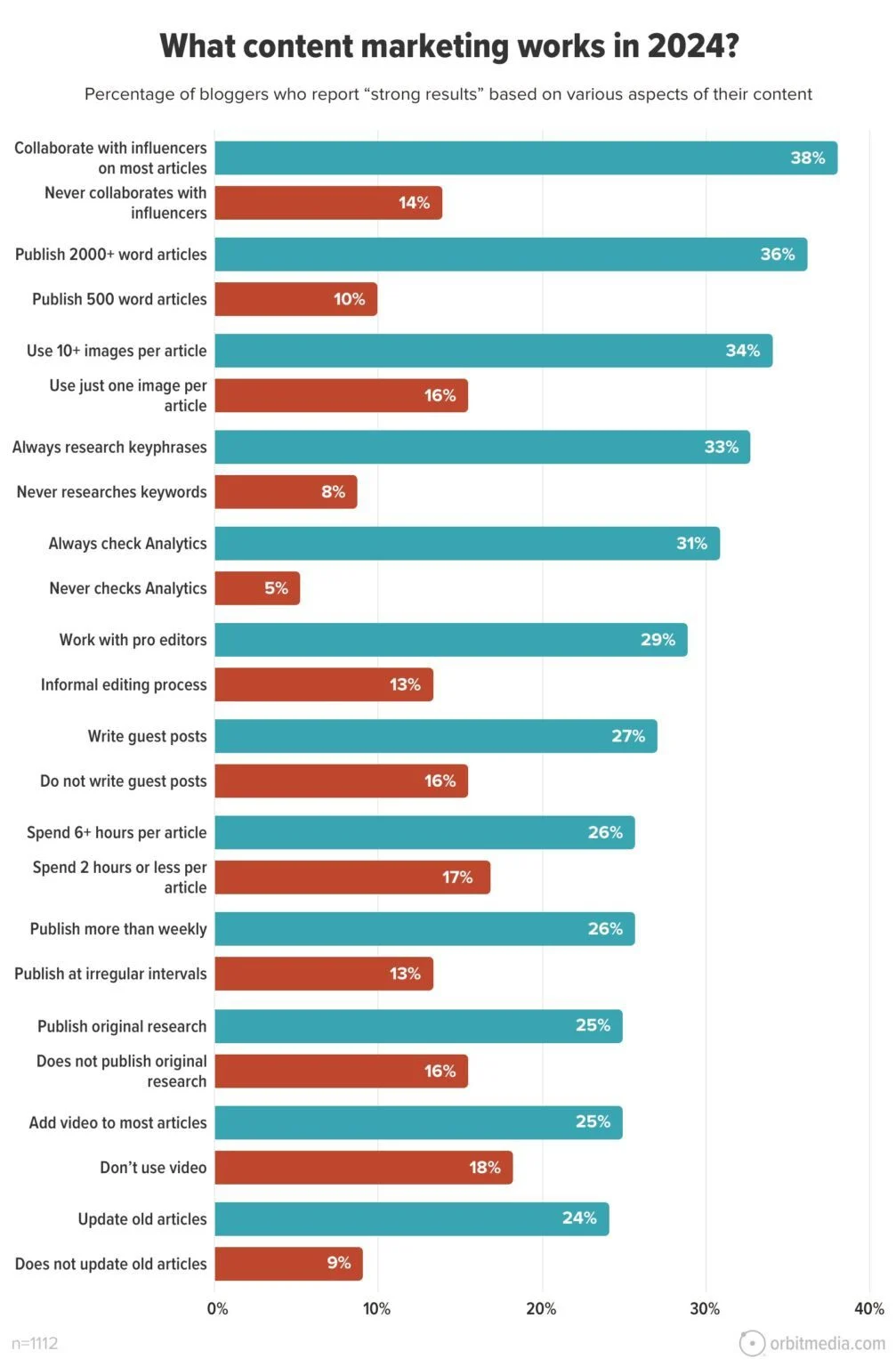
The survey highlights a clear correlation between effort and impact. The data shows that bloggers who consistently produce long-form content—specifically articles exceeding 2,000 words—are significantly more likely to report "strong results."
Furthermore, the data suggests that a bi-weekly cadence is the functional minimum for maintaining visibility and audience interest. However, volume is meaningless without strategic alignment. The most successful content programs are those that treat their blog not as a static repository of articles, but as a dynamic feed—much like a social media stream.

Key Performance Drivers:
- Original Research: Data-backed articles continue to outperform generic listicles.
- Collaboration: Working with guest experts and influencers remains a top-tier strategy for expanding reach.
- Multimedia Integration: The survey explicitly notes that podcasters and those incorporating video are twice as likely to report strong results.
- Strategic Distribution: Content is only as good as its reach. The data shows that relying solely on organic search is a losing game; high-performing blogs are diversifying into newsletters and community-driven platforms.
Official Insights: A Q&A with Andy Crestodina
To gain deeper context on these findings, we spoke with Andy Crestodina, CMO and Co-Founder of Orbit Media.
Q: What research findings were the most surprising to you personally?
"The data is telling us, year after year, that big efforts drive big outcomes," says Crestodina. "What is surprising is to see so many content programs sticking with the same low-effort, short-form posts on a monthly cadence. No research pieces, no collaboration, no guest posts, no video. If you aren’t doing these things, the data suggests you should set your expectations very low."
Q: The data suggests that podcasters are the most likely to report strong results. Why?
"It tracks perfectly with everything else that works," Crestodina notes. "Podcasters aren’t just typing on keyboards; they are collaborating with others and hitting the record button. They are inherently doing the extra work that makes content stand out. The podcast is a symptom of a higher-effort content strategy."

Q: Many bloggers are concerned that results—specifically traffic—are down. How should they measure success today?
"The most visible metrics are often the least important," Crestodina argues. "Traffic is easy to track, but it doesn’t always align with business outcomes. As search traffic becomes more volatile, marketers must look deeper. The most important outcomes—word-of-mouth, top-of-mind awareness, and bottom-of-funnel conversions—are harder to measure but significantly more valuable."
Implications for the Future of Content Marketing
The core implication of the 2024-2025 data is a necessary pivot in mindset. Content marketing leaders must stop chasing the "vanity metrics" of page views and start focusing on high-intent engagement.
1. Embrace the "Rented Land" Strategy
Crestodina’s #1 tip for 2025 is to stop worrying about the old rule of "not building on rented land." He suggests that LinkedIn newsletters are currently one of the most effective ways to reach an audience. By publishing content where the audience already lives, brands can gain visibility that is increasingly difficult to capture on a standalone website.

2. Redefine "Results"
If traffic is the only metric that matters, your content strategy will likely fail as AI search changes the game. Instead, align your content goals with:
- Assisted Conversions: How many prospects read an article before reaching out to sales?
- Sales Enablement: Are your blog posts being used by the sales team to answer client questions?
- Authority Building: Is the content positioning your brand as the primary expert in the field?
3. The Human-AI Hybrid Model
The data makes it clear: AI is not a replacement for strategy. The 80% of bloggers using AI must shift from "using AI to generate text" to "using AI to augment the human creative process." Use AI to handle the heavy lifting of data analysis, outlining, and formatting, but reserve the "human" time for synthesis, storytelling, and expert interviews.
Conclusion: Quality Over Convenience
The 11th Annual Blogger Survey serves as a reality check for the marketing industry. The era of "content at scale" (in the sense of mass-producing low-effort posts) is effectively over. The new baseline for success requires more time, more collaboration, and a more strategic approach to distribution.

As we look toward 2025, the winners will be those who stop treating their blog as a simple SEO checkbox and start treating it as a high-value, high-effort media channel. Whether through podcasts, original research, or strategic social newsletters, the message is clear: if you want strong results, you have to do the work that others are unwilling to do.
For further reading and to view the full, detailed results of the study, we encourage you to explore the full report from Orbit Media.