The Holistic Framework: Mastering Agentic AI Fine-Tuning in 2026
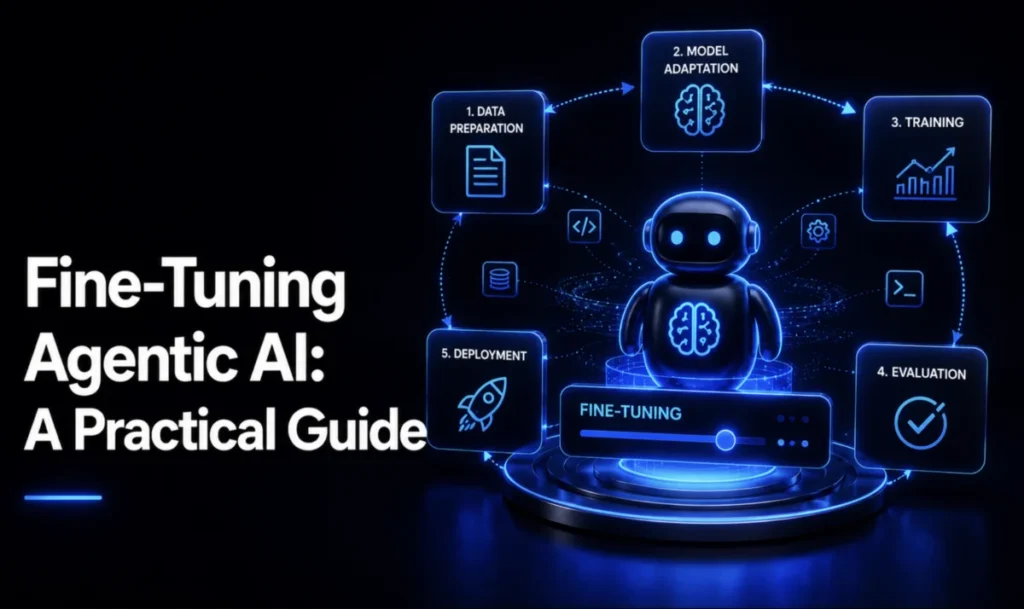
In the rapidly evolving landscape of 2026, the challenge of building reliable AI agents has shifted from simple prompt engineering to the complex, multifaceted discipline of holistic fine-tuning. While frontier base models have achieved remarkable proficiency in general instruction-following, they often falter when tasked with high-stakes, tool-reliant enterprise workflows.
The industry has reached a consensus: agentic AI is not merely a "model" problem; it is a system-level engineering challenge. Success requires the synchronization of four distinct, critical "dials": high-fidelity training data, efficient parameter adaptation, precision-tuned runtime hyperparameters, and nuanced preference alignment. This article provides a comprehensive guide to navigating these levers to move your agent from a volatile prototype to a robust production system.
The Architecture of Agentic Failure
Most developers stumble because they treat fine-tuning as a monolithic task. They focus on the base model, ignoring the fact that a perfectly trained agent can still fail in production due to an incorrect runtime temperature or a lack of preference-based refinement.
In our model case study—a support-ticket triage agent designed to manage lookup_order, issue_refund, and escalate_to_human—the difference between success and failure often comes down to the synergy between these components. If you train a model on a poorly structured tool-calling dataset, it will hallucinate function names regardless of how many parameters you tune. Conversely, a perfectly trained model shipped with an unoptimized temperature will struggle with deterministic output, leading to cascading logic errors.
1. Building the Tool-Calling Fine-Tuning Dataset
Format is the currency of agentic performance. A base model already possesses the linguistic fluency to explain refund policies; what it lacks is the precision to emit syntactically exact tool calls with consistent argument naming.
Data Quality Over Quantity
In modern fine-tuning, the era of "more is better" has been superseded by "structure is everything." A few hundred examples that strictly adhere to your tool schema will consistently outperform thousands of loosely formatted entries.
The Validation Imperative:
Before a single training epoch begins, your dataset must undergo rigorous schema validation. Using a validator function, such as the one implemented in our triage agent, ensures that every assistant message containing a tool_call strictly matches your defined function signature. This step prevents the model from learning "hallucinated" arguments—a mistake that is prohibitively expensive to diagnose after a training run is completed.
2. Parameter-Efficient Fine-Tuning (PEFT) with QLoRA
With a validated dataset secured, the industry standard for efficiency is Quantized Low-Rank Adaptation (QLoRA). By freezing the base model in 4-bit precision and training small, low-rank adapter matrices, teams can fine-tune 70B-class models on hardware that would otherwise be unable to accommodate a full training run.
The Science of the Adapter
The core hyperparameter to master here is the rank (r), which governs the expressivity of the adapter. A lower rank reduces the risk of overfitting, while a higher rank allows for more complex behavioral shifts.
- lora_alpha: This acts as a scaling factor for the adapter’s contribution to the frozen weights.
- lora_dropout: Essential for regularization when working with smaller datasets.
Peer-reviewed configurations, such as the r=4, alpha=32, dropout=0.05 setup, have proven highly effective for tool-calling agents. By isolating the trainable parameters to roughly 1.7% of the total model footprint, QLoRA ensures that the agent learns the required tool-calling behavior without destroying the base model’s underlying reasoning capabilities.
3. Tuning Runtime Hyperparameters
Perhaps the most overlooked phase of the lifecycle, inference-time configuration determines whether your model succeeds in the field.
The Temperature-Retry Paradox
Even the most sophisticated agents are susceptible to non-deterministic errors when configured with high temperatures. Our research indicates that as temperature increases, the baseline error rate for tool calling rises. However, rather than defaulting to a restrictive temperature of 0.0, the most robust systems implement a "retry policy."
By allowing the agent a single, deterministic retry at a temperature of 0.0 following a failed call, we observed success rates climb to over 98.7%. This proves that runtime logic—managing how an agent responds to its own errors—is often a more cost-effective lever than further training.
4. Aligning Agent Behavior with DPO
Supervised Fine-Tuning (SFT) can teach an agent that a tool call is correct, but it fails to teach the nuance of judgment. If a customer requests a $3,200 refund with ambiguous reasoning, SFT might teach the model that calling issue_refund is "correct" because it fits the format. However, it cannot discern that escalate_to_human is the superior judgment call.
Direct Preference Optimization (DPO) closes this gap. By training on pairs of responses—a "chosen" (optimal) and a "rejected" (suboptimal)—the model learns to prioritize human-centric policy outcomes over mere mechanical execution. Implementing a validate_pairs function is essential here, as it catches degenerate data pairs where the chosen and rejected responses are identical, preventing the waste of training resources.
Evaluation Discipline: The "Ship or Hold" Verdict
The final, and most unglamorous, step is the evaluation of your agent. This is where you must actively guard against "catastrophic forgetting," a phenomenon where the model learns your new tool-calling tasks but loses its broader reasoning capabilities.
The Verdict Function
You should move away from viewing evaluation as a collection of static metrics and toward a definitive "Verdict Function." By setting a hard threshold for performance—such as a 3% limit on general capability degradation—you can programmatically force a "HOLD" on any model that shows signs of regression.
When evaluating, ensure you are testing against standardized benchmarks like MMLU or GSM8K alongside your specific agent tasks. A model that jumps from 61% to 94% in tool accuracy but drops 7 points in general reasoning is a failure, not a success. Only by forcing these two numbers to move in tandem can you safely deploy your agent into production.
Implications for Future Development
The shift toward holistic fine-tuning represents a maturing of the AI industry. We are moving away from the "black box" era where training was treated as a mystery and toward a paradigm where every aspect of the agent—from the structure of its training data to its runtime retry logic—is observable, measurable, and tunable.
For enterprise teams, the implications are clear: the agents of 2026 will not be defined by the size of their base models, but by the rigor of their engineering. By treating the four dials of fine-tuning as a single, integrated system, organizations can build agents that not only follow instructions but also demonstrate the reliability and judgment required for real-world autonomy.
The finish line of an AI project is not the training run; it is the moment the evaluation suite gives you the green light to ship. By internalizing this discipline, developers can bridge the gap between impressive demonstrations and production-grade software that holds up under the pressure of real user traffic.