NEW DELHI — The Indian space economy has crossed a pivotal Rubicon. What began as a domain strictly guarded by state monopoly and characterized by decades of painstaking institutional research has rapidly transformed into a vibrant, venture-backed commercial arena.
However, as homegrown spacetech startups reach unprecedented technical heights—placing rockets into orbit, patenting advanced imaging systems, and building the world’s largest 3D-printed rocket engines—the ecosystem faces a defining reality check. The era of pure technical experimentation and vision-driven pitches has officially given way to a relentless pursuit of commercial viability, market defensibility, and scalable revenues.
1. Main Facts: Funding Surges Amid a Quest for Commercial Reality
The Indian spacetech sector is navigating its most capital-intensive yet critical phase. According to market intelligence data, homegrown spacetech startups have already raised a staggering $252.9 million in the year so far, nearly doubling the total capital secured by the sector throughout the entirety of 2025.
This financial momentum is anchored by milestone funding rounds that have rewritten the playbook for Indian deeptech:
Skyroot Aerospace made history in May by securing a $60 million funding round, vaulting it into the unicorn club as India’s first spacetech unicorn. Shortly after, it etched its name in the global ledger by becoming the first Indian private entity to successfully place a rocket into orbit via its Vikram-1 mission. The company is now preparing for a much larger $200 million round.
Pixxel, a hyperspectral imaging startup backed by global heavyweights like Temasek, captured headlines earlier this month by closing a $100 million Series C round—the single-largest financing round ever raised by an Indian spacetech venture.
Despite these headline-grabbing numbers, venture capitalists and industry observers are increasingly raising a yellow flag. The rapid influx of institutional capital has triggered concerns over frothy valuations, limited revenues at scale, and a crowded startup landscape. Investors are pivoting away from simple proof-of-concept bets to evaluate whether these ventures can convert technical breakthroughs into durable, cash-flowing business models.
2. Chronology: From State Monopoly to Private-Sector Dynamism
The transformation of India’s space sector is best understood through the rapid chronology of regulatory reform, technological breakthroughs, and market maturation over the past decade:
2018–2019 (The Genesis): Early-stage investors evaluated foundational questions: Could private startups build satellites and propulsion systems out of India? Evaluations were heavily qualitative, focusing on founder pedigree and basic technical feasibility.
2020 (The Policy Pivot): The Indian government opened the space sector to private participation, establishing the Indian National Space Promotion and Authorisation Centre (IN-SPACe) to act as a single-window autonomous agency for enabling and regulating space activities.
2022–2024 (First Launch Milestones): Startups moved from drawing boards to launchpads. Skyroot launched India’s first privately developed rocket (Vikram-S), while Agnikul Cosmos successfully tested its sub-orbital vehicle powered by 3D-printed engines.
2025 (The Scale-Up & Capital Crunch): Funding crossed previous thresholds, but early cracks appeared regarding the gap between high valuations and verified market demand.
2026 (The Commercialisation Era): Funding skyrocketed past $250 million. Key regulatory funds began deployment, and startups faced intense pressure to demonstrate real-world utility, foreign enterprise adoption, and sustainable unit economics.
3. Supporting Data & Institutional Backing
The unprecedented capital surge is not merely a product of private venture enthusiasm; it is heavily catalyzed by a coordinated state policy push aimed at expanding India’s footprint in the global space economy.
Macro Projections and State Funds
Earlier this year, Union Minister of State (MoS) Dr. Jitendra Singh estimated the size of India’s space economy at approximately $9 billion, projecting an aggressive expansion to $45 billion over the next decade.
To fuel this trajectory, institutional capital has been unlocked via public-backed vehicles:
Antariksh Venture Capital Fund: IN-SPACe began deploying capital from this ₹1,600 Cr fund, making its maiden investment by backing Dhruva Space with a ₹60 Cr infusion.
RDI Fund: The state-backed ₹1 Lakh Cr Research, Development, and Innovation (RDI) fund allocated nearly ₹834 Cr to spacetech startups in its inaugural cohort.
Technological Breakthroughs
The market’s technical maturity is underscored by extraordinary engineering milestones achieved this year:
GalaxEye secured a landmark US patent for its proprietary OptoSAR satellite imaging technology, becoming the first Indian startup to achieve this intellectual property milestone.
Agnikul Cosmos successfully completed a test firing of its Agnite engine—showcasing India’s first semi-cryogenic engine and the largest single-piece 3D-printed rocket engine globally.
4. Official Responses & Expert Perspectives
As the sector matures, venture capitalists and institutional investors are increasingly vocal about where value truly resides across the space value chain, warning against the perils of market FOMO (Fear Of Missing Out).
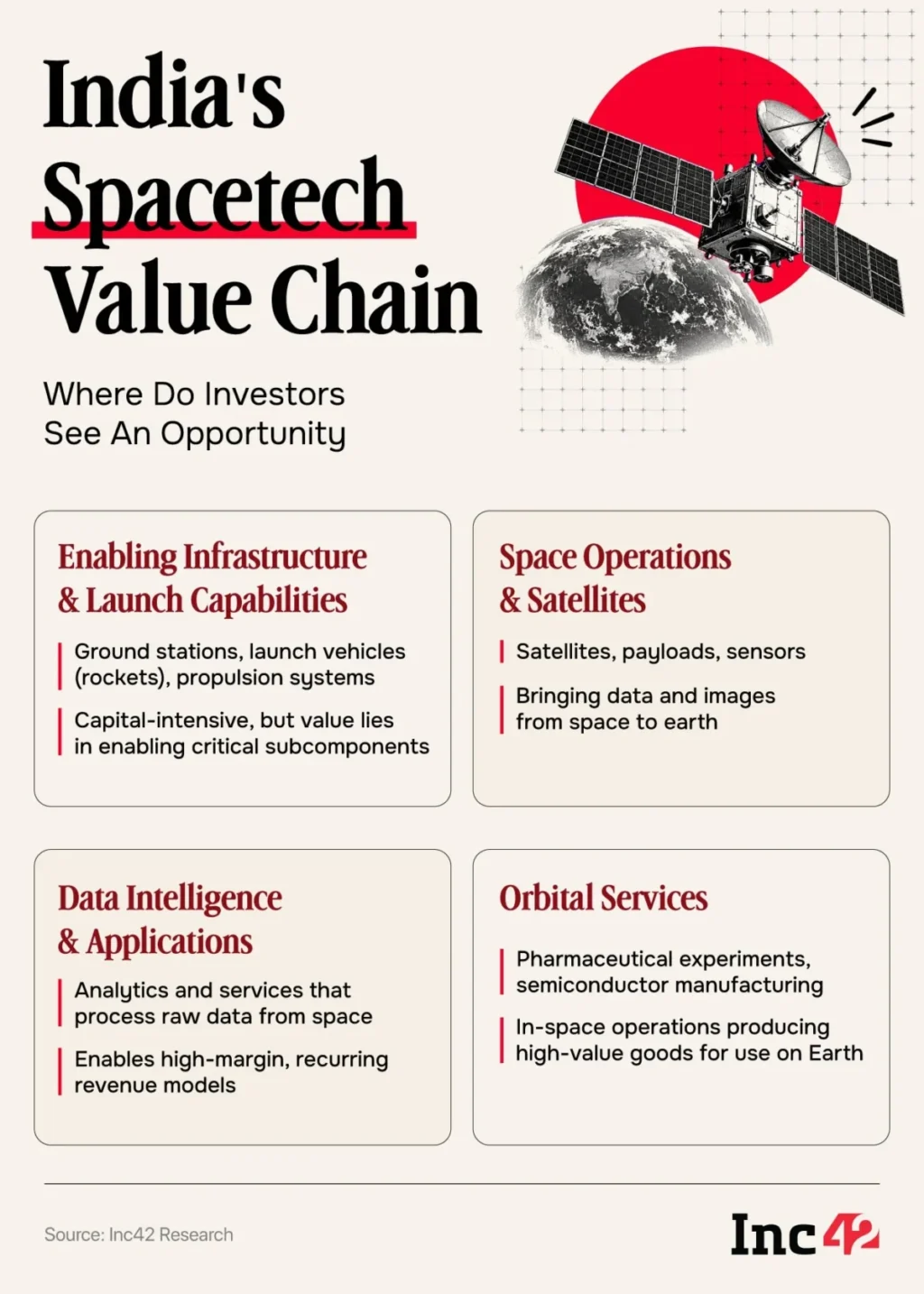
The Value Chain Divide: Upstream vs. Downstream
The space economy is broadly divided into the upstream infrastructure layer (launch vehicles, ground stations, satellite manufacturing hardware) and the downstream data and applications layer.
Viju George, Partner at Mela Ventures, highlights the stark contrast in revenue predictability between these layers:
"Revenue models in satellites tend to be very lumpy and capex-driven, whereas data streams tend to be high-margin recurring revenue."
While George views the upstream input layer as relatively commoditised, he points out that it remains investable through a "shovels approach"—supplying multi-purpose components like avionics and communication infrastructure rather than betting on a single rocket or satellite brand.
Ashish Taneja of GrowX Ventures, an early backer of Pixxel, underscores that the earth observation segment represents a massive market opportunity, noting that the infrastructure layer remains fundamentally supply-constrained. However, Taneja sounds a note of caution regarding market exuberance:
"I worry about the valuations because now somehow we are in the FOMO zone… The risk is whether you are paying a little bit more for market demand that is not yet evident."
Demanding Rigorous Metrics
The evaluation criteria for funding have undergone a seismic shift. Early-stage investors historically rewarded technical promises; growth-stage investors, however, demand hard evidence.
"Early-stage investors like to see milestones because we think they are the precursor to valuations and revenues. But once growth investors come in, they like to see tangible metrics," notes Mela Ventures’ George.
“I want a precise use case. I want clarity on the use case. I want a differentiated solution which is defensible in the long run,” adds GrowX’s Taneja.
5. Implications: Navigating the Road to Sustainable Growth
The transition from a subsidized, state-backed aerospace model to a competitive commercial ecosystem introduces distinct risks and structural challenges that will shape the survival of India’s spacetech startups.
Capital-Intensive Risks and Hardware Realities
Space hardware inherently carries extreme technical, manufacturing, and operational risks. Satellites are generally engineered for a functional lifespan of five to six years. However, because India’s private constellation deployments are relatively young, the industry lacks comprehensive historical performance data to verify how reliably newer constellations will operate over their projected life cycles.
Furthermore, because domestic launch capacity and commercial payload deployment are still scaling up, venture capitalists are finding it exceptionally challenging to benchmark predictable revenues against massive capital expenditures.
Moving Beyond Government Anchors
To achieve genuine financial sustainability, Indian spacetech startups must outgrow their reliance on domestic government bodies and institutional anchor buyers (such as ISRO). To justify their current valuations, these companies must successfully penetrate international commercial markets and secure foreign sovereign buyers.
Doing so will require ruthless optimization of costs, unwavering reliability, and world-class performance metrics. Industry veterans predict that this competitive crucible will inevitably drive consolidation.
"Not many people will make the cut," warns GrowX’s Taneja, predicting that well-capitalized, vertically integrated space infrastructure giants will eventually absorb smaller, single-product startups.
The Path Forward: Public Markets and Liquidity
As private funding pools remain relatively constrained relative to the massive capital requirements of space hardware, public markets are expected to play an increasingly vital role. For early investors, long development cycles are yielding massive returns when executed correctly—exemplified by GrowX realizing a 17X outcome over five years following a partial stake sale during Pixxel’s recent $100 million fundraise.
Ultimately, the philosophical thesis governing Indian spacetech has matured. The industry has proven that it possesses the intellect and the engineering prowess to reach the stars. The definitive test of this decade will not be technological ambition, but whether these enterprises can convert their stellar milestones into enduring, profitable, and globally competitive business models.