India-UAE Strategic Partnership: A $100 Billion Vision for Economic Integration
Introduction: A New Era of Strategic Economic Alignment
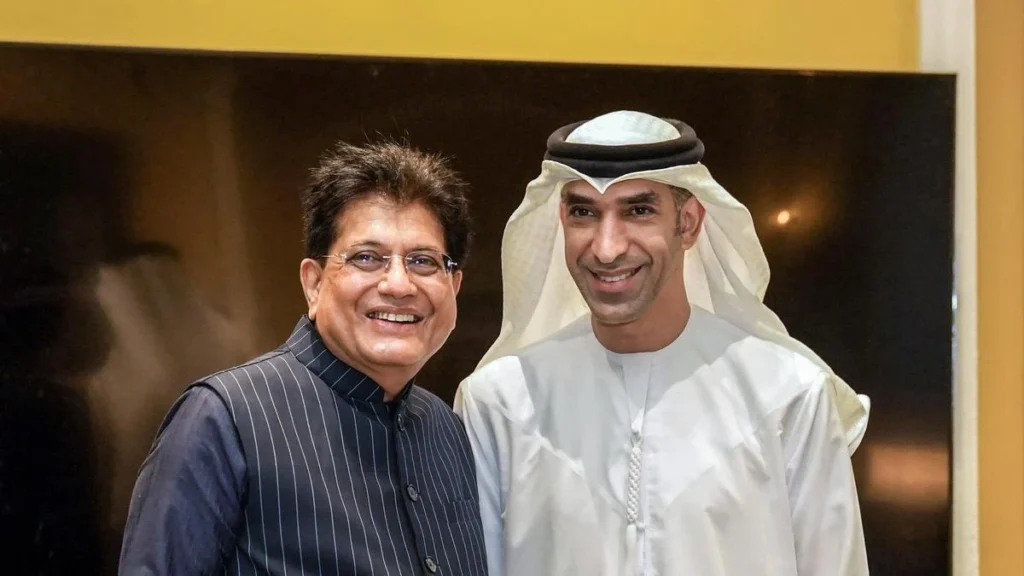
On Monday, September 28, 2026, the bilateral relationship between India and the United Arab Emirates (UAE) reached a significant milestone. During the 14th session of the India-UAE High-Level Joint Task Force on Investments, Union Commerce and Industry Minister Piyush Goyal announced a transformative commitment: the UAE intends to channel an additional $25 billion into the Indian economy in the near term.
This announcement marks a pivotal escalation in what has become one of the world’s most dynamic economic partnerships. As global geopolitical landscapes shift, the deepening integration between New Delhi and Abu Dhabi represents a strategic pivot toward mutual energy security, maritime infrastructure, and high-tech cooperation. With a long-term goal of reaching $100 billion in total cumulative investments, the UAE is positioning itself not merely as a partner, but as a foundational pillar of India’s projected industrial growth.
The Chronology of Growing Ties
The partnership between India and the UAE has been characterized by accelerated momentum over the past few years. The recent high-level task force meeting, co-chaired by Minister Goyal and Sheikh Hamed bin Zayed Al Nahyan, Managing Director of the Abu Dhabi Investment Authority (ADIA), served as a checkpoint for the successes of the Comprehensive Economic Partnership Agreement (CEPA).
- Foundation: The two nations have historically maintained strong trade links, but the formalization of the CEPA shifted the relationship from traditional commerce to deep-tier capital investment.
- 2024-2025: The period saw a surge in institutional capital from the UAE, with entities like the International Holding Company (IHC) and Emirates NBD making landmark acquisitions.
- September 2026: The 14th Joint Task Force meeting formalized the intent for the next $25 billion tranche of investment. This meeting focused on resolving implementation bottlenecks for existing agreements while expanding the scope of collaboration into nascent sectors like space technology and artificial intelligence.
Supporting Data: The Anatomy of a $100 Billion Roadmap
The ambition to reach a $100 billion investment milestone is supported by hard data and tangible financial flows. Currently, the UAE stands as the seventh-largest source of Foreign Direct Investment (FDI) into India, with approximately $25 billion already deployed.
Recent Capital Injections
The confidence of UAE investors is best reflected in recent, high-profile capital allocations:
- RBL Bank Acquisition: In June 2026, Emirates NBD successfully finalized a $2.75 billion investment, securing a majority stake. This move is viewed as a strategic entry into India’s robust retail and private banking sector.
- Sammaan Capital: The International Holding Company (IHC) has committed roughly $1 billion to acquire a controlling stake, signaling deep interest in India’s non-banking financial sector.
Trade Targets
Beyond investment, the two nations are aggressively targeting trade growth. Having already surpassed the $100 billion threshold in annual bilateral trade, the countries have committed to doubling this figure to $200 billion by 2032. Minister Goyal noted that India’s merchandise exports have shown a robust growth trajectory, rising over 15% in the first half of the current fiscal year, reinforcing the feasibility of these ambitious targets.
Official Responses and Strategic Priorities
The discussions held in the task force meeting were expansive, covering everything from regulatory harmonization to the use of local currencies in bilateral trade.
The Maritime and Infrastructure Frontier
A primary outcome of the September meeting was the creation of a bilateral working group dedicated to maritime cooperation. This group will oversee six critical areas:
- Ship Ownership: Facilitating UAE fleet expansion in Indian waters.
- Modern Port Development: A direct response to India’s need to double its port capacity over the next decade.
- Manufacturing and Repair: Establishing India as a hub for ship maintenance and container manufacturing.
- Ship Breaking: Adopting international environmental standards for sustainable recycling.
Minister Goyal explicitly identified the upcoming Vadhavan port in Maharashtra as a flagship project where UAE expertise and capital could prove transformative. "India’s port capacity has doubled over the last decade," Goyal remarked, "and we must double it again. The UAE is looking at our ports, our shipbuilding capabilities, and our startups with a level of seriousness that signals a long-term belief in the India story."
Energy Security and Future-Proofing
Energy remains the lifeblood of the India-UAE relationship. Beyond the traditional supply of hydrocarbons, the two nations are exploring:
- Strategic Petroleum Reserves: Expanding India’s storage capacity through joint ventures.
- Subsea Pipelines: A feasibility study is currently underway to assess the viability of transporting gas directly to India via subsea infrastructure, which would drastically reduce transit risks and costs.
- Renewables and LNG: Increasing the supply of Liquefied Natural Gas (LNG) to fuel India’s industrial expansion.
Implications: A Model for Regional Stability
The strengthening of this partnership has profound implications for both nations and the broader global economy.
1. Navigating Geopolitical Uncertainty
While Minister Goyal maintained that the task force meeting remained focused on economics rather than geopolitical tensions, the underlying context is clear. By deepening ties in energy security and maritime trade, India and the UAE are creating a resilient framework capable of withstanding global supply chain disruptions. The emphasis on "local currency settlement" for trade is a direct move toward de-risking bilateral commerce from fluctuations in global currency markets.
2. Technological Leapfrogging
The move into space technology and AI is a new, sophisticated chapter in the relationship. By focusing on "orbital debris" management and fintech-driven financial services, the UAE and India are moving beyond the "buyer-seller" dynamic. They are now co-developing solutions. This collaborative innovation is expected to filter down to MSMEs and startups, allowing Indian companies to access Gulf capital and markets with greater ease.
3. Food Security and Agri-Innovation
A critical, often overlooked aspect of the discussions was the focus on food processing. By integrating UAE investment into Indian food branding and quality control, the partnership aims to elevate Indian agricultural exports. This is expected to provide Indian farmers with a direct pipeline to Gulf consumers, ensuring better price realization and reducing post-harvest losses through modern packaging and cold-chain logistics.
Conclusion: The Path Ahead
The 14th India-UAE High-Level Joint Task Force has set a blueprint that moves far beyond basic trade. With Prime Minister Narendra Modi and UAE President Sheikh Mohamed bin Zayed Al Nahyan having met four times in the past year alone, the political will to sustain this momentum is unprecedented.
As India marches toward its goal of $1 trillion in annual exports, the partnership with the UAE serves as a vital engine. The $25 billion commitment is not just a capital figure; it is a vote of confidence in India’s regulatory landscape and economic trajectory. For the UAE, the partnership provides a diverse, high-growth investment destination that is essential for its own economic diversification efforts.
In the coming decade, as the world navigates the complexities of energy transition and the digital revolution, the India-UAE corridor stands out as a template for how two sovereign nations can achieve strategic autonomy through economic interdependence. Whether through the construction of the Vadhavan port or the integration of subsea gas pipelines, the future of this partnership is clearly defined by shared growth, technological collaboration, and a relentless focus on the $100 billion investment objective.