The Architecture of Speed: Mastering LLM Inference Optimization for Production
In the rapidly evolving landscape of generative artificial intelligence, moving a Large Language Model (LLM) from a research notebook to a high-traffic production environment is the defining challenge for modern engineering teams. While achieving high-quality output is a solved problem for most, maintaining that quality at scale—while keeping latency low and costs manageable—is where most systems falter.
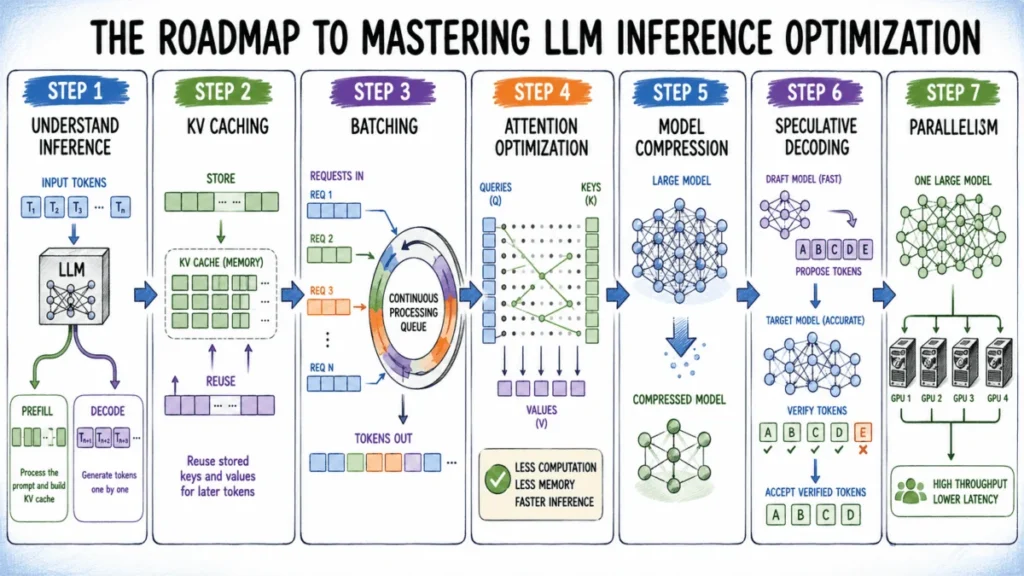
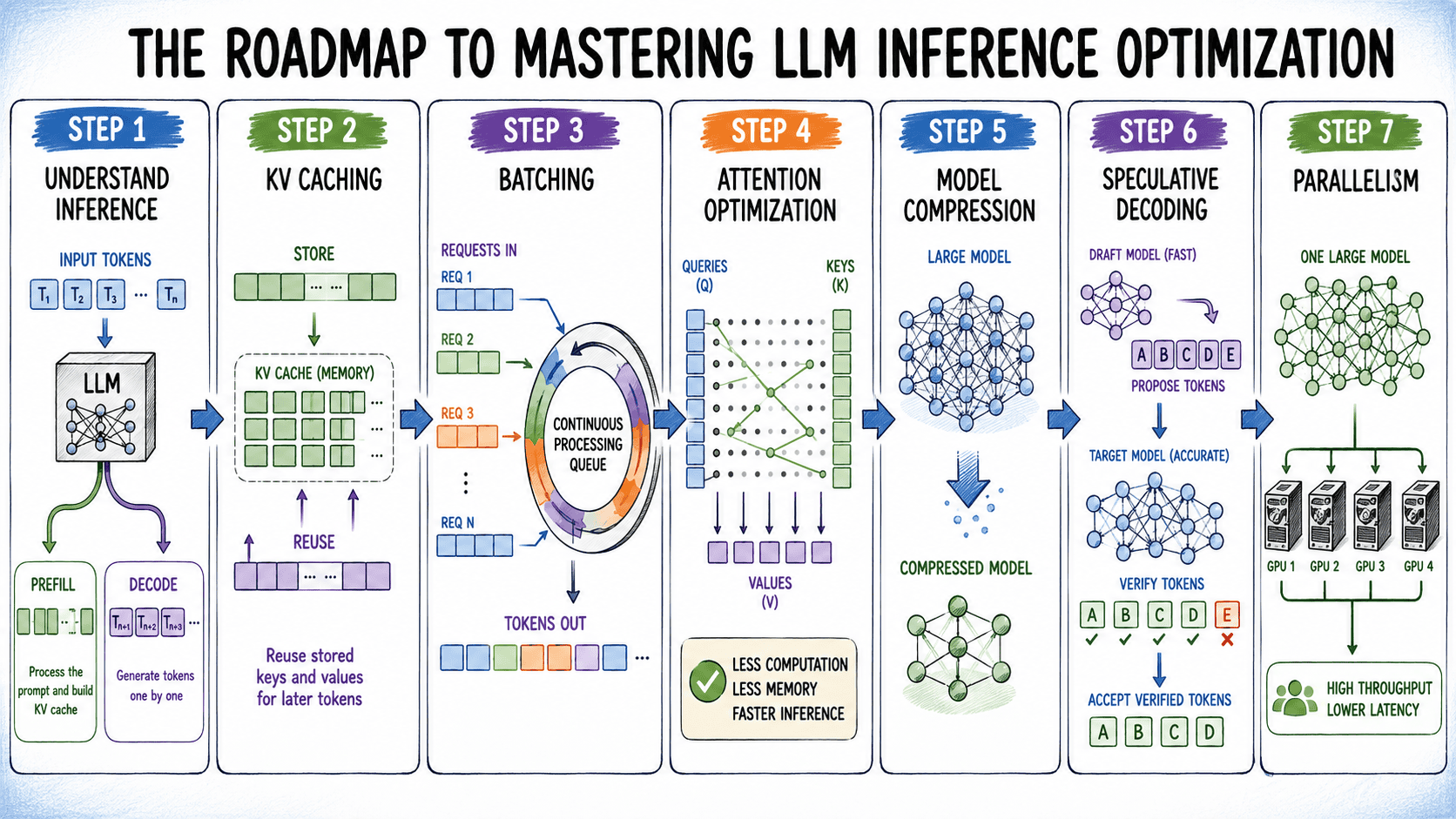
Inference optimization has emerged as a specialized discipline, focused on closing the gap between raw model capability and operational efficiency. It is the art of making the same model serve more requests, faster, and at a lower cost, all without altering the model’s fundamental intelligence or requiring expensive retraining. This guide provides a comprehensive roadmap for optimizing LLM inference, from the foundational mechanics of the decoder to advanced distributed computing strategies.
The Two-Phase Inference Process: A Technical Foundation
To optimize an LLM, one must first understand the life cycle of a single request. Every forward pass through a decoder-only LLM is bifurcated into two distinct phases, each presenting unique performance bottlenecks.
The Prefill Phase
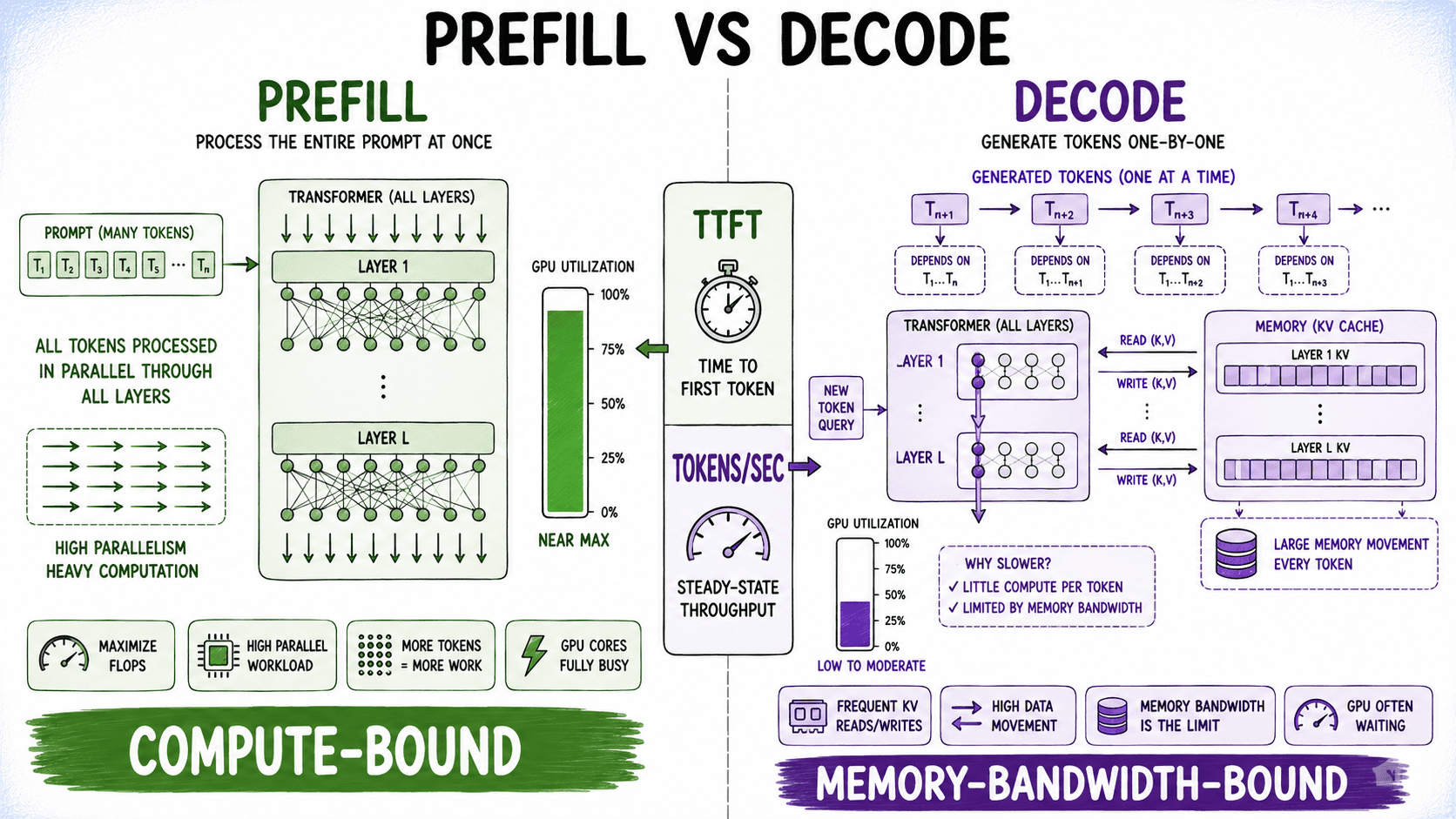
When a user submits a prompt, the model processes the entire input sequence simultaneously. This stage computes the intermediate key and value tensors necessary to generate the first output token. Because the entire input is known upfront, the GPU can parallelize this computation across its cores, effectively saturating compute capacity. Consequently, the prefill phase is compute-bound. The efficiency here dictates your "Time-to-First-Token" (TTFT), a critical metric for user-perceived responsiveness.
The Decode Phase
Once the first token is generated, the model enters the decode phase. Here, generation becomes autoregressive: each new token depends on all previously generated tokens. Because each token must be produced one by one, the GPU cannot parallelize the generation process in the same way it does for prefill. The bottleneck shifts from compute to memory; the GPU spends the vast majority of its time fetching weights and KV cache values from high-bandwidth memory (HBM). Thus, the decode phase is memory-bandwidth-bound.
Understanding this distinction is critical. If your application requires low-latency chat, you are optimizing for TTFT (prefill). If your application requires high-volume document summarization, you are likely optimizing for tokens-per-second (decode).
The Memory Bottleneck: KV Caching and Its Evolution
The most significant hurdle in the decode phase is the KV cache. By storing the intermediate key and value tensors for previous tokens, the system avoids redundant recomputation. However, this convenience comes at a heavy price: memory consumption.
The Problem with Naive Caching
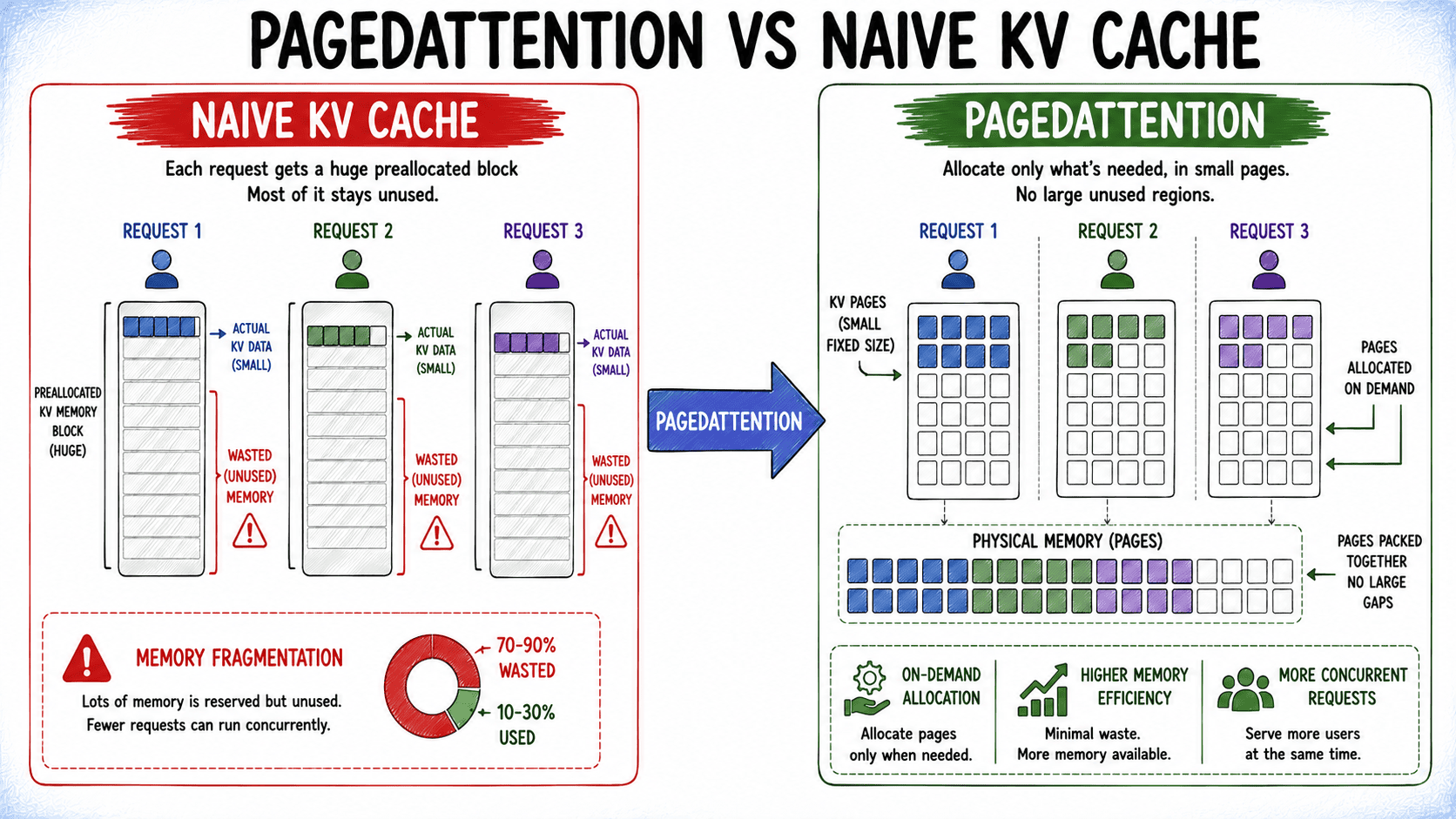
In a traditional implementation, the KV cache grows linearly with sequence length and batch size. For a 7B parameter model, a long-context request can consume gigabytes of VRAM. If memory is allocated for the maximum possible sequence length upfront, the system suffers from severe internal fragmentation, drastically limiting how many concurrent requests can be handled.
PagedAttention and Prefix Caching
Modern runtimes like vLLM have revolutionized this through PagedAttention. Borrowing a concept from virtual memory management in operating systems, PagedAttention divides the KV cache into fixed-size blocks. These blocks can be allocated non-contiguously on demand. This virtually eliminates memory waste, allowing for significantly higher batch sizes.
Complementing this is Prefix Caching. In scenarios where many requests share a common prompt (e.g., a shared system prompt or a RAG pipeline querying a large document), the KV cache for that common prefix can be computed once and stored in the cache. This removes redundant computations for every incoming request, saving both GPU cycles and latency.
Scaling Throughput via Advanced Batching
GPU utilization is the primary driver of cost-efficiency. If a GPU is processing only one request at a time, it is largely idle, as the overhead of loading model weights is not amortized across enough work.
From Static to Continuous Batching
- Static Batching: The traditional, inefficient method of waiting for a fixed number of requests before initiating a forward pass. This fails in real-world scenarios because different requests have different output lengths; the entire batch is held hostage by the longest-running request.
- Continuous (In-Flight) Batching: The current industry standard. This technique decouples the batch from the request lifecycle. As soon as one sequence finishes, its slot is immediately filled by a new incoming request. This ensures that the GPU remains saturated with active computations, maintaining high throughput even under highly variable traffic conditions.
Architecture-Level Optimizations: Attention Variants
The attention mechanism is the most computationally expensive component of the Transformer architecture. Optimizing it directly yields outsized performance gains.
Multi-Query (MQA) and Grouped-Query Attention (GQA)
Standard Multi-Head Attention (MHA) maintains separate key and value heads for every query head, which is memory-intensive. MQA simplifies this by having all query heads share a single set of key and value heads. GQA offers a middle ground, grouping query heads to share a subset of KV heads. Both methods drastically reduce memory traffic during the decode phase, which is essential for performance, though they typically require the model to be trained or fine-tuned with these specific architectures.
FlashAttention
Unlike architecture changes, FlashAttention is a drop-in software optimization. It reorders the attention computation to keep intermediate values in fast on-chip SRAM rather than writing them to slow global GPU memory. By reducing the number of memory reads and writes, FlashAttention provides significant speedups without requiring any model retraining or loss of mathematical accuracy.
Model Compression: Shrinking the Footprint
When hardware constraints prevent the deployment of a full-precision model, compression techniques allow for the deployment of high-performing models on more modest hardware.
- Quantization: Reducing the numerical precision of weights (e.g., from FP16 to INT4). This can reduce memory usage by 75% with negligible degradation in output quality. Techniques like GPTQ and AWQ are now standard for deploying massive models on consumer-grade or mid-tier enterprise GPUs.
- Sparsity: Leveraging the fact that many weights in a model are near-zero. Using structured sparsity, such as the 2:4 ratio supported by NVIDIA’s Ampere architecture, allows hardware to skip computations for zero-valued weights, effectively doubling throughput.
- Knowledge Distillation: Instead of compressing a model, you train a smaller "student" model to mimic the output distribution of a larger "teacher" model. This is often the most effective path for latency-critical applications.
Latency-Critical Innovation: Speculative Decoding
Speculative decoding is a clever way to break the autoregressive bottleneck. By using a small, extremely fast "draft" model to guess the next few tokens, and then using the large, accurate "verification" model to check those guesses in parallel, one can generate multiple tokens in a single forward pass. If the draft model is accurate, the latency is slashed significantly. This technique is particularly potent for interactive chat applications where the sequence length is short and individual user latency is the primary metric for success.
Scaling with Parallelism
When a model is too large to fit in the memory of a single GPU, or when throughput requirements exceed the capacity of one device, engineers turn to parallel strategies:
- Tensor Parallelism: Distributing individual layers across multiple GPUs. This is ideal for reducing latency by spreading the compute load.
- Pipeline Parallelism: Splitting the model vertically, with different GPUs responsible for different layers. While effective for massive models, it is susceptible to "pipeline bubbles," where GPUs wait for the previous stage to finish.
- Prefill-Decode Disaggregation: A cutting-edge pattern where the prefill and decode stages are routed to entirely different hardware clusters. Because prefill is compute-heavy and decode is memory-heavy, this separation allows for optimal resource utilization, preventing a surge in long-context prefill tasks from stalling the decode pipeline for other users.
Conclusion: The Path Forward
Optimizing LLM inference is not a one-size-fits-all endeavor. It is a layered approach that requires a deep understanding of hardware bottlenecks and model architecture. The process begins with profiling: determine whether your specific workload is constrained by memory bandwidth or raw compute, and whether your priority is TTFT or total throughput.
By implementing these strategies—from the memory-efficient PagedAttention to the latency-slashing Speculative Decoding—organizations can bridge the gap between experimental AI and robust, scalable production systems. As hardware continues to advance, the focus will increasingly shift toward these software-driven optimizations, making them the most critical skills for any AI engineer operating in the modern enterprise.