The Sovereign AI Stack: Building a Zero-Cost, Private Agentic Workflow with Hermes and Ollama
In an era where artificial intelligence is rapidly becoming the backbone of professional productivity, a significant barrier to entry persists: the "privacy tax." For developers, researchers, and hobbyists alike, the standard path for utilizing advanced AI agents—such as those capable of executing code, searching the web, and manipulating files—involves offloading sensitive data to cloud-based APIs. This reliance not only incurs significant recurring costs, ranging from $0.60 to $20 per session depending on the complexity of the task, but also forces users to relinquish control over their proprietary codebases and private conversations.
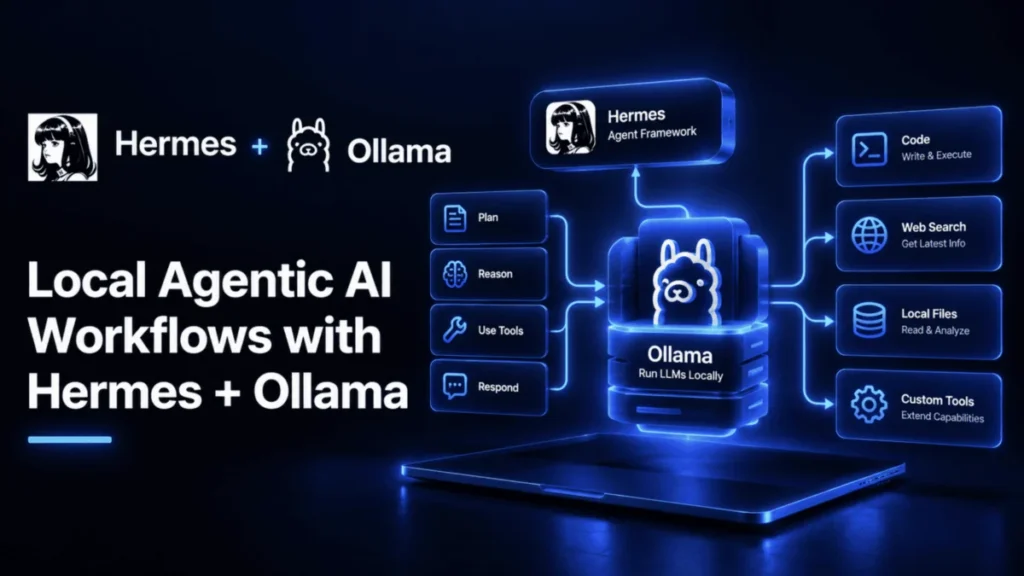
However, a paradigm shift is underway. By integrating the Hermes Agent, an open-source framework developed by Nous Research, with Ollama’s robust local model-serving architecture, users can now construct a fully sovereign, zero-cost agentic workflow. This article explores how to reclaim your digital sovereignty by moving your AI operations entirely onto your own hardware.
The Architecture of Local Autonomy
The core of this self-hosted AI revolution lies in the division of labor between two distinct, highly specialized tools.
Hermes Agent functions as the "brain" and the "hand." Unlike standard LLM interfaces that merely provide text-based responses, Hermes is designed to interact with your operating system. It possesses the capability to edit local files, execute terminal commands, conduct web searches, and delegate sub-tasks to specialized agentic modules. Released under the MIT license, its architecture prioritizes persistent memory, allowing the agent to "learn" your project workflows over time.
Ollama serves as the "engine." It is the industry-standard tool for downloading and managing open-weight models locally. By providing an OpenAI-compatible API endpoint at localhost:11434, Ollama allows the Hermes Agent to interface with powerful models—such as Gemma or Llama—as if it were communicating with a cloud-based server. This interoperability is the linchpin of the entire system; it allows users to swap out models or providers without reconfiguring their primary agentic setup.
Chronology: From Installation to Autonomous Operation
Building a private agentic stack requires a methodical approach, moving from base-layer infrastructure to high-level automation.
Phase 1: Infrastructure Deployment
The initial step involves installing Ollama. A simple command-line execution (curl -fsSL https://ollama.com/install.sh | sh) deploys the server. Once operational, the user must select a model that supports "tool calling." This is a critical technical distinction: a model that cannot call tools is merely a chatbot. For agents intended to perform file system operations, selecting a model with high reasoning capabilities—such as the 31B parameter variants—is non-negotiable.
Phase 2: Configuring the Hermes Gateway
Once the Ollama endpoint is active, the Hermes Agent is pointed toward http://localhost:11434/v1. By editing the ~/.hermes/config.yaml file, users can define their preferred provider as "custom," effectively tethering the agent to their local compute resources. At this stage, the agent becomes capable of executing commands like "List all Python files and calculate their line counts" or "Summarize the project README."
Phase 3: Scaling and Remote Access
The final stage of implementation involves extending the agent’s reach. By configuring the Hermes platform settings, users can link their local instance to a Telegram bot. This allows the user to interact with their local, private files from a mobile device while away from their workstation, all while the processing remains strictly confined to the host machine.
Supporting Data: Hardware Requirements and Performance Metrics
The viability of a local agentic workflow is dictated by the user’s hardware. While CPU-only execution is technically possible, it is rarely optimal for interactive work.
| Component | Minimum Specification | Recommended Specification |
|---|---|---|
| RAM | 8 GB (for 3B models) | 32+ GB (for 27B+ models) |
| Storage | 5 GB free | 30+ GB (for model variations) |
| CPU | 4 cores | 8+ cores |
| GPU | Not required | NVIDIA GPU with 8+ GB VRAM |
Performance varies significantly based on the model size. A 9B model on a modern 8-core CPU may yield roughly 10 tokens per second (TPS), which is sufficient for real-time conversation. However, larger 31B models, which are necessary for complex code refactoring and multi-step agentic reasoning, may drop to 2–5 TPS on CPU-only machines. The inclusion of an NVIDIA GPU significantly mitigates this, enabling "layer offloading" that accelerates response times, making the agent feel responsive rather than latent.
The Case for Hybrid Intelligence: Official Perspectives
Nous Research, the architects behind Hermes, emphasizes that the goal of local agentic workflows is not to necessarily banish cloud computing, but to "right-size" it. In their technical documentation, they advocate for a hybrid approach.
By configuring "fallback providers" within the Hermes configuration file, users can set their system to utilize a local model for 90% of tasks—such as file navigation, boilerplate code generation, and routine inquiries—while reserving cloud-based APIs (like Claude 3.5 Sonnet or GPT-4o) only for the most complex reasoning tasks. This strategy minimizes costs while ensuring that the "everyday" workflow remains entirely private and free.
Implications: The Shift Toward Digital Sovereignty
The transition toward local-first AI workflows has profound implications for data security and professional efficiency.
1. Data Privacy as a Default: When code, internal documents, and private correspondence never leave the local environment, the risk of data leaks—common in cloud-based AI workflows—is effectively eliminated. This is particularly crucial for developers working with proprietary source code or enterprises handling sensitive client data.
2. Economic Sustainability: For a student or a freelance developer, the cost of cloud AI can quickly become prohibitive. By shifting to a zero-cost local stack, these users can run unlimited agentic iterations without the anxiety of "token usage" or subscription fees.
3. Resilience and Latency: An all-local system is immune to the outages that occasionally plague major AI providers. Furthermore, the absence of network round-trips for every prompt can significantly reduce latency in environments where local hardware is high-performance, such as workstations equipped with dedicated VRAM.
4. The "Skill" Accumulation: A unique feature of the Hermes architecture is its ability to learn and persist skills over time. Because the memory is stored locally, the agent develops a longitudinal understanding of the user’s projects. This creates a compounding effect: the more the agent is used, the more capable it becomes at navigating the specific idiosyncrasies of the user’s codebase.
Conclusion
The "Hermes + Ollama" stack represents the maturation of local AI. It moves beyond the novelty of running a chatbot on a laptop and enters the realm of practical, professional-grade automation. By managing the model locally, maintaining context with large 64k token windows, and selectively utilizing cloud fallbacks for only the most arduous tasks, users can build a system that is as powerful as it is private.
As we move toward a future where AI agents become our primary interface for work, the ability to control that intelligence—rather than renting it—will be the defining factor in productivity. The tools to build this sovereign infrastructure are available today, free of charge, and fully under your command. The era of "local-first" AI is not just coming; it is already here.