Tensions Escalate: Internet Suspended at Jantar Mantar as Nationwide Protests Erupt Against CEC Gyanesh Kumar
New Delhi | October 2, 2026
The political atmosphere across India reached a boiling point on Gandhi Jayanti, October 2, 2026, as widespread protests erupted against Chief Election Commissioner (CEC) Gyanesh Kumar. Following weeks of growing public and political dissatisfaction, the situation in the national capital turned volatile, with authorities resorting to the suspension of internet services around the Jantar Mantar protest site.
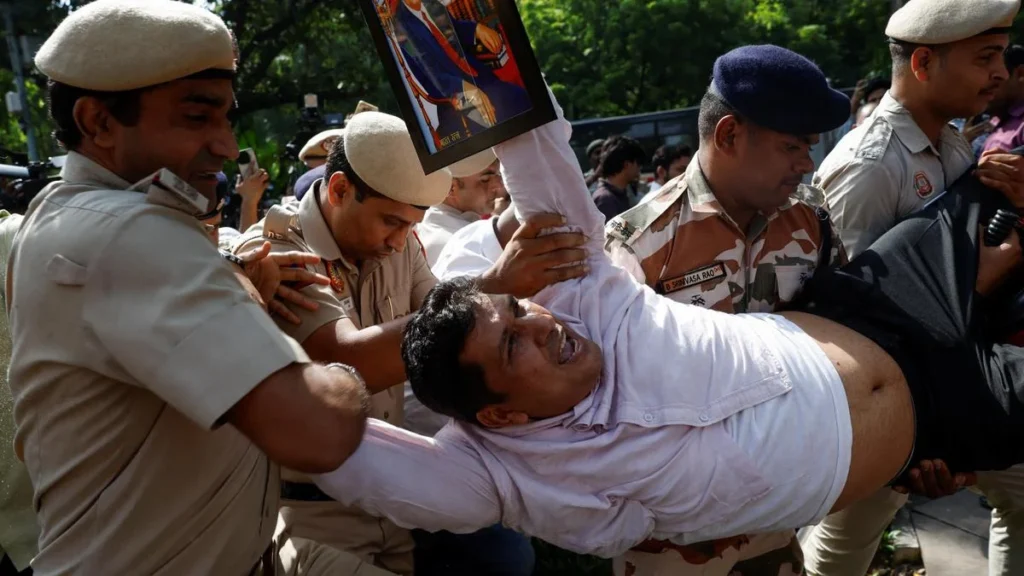
The unrest, fueled by allegations regarding the integrity of the electoral process and the handling of voter lists, saw the detention of prominent political figures, including Aam Aadmi Party (AAP) leader Saurabh Bharadwaj, as police moved to enforce strict prohibitory orders.
The Core Controversy: Why is the CEC Facing Calls for Resignation?
The current crisis centers on mounting allegations against CEC Gyanesh Kumar, specifically regarding the "Systematic Integrity Report" (SIR) and its impact on the electoral roll. Critics, including opposition leaders, legal experts, and civil society groups, argue that the current administration of the Election Commission (EC) has failed to uphold the democratic mandate.
The primary catalyst for the current unrest is the reported disenfranchisement of a significant number of eligible voters. Former CEC O.P. Rawat recently voiced concerns, noting that the scale of eligible electors who lost their voting rights due to technical glitches or administrative oversight under the current regime is unprecedented in the history of Indian elections.
For protesters, the demand for Mr. Kumar’s resignation is not merely a political grievance; it is framed as a defense of the constitutional framework. They argue that the Election Commission must remain an impartial arbiter, and that the current leadership has compromised the commission’s independence.
Chronology of the October 2 Mobilization
07:48 AM: The Initial Lockdown
As the country commemorated the birth anniversary of Mahatma Gandhi, the atmosphere in New Delhi was anything but peaceful. Early morning reports indicated that security forces had cordoned off the Jantar Mantar area. Authorities cited "law and order" concerns as the justification for denying formal permission for a protest march.
09:30 AM: Communication Blackout
In a move that drew sharp criticism from digital rights activists, the Delhi Police, in coordination with the Ministry of Home Affairs, ordered the suspension of internet services in the vicinity of Jantar Mantar. This "digital curfew" was intended to prevent the rapid mobilization of protesters via social media platforms.

11:00 AM: The Confrontation
By late morning, a large assembly—estimated by police sources at between 3,000 and 4,000 people—gathered near the protest site. The crowd, comprising members of the All India Students’ Association (AISA), student activists, and political workers, faced heavy police barricading. Shortly after the scheduled start time, AAP’s Saurabh Bharadwaj was taken into preventive detention by police, a move that sparked immediate outrage among his supporters.
12:30 PM: Simultaneous Unrest in Mumbai
While the capital witnessed a standoff, Mumbai’s Azad Maidan and Shivaji Park became focal points for the Coalition for Justice and Peace (CJP). Despite being denied permission by the Mumbai Police to congregate at Shivaji Park, activists led by CJP founder Abhijeet Dipke attempted to hold a peaceful assembly. Mr. Dipke warned of a potential "nationwide movement" if the grievances regarding the electoral process are not addressed immediately.
Supporting Data and Historical Context
The current agitation is not an isolated event but the culmination of months of friction between the Election Commission and opposition factions.
The Voter Disenfranchisement Data
Recent reports from election monitoring bodies suggest that voter rolls have seen "unexplained deletions" in key constituencies. Independent analysts point out that in the last two election cycles, the discrepancy between the expected voter turnout and actual voter registration has widened.
The Legal Framework
As the debate over the removal of a CEC intensifies, constitutional experts have been frequently cited in the media. Under Article 324 of the Indian Constitution, the removal of a Chief Election Commissioner is a process akin to the impeachment of a Supreme Court judge. It requires a motion supported by a special majority in both Houses of Parliament. While the protesters are calling for a voluntary resignation, the legal reality remains that the process for removing a CEC is intentionally rigorous to ensure the office remains insulated from partisan political pressure.
Official Responses and Political Repercussions
The Government Stance
As of mid-day, the central government has maintained a guarded silence on the specific demands for the CEC’s resignation. Sources close to the Election Commission have dismissed the protests as "politically motivated" attempts to undermine a constitutional body. The EC issued a brief statement reiterating its commitment to "free and fair elections" and dismissed the allegations regarding the SIR as "baseless, technically flawed interpretations."
The Opposition’s Unified Front
The protest has brought together a diverse range of political actors. Rajya Sabha MP Manoj Jha, who was at the forefront of the Delhi mobilization, stated, "The Election Commission is the temple of our democracy. When the priest of the temple begins to favor one side, the faith of the people is shattered. We are here to restore that faith."
Supreme Court lawyer Prashant Bhushan, also a key organizer, has emphasized that the judiciary must take note of the systemic failures at the ECI. He argued that the current crisis is a test for the Indian legal system’s ability to protect democratic institutions from executive overreach.

The Implications for Indian Democracy
The events of October 2, 2026, pose significant questions for the future of Indian governance.
1. Erosion of Trust
The most immediate implication is the deepening divide between the public and the Election Commission. When a significant portion of the electorate views the referee of the democratic game as biased, the legitimacy of all future election results, regardless of the winner, will be questioned.
2. The Role of Civil Society
The involvement of student organizations like AISA and civil society groups like the CJP indicates that this is not just a partisan struggle but a broader movement concerned with civil liberties. The use of internet shutdowns—a tactic previously reserved for extreme security threats in border regions—in the heart of the national capital sets a concerning precedent for the state’s approach to peaceful dissent.
3. Potential for National Escalation
Abhijeet Dipke’s warning of "nationwide unrest" is being taken seriously by intelligence agencies. If the government fails to address the concerns regarding voter data and the conduct of the CEC, the protests are likely to expand from urban centers to the grassroots level. A sustained campaign could potentially paralyze administrative functions in several states.
Conclusion: A Turning Point
As the sun sets on this turbulent Gandhi Jayanti, the situation remains fluid. The detention of political leaders and the heavy-handed security response have done little to dampen the resolve of the protesters. Instead, the images of police detaining dissenters have begun to circulate on alternative networks, further galvanizing the opposition.
The crisis surrounding CEC Gyanesh Kumar is a defining moment for Indian democracy. It raises fundamental questions about the balance of power, the necessity of transparency in electoral technology, and the right to peaceful protest in the digital age. Whether the government chooses to engage in dialogue or continue with a hardline stance will likely dictate the political trajectory of the country for the remainder of the year.
For now, the country watches and waits. The streets of Delhi and Mumbai have sent a clear message: the integrity of the vote is not negotiable. As the opposition prepares for its next phase of action, the question remains whether the constitutional authorities will rise to meet the challenge of restoring public trust, or if the chasm between the government and the governed will only continue to widen.
Follow our live blog for real-time updates as this story continues to develop.