The New Frontier of Enterprise AI: OpenAI’s GPT-6 Astra Arrives on Amazon Bedrock
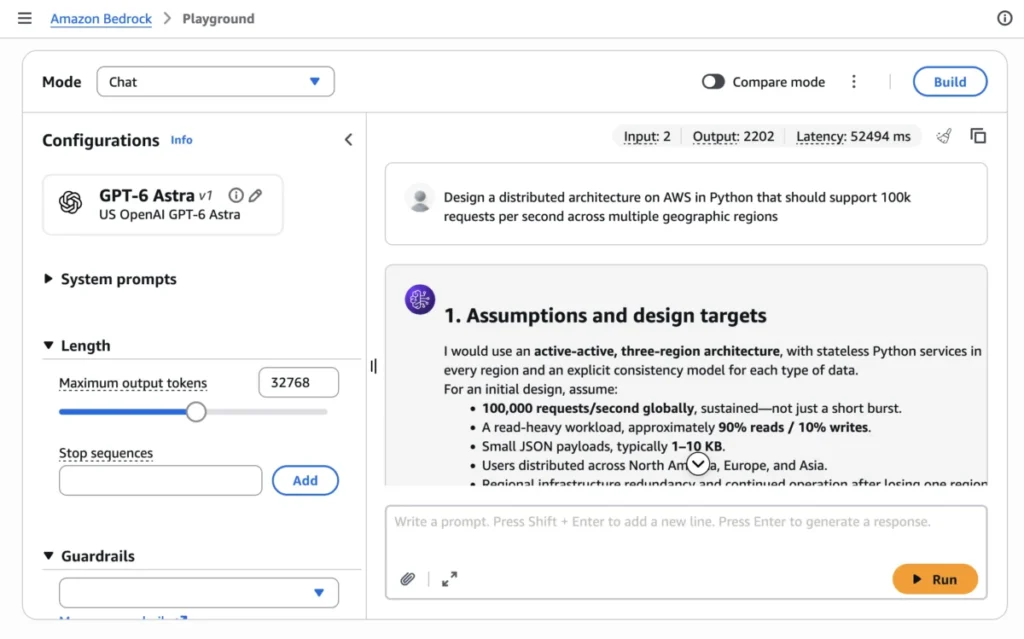
NEW YORK — As the autumn chill settles into Manhattan and the technology sector accelerates into its busiest seasonal cadence, Amazon Web Services (AWS) has delivered a watershed moment for enterprise artificial intelligence. In a mid-September announcement that underscores the rapidly converging ecosystems of cloud computing and frontier foundational models, AWS confirmed the general availability of OpenAI’s flagship model, GPT-6 Astra, on Amazon Bedrock.
This release marks a significant milestone in how organizations deploy artificial intelligence. By combining OpenAI’s most capable architecture to date with the robust security, scalability, and governance frameworks of Amazon Bedrock, enterprises are being handed unprecedented computational leverage. According to industry analysts, the integration signals a shift away from isolated AI tooling toward deeply embedded, multi-modal autonomous workflows capable of handling heavy cognitive lifting at scale.
Main Facts
The core of the announcement centers on the deployment of OpenAI GPT-6 Astra within the managed service environment of Amazon Bedrock. Designed specifically to tackle complex, high-stakes enterprise workloads, GPT-6 Astra introduces several capabilities that push past the boundaries of previous-generation LLMs:
- Advanced Reasoning and Judgment: GPT-6 Astra is engineered to navigate nuanced ambiguity, making it well-suited for executive-level decision support, strategic financial modeling, and complex legal analysis.
- Professional-Quality Writing and Design: The model exhibits a heightened fluency in generating domain-specific content, ranging from architectural design specifications to comprehensive corporate communications.
- Advanced Computer and Browser Use: Moving beyond text-in, text-out paradigms, Astra features native capabilities to interact with digital environments, utilizing browsers and software applications to execute multi-step digital tasks.
- Massive Context Window: Supporting up to 1 million input tokens, the model can ingest sprawling codebases, years of financial records, multi-volume legal contracts, or entire corporate document archives simultaneously, synthesizing competing inputs with high fidelity.
- Flexible Integration Paths: Developers can invoke GPT-6 Astra directly through supported Amazon Bedrock APIs or configure existing developer environments like ChatGPT Work and Codex to route through the Bedrock infrastructure.
- Enterprise-Grade Security and Privacy: True to AWS’s architectural guarantees, customer inference data is strictly isolated and never utilized for model training. Built-in AWS governance tools allow organizations to enforce strict access controls, monitor invocation activity, and secure workloads to meet rigorous compliance standards.
Chronology of the Release
The arrival of GPT-6 Astra on Amazon Bedrock is the culmination of a multi-year evolution in cloud-hosted artificial intelligence, reflecting a timeline of rapid capability expansion:
- Late 2024 – 2025 (The Foundation Era): As foundational models matured, enterprises grappled with the friction of deploying frontier models alongside proprietary data. Early integrations on Amazon Bedrock focused on security, data privacy, and foundational retrieval-augmented generation (RAG) pipelines.
- Early 2026 (The Rise of Agentic Workflows): The industry shifted from conversational chatbots to autonomous AI agents. Developers quickly realized that the greatest productivity gains required not just better models, but fundamental shifts in how engineering and operational teams collaborated with AI.
- Mid-September 2026 (The GPT-6 Astra Launch): AWS kicked off its autumn launch calendar in New York by officially releasing GPT-6 Astra on Amazon Bedrock. Alongside the model deployment, OpenAI introduced new enterprise plugins for ChatGPT Work, extending Astra’s browser-automation features directly into standard corporate software suites.
- Present Day: Enterprises are actively migrating demanding legacy workflows onto the combined AWS-OpenAI stack, testing the boundaries of the 1-million-token context window and autonomous browser interactions.
Supporting Data and Technical Specifications
To fully understand the weight of the GPT-6 Astra integration on Amazon Bedrock, one must examine the underlying metrics and architectural parameters that define its performance:
| Technical Parameter | Specification / Feature | Enterprise Implication |
|---|---|---|
| Context Window | Up to 1,000,000 input tokens | Enables simultaneous ingestion of massive code repositories, multi-year audits, and extensive regulatory frameworks. |
| Modalities | Advanced reasoning, text, code, computer/browser use | Bridges the gap between static analysis and active execution of digital workflows. |
| Deployment Channel | Amazon Bedrock Managed APIs & ChatGPT Work/Codex | Provides architectural flexibility, allowing teams to use native AWS tooling or specialized OpenAI interfaces. |
| Data Privacy Guarantee | Zero data leakage; no model training on customer inputs | Ensures compliance with GDPR, HIPAA, and proprietary corporate data protection policies. |
| Governance & Auditability | AWS Identity and Access Management (IAM) & CloudTrail integration | Delivers granular access control, real-time monitoring, and comprehensive audit logs for AI interactions. |
Furthermore, OpenAI’s introduction of enterprise plugins for ChatGPT Work acts as a force multiplier. By extending Astra’s browser-use capabilities across standard business applications—ranging from enterprise resource planning (ERP) platforms to customer relationship management (CRM) software—organizations can automate tasks that previously required human navigation across multiple legacy systems.
Official Responses and Industry Perspectives
The release has drawn significant commentary from technology leaders, enterprise architects, and cloud strategists, all highlighting the strategic convergence of OpenAI’s model intelligence with Amazon’s enterprise infrastructure.
"The conversation around enterprise AI has fundamentally matured," notes a senior cloud solutions architect closely tracking the Amazon Bedrock ecosystem. "Organizations are no longer asking if they should use generative AI, but how they can safely integrate a model that possesses actual judgment and computer-use capabilities without exposing sensitive intellectual property."
AWS representatives have repeatedly emphasized that the integration of GPT-6 Astra aligns with their broader mission to offer builders the industry’s most comprehensive selection of high-performing foundation models. By coupling OpenAI’s bleeding-edge intelligence with AWS’s unmatched security posture, enterprises are given a secure sandbox to experiment with and deploy agentic AI at scale.
Concurrently, OpenAI leadership has stressed that Astra’s browser-use and advanced reasoning capabilities are designed to augment human potential rather than replace it. By offloading tedious, multi-step digital reconciliations—such as reconciling conflicting compliance regulations across disparate international jurisdictions—knowledge workers can redirect their energy toward higher-order strategy and creative problem-solving.
Implications for the Enterprise and Developer Ecosystem
The deployment of GPT-6 Astra on Amazon Bedrock carries profound implications across multiple verticals, reshaping software development, legal compliance, financial services, and corporate governance.
1. Paradigm Shift in Software Engineering
The developers extracting the highest value from AI agents are no longer just utilizing better code-completion tools; they are fundamentally altering their workflows. With a 1-million-token context window, engineering teams can feed entire legacy systems into GPT-6 Astra via Bedrock, asking the model to refactor architecture, identify latent security vulnerabilities, and generate comprehensive documentation in a single operational pass.

2. Streamlining Complex Compliance and Legal Workflows
In sectors governed by stringent regulatory frameworks—such as banking, healthcare, and aerospace—reviewing contracts and policy documents has historically been a major operational bottleneck. Astra’s deep reasoning capabilities and vast memory allow legal teams to upload massive repositories of past case law, regulatory updates, and active contracts to instantaneously cross-reference obligations and flag potential risks.
3. The Rise of Secure, Autonomous Agents
Security has long been the primary barrier preventing enterprises from unleashing autonomous AI agents on live systems. By housing GPT-6 Astra within Amazon Bedrock, organizations benefit from enterprise-grade perimeter defenses, data encryption in transit and at rest, and strict governance controls. Because inference data is siloed away from public training sets, companies can innovate aggressively without fearing data contamination or intellectual property leakage.
4. Community and Continuous Learning
As AWS continues its robust autumn launch schedule, the company is doubling down on developer community engagement. Through platforms like the AWS Builder Center, developers, cloud architects, and data scientists are encouraged to share deployment templates, fine-tuning strategies, and architectural best practices for integrating frontier models like GPT-6 Astra.
Looking Ahead
As the mid-September launch momentum rolls forward, the technology landscape stands on the precipice of a new era defined by autonomous, secure, and deeply contextual artificial intelligence. The availability of OpenAI’s GPT-6 Astra on Amazon Bedrock bridges the once-formidable gap between raw model intelligence and enterprise-grade operational security.
For builders and enterprise leaders alike, the message is clear: the tools are no longer the bottleneck. The competitive advantage now belongs entirely to those organizations imaginative enough to redesign their workflows around the boundless potential of agentic cloud architecture.
As AWS continues its relentless pace of innovation, developers are encouraged to monitor the official "What’s New with AWS" and "AWS Blogs" pages for ongoing updates, and to engage with peers through upcoming virtual and in-person builder events.