AWS Bridges the Gap Between Operational Databases and Data Lakes with Direct DuckDB Integration in Amazon Aurora PostgreSQL
SEATTLE — In a major development for enterprise database management and data architecture, Amazon Web Services (AWS) has announced a powerful new capability for Amazon Aurora PostgreSQL. By natively embedding the high-performance analytical engine DuckDB directly into the database service, AWS now allows developers and data engineers to query operational data alongside large-scale data lake formats—specifically Apache Iceberg and Apache Parquet—using standard PostgreSQL syntax.
This architectural leap effectively eliminates the traditional, costly friction between transactional databases and analytical data stores. Organizations no longer need to build, maintain, and monitor complex Extract, Transform, Load (ETL) pipelines or reverse-ETL syncing mechanisms just to analyze unified datasets. Whether powering real-time executive dashboards, enriching customer transactions with years of historical context, or providing AI agents with live and archived operational context, users can now execute unified queries through a single, familiar interface.
Main Facts: What is Amazon Aurora PostgreSQL Analytics Integration?
The newly released feature natively integrates DuckDB—courtesy of the DuckLabs team joining Amazon—deeply into the architecture of Amazon Aurora PostgreSQL. Rather than relying on external bridges or requiring the movement of massive volumes of data, the query processing engine executes analytical scans locally within Aurora.
Key operational highlights of the release include:
- Zero ETL Architecture: Data stored in Amazon S3, S3 Tables, or managed through the AWS Glue Data Catalog and Iceberg REST Catalog (IRC)-compatible endpoints can be queried directly.
- Unified Query Interface: Developers use standard PostgreSQL syntax, tools (such as
psql), and the Amazon RDS console to query external lakehouse formats alongside live, uncommitted operational writes. - Smart Optimizations: Aurora automatically applies advanced database optimizations, including predicate pushdown and column pruning, ensuring that only relevant data blocks are scanned from Amazon S3.
- Federated Catalog Support: External IRC-compatible catalogs can be federated via the AWS Glue Data Catalog, allowing businesses to join data across multiple external analytical catalogs in a single query without duplicating infrastructure.
- Broad Version Support: The capability is available immediately on Aurora PostgreSQL major versions 17 (starting with version 17.11) and 18 (starting with version 18.6).
- Cost Efficiency: There is no additional software surcharge for using the feature. Customers pay only for the incremental Aurora compute utilized during query processing and standard Amazon S3 API request costs.
Chronology: The Journey to Unified Operational and Analytical Workloads
The convergence of operational databases (OLTP) and analytical systems (OLAP)—often referred to in the industry as HTAP (Hybrid Transactional/Analytical Processing)—has been a long-standing challenge in enterprise software architecture.
Historically, organizations adopted a bifurcated approach. Operational databases like Amazon Aurora handled high-throughput, low-latency transactions (e.g., e-commerce checkouts, user account updates). Meanwhile, historical records, logs, and massive reporting datasets were offloaded to data lakes on Amazon S3, structured in formats like Apache Parquet or managed as open table formats like Apache Iceberg via the AWS Glue Data Catalog.
To bridge this gap, companies routinely constructed intricate ETL pipelines. Data from Aurora was periodically extracted, transformed into Parquet, and loaded into data lakes. Conversely, if an operational application required historical context, reverse-ETL jobs would pull data back into the database or separate caches. These pipelines incurred heavy infrastructure costs, introduced synchronization lag, and created significant maintenance burdens for engineering teams.
The modern paradigm shift began when DuckLabs—the core engineering team behind the ultra-efficient open-source analytical database DuckDB—joined Amazon. AWS recognized an opportunity to leverage DuckDB’s vectorized execution engine inside its managed cloud databases. By embedding DuckDB directly into Aurora PostgreSQL, AWS has bypassed the network hops and data duplication of the past, marking a milestone in how cloud-native databases handle lakehouse integration.
Supporting Data: Under the Hood and Implementation Mechanics
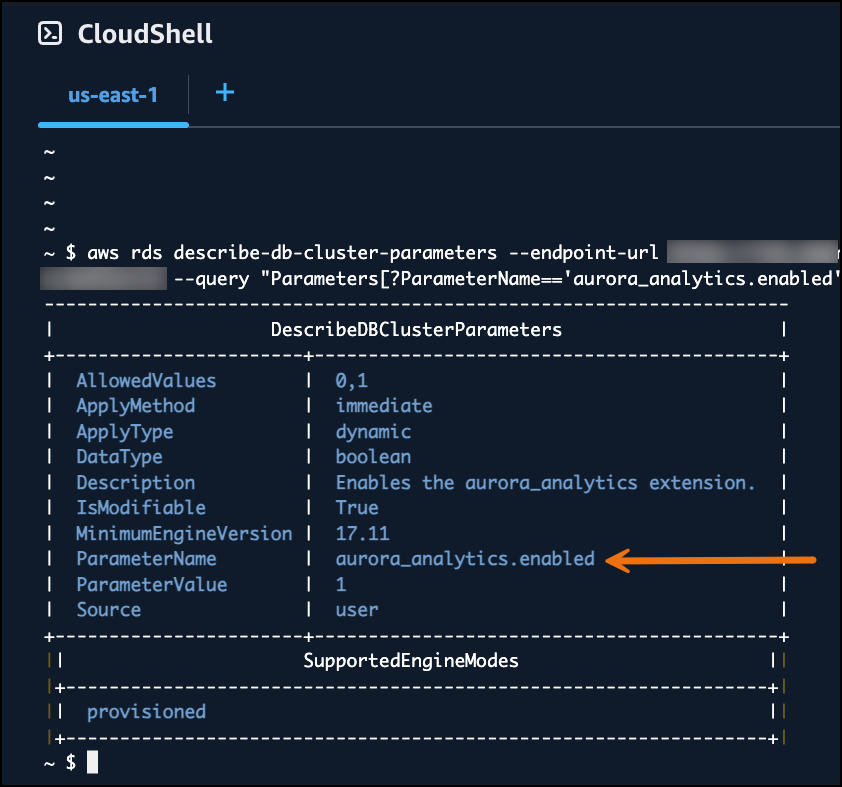
The technical implementation of direct data lake querying in Aurora PostgreSQL is designed for simplicity and performance. To put the system into practice, administrators follow a straightforward configuration workflow.
Setup and Configuration
- Cluster Provisioning: Deploy an Aurora PostgreSQL cluster running version 17.11+ or 18.6+.
- IAM Permissions: Attach an AWS Identity and Access Management (IAM) role containing the
AuroraAnalyticspolicy to grant the cluster read access to Amazon S3 and the AWS Glue Data Catalog. - Extension Activation: Connect via any standard PostgreSQL client (such as
psql) and enable the extension:CREATE EXTENSION aurora_analytics; - Foreign Table Definition: Map external data lake files or tables using standard foreign table declarations. Notably, Aurora’s integration automatically infers column schemas directly from Parquet file metadata or Iceberg table definitions, eliminating manual schema definition:
CREATE FOREIGN TABLE transaction_history ()
SERVER aurora_analytics_server
OPTIONS (
   location 's3://<my-bucket>/finance/transaction_history.parquet',
   format 'parquet'
);
For larger catalogs, a single
IMPORT FOREIGN SCHEMAcommand can bulk-create foreign tables for an entire database in the AWS Glue Data Catalog.
Execution and Performance Monitoring
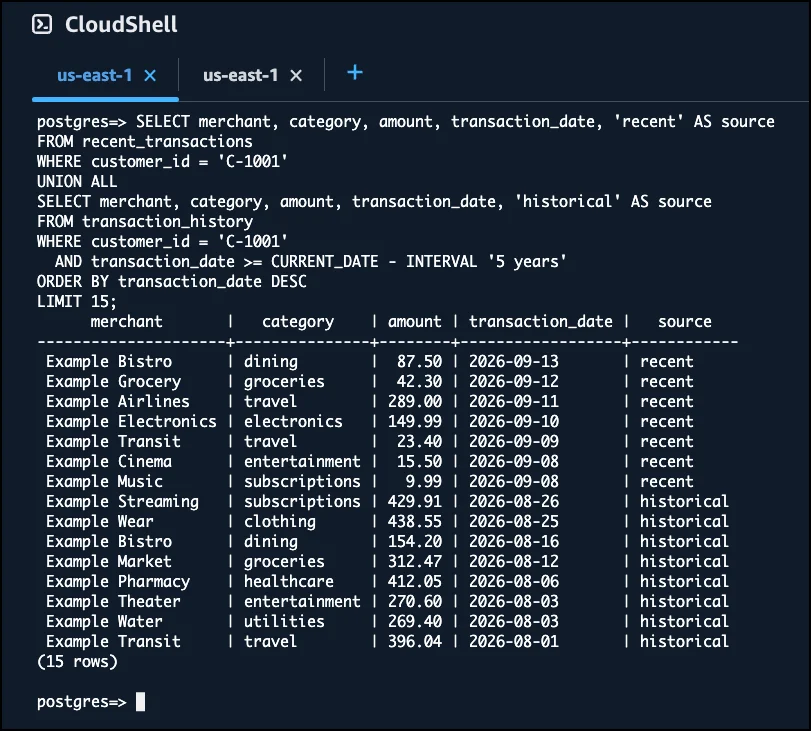
Once configured, developers can construct standard SQL queries that seamlessly blend live operational rows with multi-year data lake archives:
SELECT merchant, category, amount, transaction_date, 'recent' AS source
FROM recent_transactions
WHERE customer_id = 'C-1001'
UNION ALL
SELECT merchant, category, amount, transaction_date, 'historical' AS source
FROM transaction_history
WHERE customer_id = 'C-1001'
  AND transaction_date >= CURRENT_DATE - INTERVAL '5 years'
ORDER BY transaction_date DESC
LIMIT 15;
In this architecture, DuckDB executes the analytical scan over the S3-hosted Parquet files under the hood, while Aurora manages the live operational tables. Furthermore, administrators can monitor query performance, cache hits, rows scanned, and bytes read from S3 using the built-in aurora_analytics_stat_statements() diagnostic function. Frequently accessed analytical segments are automatically cached within the Aurora instance to accelerate subsequent lookups.
For workloads requiring single-digit-millisecond latency, users can materialize queried data lake subsets directly into native Aurora tables using standard commands like CREATE TABLE AS SELECT or MERGE INTO, completely avoiding the overhead of managing separate ingestion services. Read queries can also be distributed across read replicas, safeguarding the primary writer instance from heavy analytical loads.
Official Responses and Industry Context
While AWS has streamlined the technical delivery of this feature, industry analysts note that the move addresses a critical bottleneck in modern artificial intelligence application development.
As enterprises aggressively deploy AI agents and large language model (LLM) workflows into their production environments, these agents require dynamic, real-time access to vast repositories of both live transactional records and deep historical data. Pre-replicating every conceivable dataset an AI agent might query via traditional data pipelines is functionally impossible. By giving AI applications and traditional microservices a unified SQL interface that spans live databases and S3 data lakes natively, AWS has provided a foundational building block for autonomous enterprise applications.
Furthermore, because this capability is built upon the open-source DuckDB engine, AWS has positioned the feature to benefit from ongoing upstream performance enhancements. As the open-source community drives future iterations of DuckDB, Aurora PostgreSQL and other integrated AWS services will inherit those performance and functionality gains natively.
Implications for Developers, Data Engineers, and Enterprise Architecture
The introduction of direct data lake querying inside Amazon Aurora PostgreSQL carries profound implications across multiple technical disciplines:
- Reduced Infrastructure Footprint: Organizations can decommission numerous fragile ETL pipelines, reducing AWS compute bills associated with running intermediary data transformation jobs, orchestrators, and redundant storage silos.
- Simplified Developer Experience: Software engineers no longer need to learn specialized big-spark frameworks or distributed query engines just to correlate recent database updates with historical trends. Standard SQL is all that is required.
- Enhanced AI Readiness: Generative AI solutions and autonomous agents can reason over multi-year operational histories and live transactional data simultaneously through a standard database connection string.
- Optimized Cost Management: Available at no extra software cost across all commercial and AWS GovCloud (US) Regions, businesses only pay for the exact compute used during query execution and standard S3 data retrieval fees.
Getting Started
The new capability is available today. Engineering teams can begin testing unified operational and analytical queries by navigating to the Amazon RDS console, updating their Aurora PostgreSQL clusters to version 17.11 or 18.6, and consulting the official Aurora PostgreSQL User Guide for step-by-step configuration tutorials.