AWS Revolutionizes Cloud Optimization with the Public Preview of the AI-Powered Well-Architected Agent
SEATTLE — In a major development for cloud architects, DevOps engineers, and enterprise IT leaders, Amazon Web Services (AWS) has officially announced the public preview of the AWS Well-Architected Agent. This groundbreaking, artificial intelligence-powered service is designed to autonomously analyze complex AWS environments, moving past traditional generic checklists and manual audits to deliver highly targeted, contextual recommendations.
The new service evaluates cloud infrastructure much like an experienced human cloud architect would. By intelligently correlating utilization metrics, underlying resource configurations, and intricate application topologies, the agent measures environments against AWS Well-Architected best practices spanning over 65 distinct AWS services.
Delivered by AWS Support and available to customers with an active AWS Support plan, the Well-Architected Agent represents a paradigm shift. It transitions cloud management from reactive troubleshooting and tedious manual reviews to proactive, automated, and context-aware optimization across cost, security, performance, and resilience.
Main Facts: What is the AWS Well-Architected Agent?
The AWS Well-Architected Agent is an advanced, AI-driven diagnostic and optimization tool embedded within the AWS ecosystem. Rather than offering one-size-fits-all suggestions, the agent is engineered to understand an organization’s unique business goals, tailoring its feedback loop to align directly with corporate priorities.
Core Capabilities and Architecture
- Holistic Analysis: The agent automatically evaluates multi-account, multi-region environments by synthesizing telemetry, configuration states, and resource relationships.
- Goal-Driven Optimization: Users can declare specific business objectives for different optimization pillars (Cost Optimization, Performance Efficiency, Reliability/Resilience, and Security), ensuring that recommendations support overarching company strategies.
- Cross-Pillar Trade-Off Visibility: Real-world cloud engineering often involves compromise—such as increasing cost to achieve higher resilience. The agent explicitly surfaces these trade-offs, helping decision-makers weigh risks and benefits effectively.
- Ready-to-Implement Remediation Packages: Every finding generated by the agent comes bundled with actionable implementation packages, including step-by-step console instructions, Command Line Interface (CLI) commands, and updated Infrastructure as Code (IaC) templates.
- Pre-Deployment and Runtime Reviews: Beyond monitoring live infrastructure, the agent can analyze pre-deployment workloads by reviewing uploaded IaC projects, catching architectural flaws before they ever reach production.
Chronology: The Journey to Intelligent Cloud Architecture
To fully appreciate the significance of the Well-Architected Agent, it is helpful to trace the evolution of AWS’s architectural governance framework:
- 2012 (The Inception): AWS introduced the Well-Architected Framework, providing a consistent set of conceptual best practices for designing and running secure, high-performing, resilient, and efficient infrastructure in the cloud.
- 2017 (Automation Era): AWS launched the AWS Well-Architected Tool within the console, enabling customers to manually review their workloads against the framework pillars via structured questionnaires.
- 2020–2024 (Expansion and Customization): AWS expanded the tool’s capabilities, introducing custom lenses, API integrations, and deeper integration with native AWS cost and security services. However, audits largely remained a manual exercise requiring significant time and specialized expertise.
- Today (The AI Leap): AWS introduces the public preview of the Well-Architected Agent. By embedding artificial intelligence into the core analysis engine, AWS has automated the diagnostic process, bridging the gap between identifying an architectural flaw and immediately deploying its code-level fix.
Supporting Data: Features, Mechanics, and Technical Workflow
The AWS Well-Architected Agent is structured around a streamlined, user-friendly workflow designed to integrate seamlessly into existing enterprise pipelines.

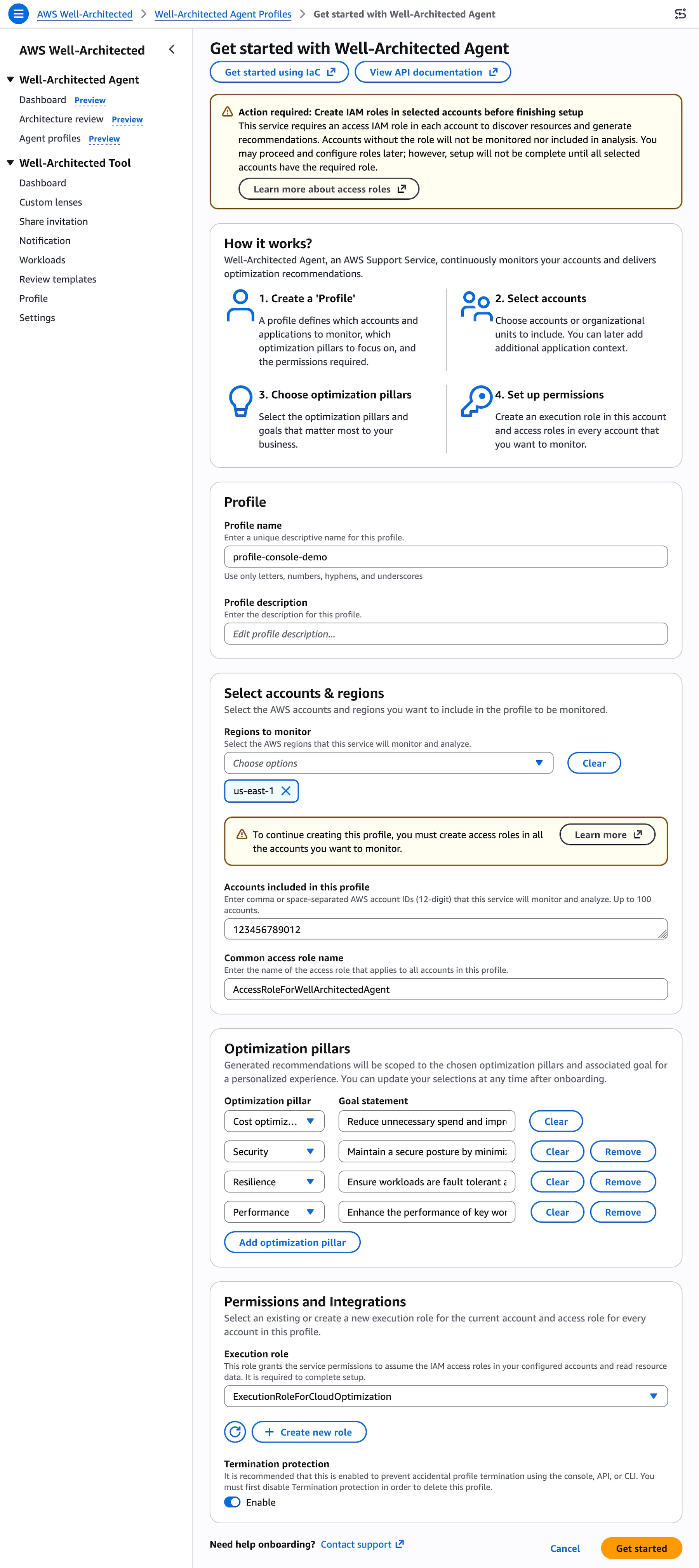
1. Creating an Agent Profile
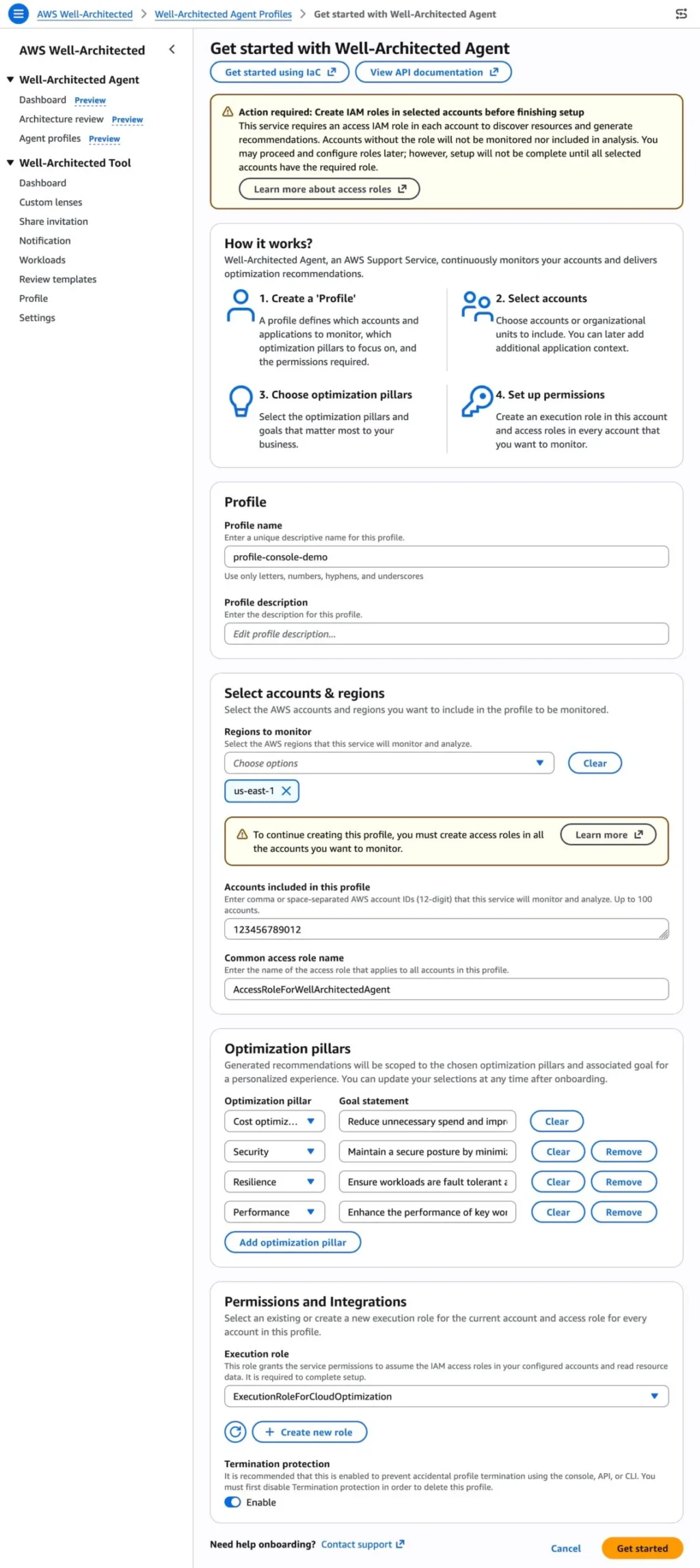
To begin utilizing the service, administrators navigate to the AWS Well-Architected console and select Get started with Well-Architected Agent. Here, they define an agent profile specifying:
- Target AWS accounts and regions to monitor.
- Optimization pillars of primary focus.
- Specific business goals mapped to each pillar.
- Customer-managed AWS Identity and Access Management (IAM) roles granting the agent read-only access to resource configurations, utilization metrics, and application topology.
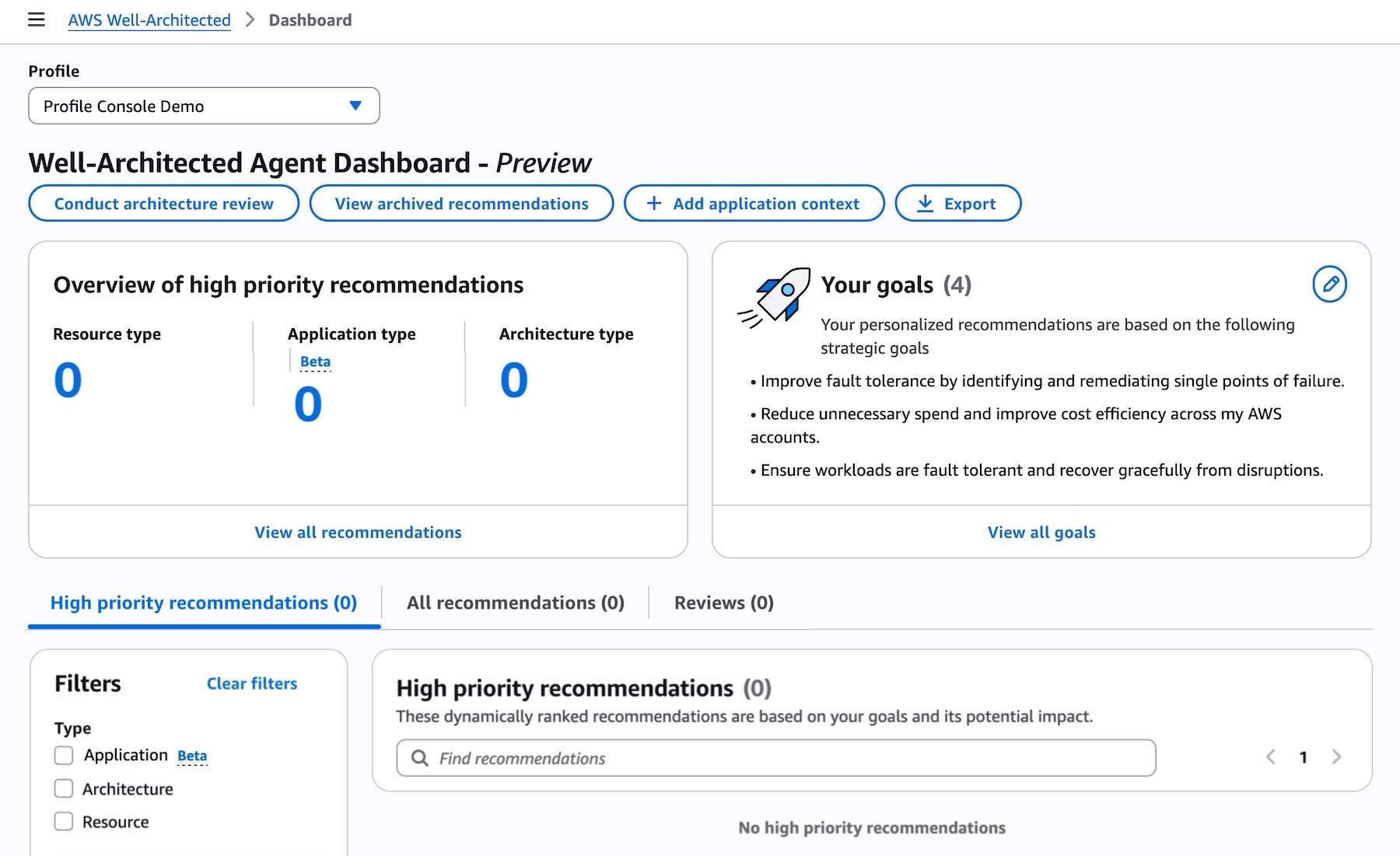
Once initialized, the agent processes the environment and begins generating prioritized resource and application recommendations within 24 hours.
2. Adding Application Context and Pre-Deployment Reviews
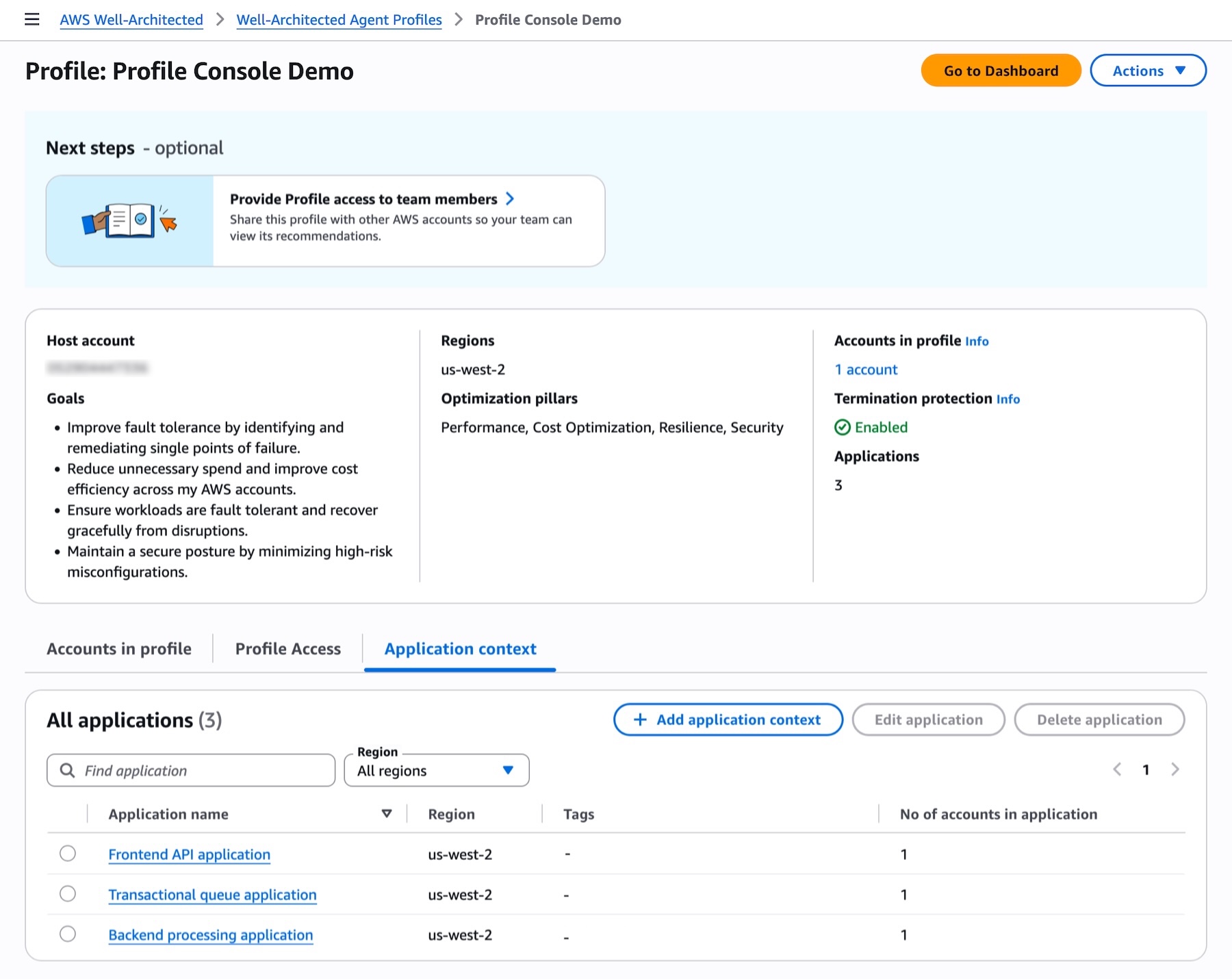
Context is critical for accurate cloud optimization. Users can choose Add application context in the dashboard to associate specific AWS accounts, regions, services, and resource tags with named applications. This targeted scoping ensures recommendations directly address business-critical workloads.
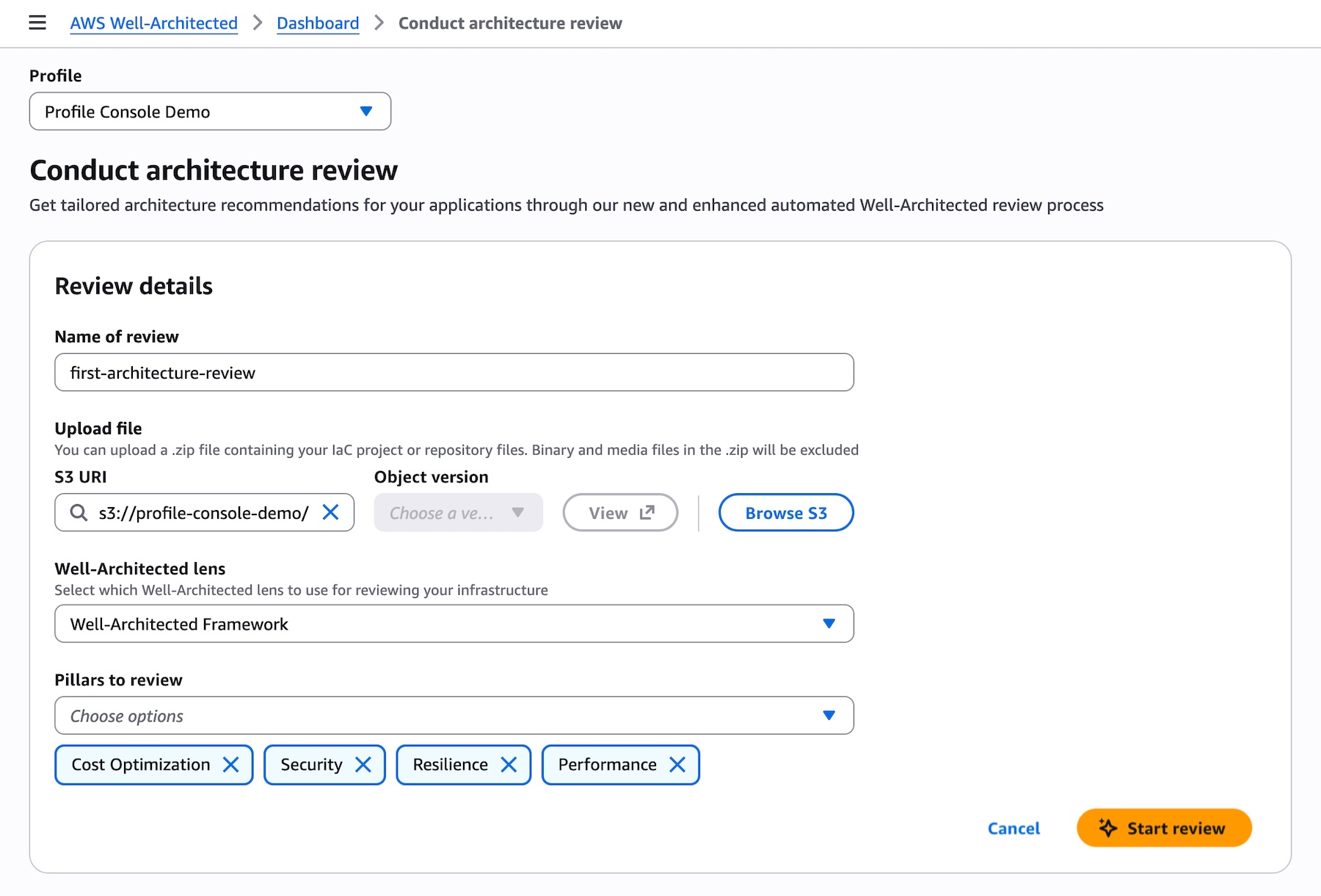
Furthermore, development teams can conduct architecture reviews prior to deployment. By uploading a .zip file containing an Infrastructure as Code project—built in Terraform, AWS CloudFormation, or the AWS Cloud Development Kit (CDK)—along with a selected Well-Architected lens, teams can vet codebases for architectural soundness before provisioning cloud resources.
3. Reviewing Prioritized Recommendations and Remediating
Once the analysis is complete, the agent presents a prioritized list of findings. Selecting an individual recommendation reveals:
- Deep technical insights explaining why the agent flagged the resource.
- Quantified impacts and cross-pillar trade-offs.
- Remediation paths tailored to the organization’s workflow.
When clicking Start remediation, engineers can choose their preferred resolution mechanism. For teams utilizing Infrastructure as Code, selecting Using updated IaC template provides precise code adjustments (such as updated AWS CDK functions) that can be copied directly into the codebase.
Additionally, through the AWS MCP Server and developer plugins, teams can integrate the agent’s intelligence directly into their preferred AI coding tools and CI/CD pipelines, querying documentation and calling APIs programmatically.
Official Responses and Strategic Implications
Industry and Enterprise Implications
For enterprise IT departments facing chronic skill shortages and soaring cloud bills, the Well-Architected Agent arrives as a welcome relief. Historically, conducting comprehensive Well-Architected reviews required mobilizing cross-functional teams of specialized architects for weeks at a time. By automating the discovery phase and auto-generating code fixes, AWS is drastically lowering the barrier to achieving elite-tier cloud architecture standards.
The inclusion of IaC scanning is another strategic leap. By shifting architectural governance left into the development phase, organizations can prevent misconfigurations, security vulnerabilities, and cost overruns before infrastructure is ever deployed.
Availability and Regional Support
During the initial public preview phase, access to the AWS Well-Architected Agent and its core recommendation engine is available in three key regions:
- US East (N. Virginia)
- US East (Ohio)
- US West (Oregon)
However, organizations can onboard and analyze workloads housed in any AWS commercial Region. The service is delivered via AWS Support and is accessible to customers maintaining an active AWS Support plan.
Existing users of the traditional AWS Well-Architected Tool need not worry; the legacy manual evaluation tool and user-defined lenses remain fully operational for teams preferring manual architectural reviews.
Conclusion
The introduction of the AWS Well-Architected Agent marks a defining moment in cloud computing. By combining deep telemetry correlation with generative AI and automated remediation workflows, AWS has transformed architectural best practices from a static documentation framework into a dynamic, living system that actively repairs and optimizes cloud environments.
Cloud administrators and engineering leaders interested in experiencing the future of automated architecture review can access the public preview today through the AWS Well-Architected console, with feedback channeled through standard AWS Support pathways.