From Digital Wallet to AI-Powered Fintech Titan: Inside Paytm’s Strategic Reinvention
By Financial News Desk
Edited by Nikhil Subramanium
Main Facts
Paytm, one of India’s most prominent digital payment pioneers, is undergoing a profound structural evolution. Having weathered intense regulatory headwinds—most notably the bruising restrictions placed on Paytm Payments Bank—the company has successfully orchestrated a pivot from a low-margin payments processor to a high-margin financial services distributor.
Led by founder and CEO Vijay Shekhar Sharma, the company has drastically altered its revenue composition. While payment services historically formed the bedrock of its business, financial services distribution—specifically merchant and consumer credit—has emerged as its primary profit engine.
Today, Paytm stands at another strategic crossroads. With potential shifts in the Merchant Discount Rate (MDR) for Unified Payments Interface (UPI) transactions looming, alongside heavy strategic investments in artificial intelligence (AI) and software solutions like "Paytm Intelligence," the fintech giant is redefining its playbook once again. Operating on a newly achieved foundation of profitability, Paytm is seeking to transition from a traditional payments-plus-lending platform into a hybrid fintech and AI enterprise.
Chronology: The Evolution of a Payments Behemoth
To understand Paytm’s current trajectory, one must examine the chronological milestones that have shaped its business model over the past half-decade:

- The FY21 Baseline (The Wallet & Payments Era): Five years ago, Paytm operated predominantly as a payments-first entity. Out of an operating revenue of ₹2,802 Cr in FY21, payment services accounted for ₹1,981 Cr (roughly 71%). Financial services distribution was a nascent segment, contributing a meager ₹128 Cr (under 5%).
- January 2024 (The Regulatory Shock): The Reserve Bank of India (RBI) imposed severe regulatory restrictions on Paytm Payments Bank, forcing the parent company to abruptly halt several core banking operations and slow down its expansive super-app ambitions. This disruption triggered a temporary contraction in payments revenue and forced a strategic rethink.
- FY25 to FY26 (The Pivot to Lending): To survive and return to profitability, Paytm throttled back on peripheral ventures—exiting entertainment ticketing and scaling down broader e-commerce ambitions—to focus intensely on core payments and credit distribution. By the end of FY26, financial services distribution had surged at an 83% compound annual growth rate (CAGR) over five years to reach ₹2,594 Cr, now comprising 31% of the company’s total topline.
- FY26 Financial Recovery: Paytm reported a net profit of ₹552 Cr for FY26, staging a dramatic turnaround from a net loss of ₹663 Cr in FY25.
- Q1 FY27 and Beyond (The AI & MDR Horizon): In the first quarter of FY27, operating revenue climbed 28% year-on-year to ₹2,448 Cr. Concurrently, the company laid the groundwork for its next major evolution, spotlighting artificial intelligence capabilities and agentic workflows at its September 2026 Annual General Meeting (AGM).
Supporting Data: Dissecting the Financial Transformation
A deep dive into Paytm’s financial disclosures reveals how dramatically its underlying business model has been inverted.
Revenue Mix Shift
The contrast between FY21 and the FY26 annual report highlights an unprecedented structural shift:
- Financial Services Distribution: Grew at an 83% CAGR, expanding more than 20 times its FY21 base to hit ₹2,594 Cr in FY26. It now commands 31% of the company’s ₹8,437 Cr topline.
- Payment Services: While still the largest individual revenue contributor at 58% (down from 71%), payment services grew at a much slower 19% CAGR over the same period.
Recent Performance Metrics
- Profitability Momentum: Following its FY26 net profit of ₹552 Cr, Q1 FY27 continued the upward march with operating revenues rising 28% YoY to ₹2,448 Cr.
- Merchant and Consumer Volumes: Merchant Gross Merchandise Value (GMV) rose 31% YoY to ₹7.1 Lakh Cr in Q1 FY27. Subscription-based merchant deployments reached 1.57 million storefronts. Meanwhile, consumer UPI transaction values grew 45% YoY to ₹5.9 Lakh Cr—outpacing the wider industry’s roughly 20% growth rate—supported by 80 million monthly transacting users (MTUs).
- Workforce and Operational Costs: Paytm’s sales workforce stood at 40,512 in Q4 FY26, up from 36,724 previously. Quarterly sales employee costs increased 30% YoY to ₹317 Cr, while payment processing charges reached ₹2,573 Cr in FY26 compared to ₹2,125 Cr a year prior.
The Lending Economics
Rather than extending credit from its own balance sheet, Paytm acts as a digital distribution channel, partnering with banks and non-banking financial companies (NBFCs) that assume the primary credit risk. In Q1 FY27, over half of all merchant loan disbursements were directed to repeat borrowers, indicating healthy customer stickiness. However, the lending business currently penetrates only about 7% of Paytm’s total subscription merchant base, leaving vast headroom for future expansion.
Official Responses and Stakeholder Perspectives
Paytm’s leadership has been vocal about shifting the narrative from raw volume generation to high-quality, sustainable engagement.
During the Q4 FY26 earnings call, CEO and founder Vijay Shekhar Sharma emphasized the qualitative nature of the company’s rebound:

"GMV growth is accelerating not just because MTUs grew, but because usage per customer did. We focus on customer quality, product quality, and engagement, not just volume."
Addressing the dynamics of the lending business and macroeconomic sensitivities, Sharma noted that while capital capacity among lending partners remains robust, the primary focus must be on curating profitable credit demand. Because Paytm operates purely as a distributor, it remains largely insulated from direct capital costs and high repo rate pressures managed by the RBI. However, tighter monetary conditions can prompt partner NBFCs to exercise greater selectivity, underscoring the necessity for Paytm to continuously monetize its active, non-lending merchant base.
Looking toward the technological horizon, leadership has doubled down on artificial intelligence. At the September 2026 AGM, the company introduced the conceptual framework of "Paytm Intelligence" (PI). Sharma projected that by FY28, dedicated AI-driven revenue streams will be formally reflected in disclosures across the company’s commerce and cloud verticals.
Strategic Implications and Market Outlook
Paytm’s multifaceted transformation carries profound implications for the Indian fintech landscape, characterized by intense competition across every operating segment.
Competitive Realities
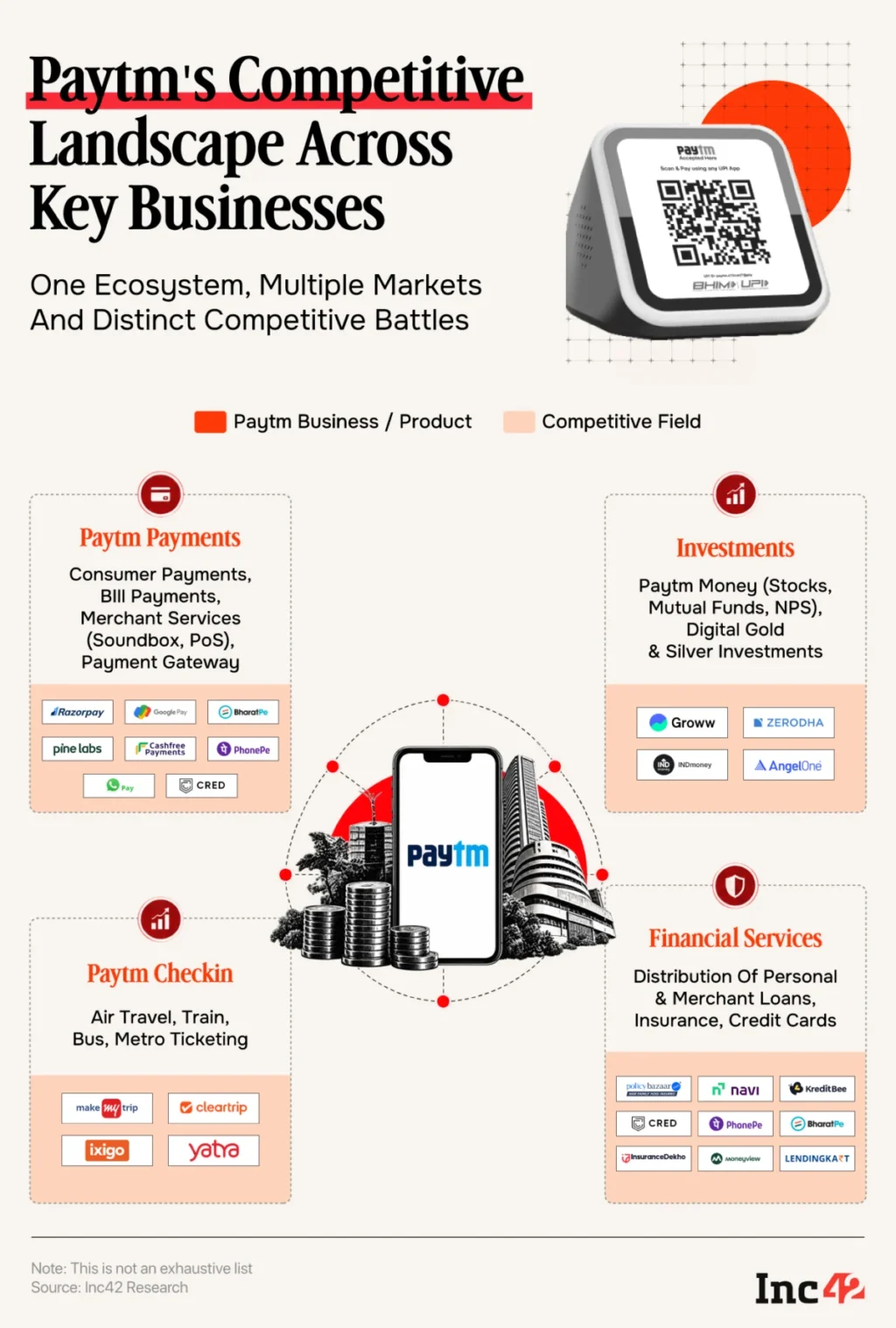
In consumer UPI, Paytm trails significantly behind industry heavyweights PhonePe and Google Pay, holding an individual volume share of roughly 8% compared to PhonePe’s market dominance. In merchant services, it competes fiercely with PhonePe, BharatPe, CRED, Pine Labs, and Razorpay. Meanwhile, investment platforms like Groww, Zerodha, and Angel One command the wealth management space, rendering Paytm Money a smaller player by comparison.

To carve out defensible moats, Paytm has abandoned its broad, unfocused super-app ambitions in favor of hyper-targeted monetization. Its strategy relies heavily on extracting higher value from existing financial relationships with active merchants and engaged consumers.
The MDR Equation and Future Growth
The regulatory environment remains a wildcard. While the Indian government has repeatedly weighed implementing a modest MDR fee on high-value UPI transactions—and subsequently deferred rollout timelines amid retailer pushback—Paytm has demonstrated that it can weather zero-MDR constraints by bundling hardware, software subscriptions, and credit distribution.
Furthermore, the integration of artificial intelligence offers a transformative frontier. Paytm plans to evolve its ubiquitous Soundbox from a simple audio payment-confirmation tool into a sophisticated small-business management hub equipped with vernacular support, automated merchant workflows, and "agentic workforce" tools for enterprise clients.
Conclusion
Given its newly restored profitability, Paytm has secured a vital buffer. Over the next 12 to 15 months, the company possesses the financial latitude to systematically scale its operations, absorb regulatory delays regarding UPI monetization, and refine its AI offerings. If Vijay Shekhar Sharma’s strategic roadmap unfolds as planned, Paytm’s next chapter will witness its metamorphosis from a pioneer of digital wallets into an integrated, AI-driven financial services powerhouse.