The Fall of PayPal Honey: A Watershed Moment for Affiliate Marketing Ethics and Program Management

By AM Navigator News Desk
January 2026
It is a rare occurrence for a premier, household-name affiliate publisher to be abruptly purged from the upper echelons of North American affiliate networks. Yet, that is precisely what unfolded in mid-January 2026, sending shockwaves through the digital marketing ecosystem.
PayPal Honey—the ubiquitous browser extension and coupon aggregator acquired by fintech giant PayPal for a staggering $4 billion six years ago—found itself ejected from America’s two dominant affiliate marketing environments: Rakuten Advertising and impact.com.
Triggered by investigative scrutiny from digital sleuths including MegaLag and veteran industry researcher Ben Edelman, the swift enforcement actions highlight an intensifying industry crackdown on "attribution manipulation." For brand managers, network operators, and publishers alike, the episode serves as a critical inflection point, exposing systemic vulnerabilities in last-touch attribution models and forcing a re-evaluation of how affiliate programs are policed, managed, and diversified.
Main Facts: The Anatomy of the PayPal Honey Crisis
The seismic shifts of January 2026 center on allegations of deliberate noncompliance regarding conversion tracking and browser extension behavior.
At the core of the controversy is the concept of "stand-down" rules. In the modern affiliate landscape, the vast majority of partner programs operate on a "last-touch-wins-all" attribution model. Under this paradigm, 100% of the commission for a conversion is awarded to the final affiliate link or cookie encountered by the consumer in their clickstream.
Because browser extensions like PayPal Honey frequently sit at the very end of the consumer journey—often activating automatically at checkout—they interact uniquely with earlier-funnel publishers (such as content creators, review sites, and early-stage researchers). To maintain fairness, networks implement strict stand-down rules, requiring browser extensions to step aside and refrain from firing if another affiliate was previously logged in the user’s clickstream.
According to platform disclosures and independent investigations, PayPal Honey was penalized for intentional violations of these stand-down protocols. Specifically, the publisher was accused of affiliate link hijacking and utilizing concealed mechanisms to overwrite prior affiliate cookies, effectively stealing conversion credit from upstream partners who had done the heavy lifting of acquiring and educating the customer.
The fallout was swift. Within days, two of the industry’s most powerful infrastructure providers took decisive action to protect the integrity of their marketplaces.
Chronology of Events: A Week That Shook the Industry
The unfolding crisis played out in rapid succession, perfectly timed with the calendar of the industry’s premier annual gathering:

- Prior to January 2026: Independent investigations by researcher Ben Edelman and digital creator MegaLag expose systemic tracking anomalies and alleged attribution manipulation tied to browser-based reward extensions, placing internal pressure on network compliance divisions.
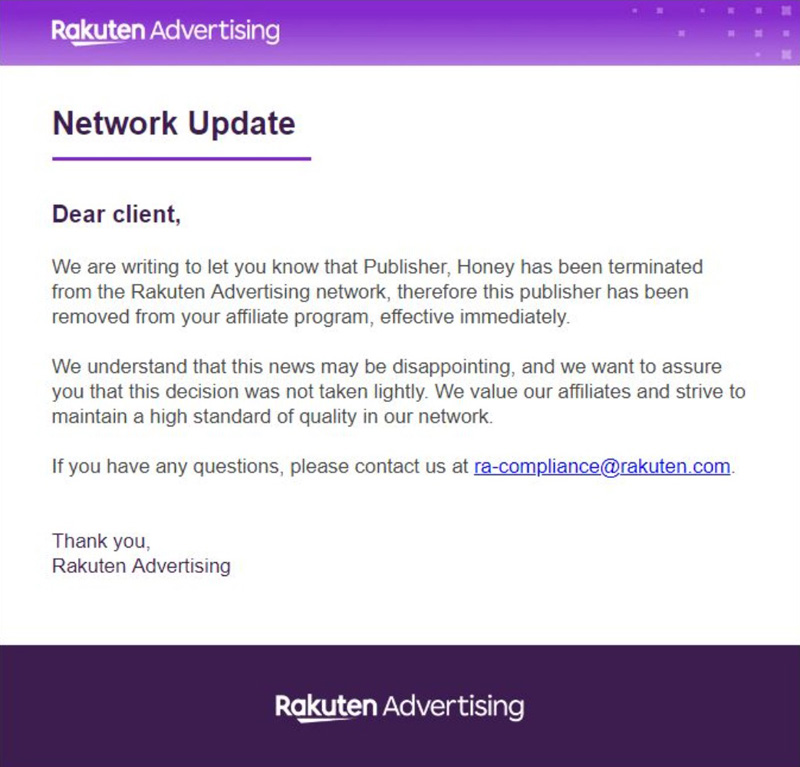
- Monday, January 12, 2026: Rakuten Advertising drops the first major blow. On the exact opening day of Affiliate Summit West—the largest U.S. affiliate marketing conference—Rakuten publicly announces that Honey has been permanently "terminated from the network." The network frames the decision as a necessary step to uphold high quality standards. The news instantly dominates conversations both on the conference floor in Las Vegas and across digital social channels.
- Friday, January 16, 2026: Impact.com follows suit, revealing that PayPal Honey was found "out of compliance" with its platform policies. Unlike Rakuten’s permanent termination, impact.com implements a temporary suspension of Honey from its Discovery Marketplace, citing behaviors that fundamentally undermine trust in the partnership economy.
- Mid-January to Present: Brand managers and affiliate program directors scramble to audit their traffic streams, evaluate revenue exposure, and reassess their compliance monitoring frameworks.
Supporting Data and Industry Context: Audits and Attribution Realities
The disciplinary actions against PayPal Honey are not isolated incidents; rather, they reflect a broader, long-overdue reckoning regarding how affiliate networks handle downloadable software publishers (DSPs) and early-funnel vs. late-funnel friction.
Recent data underscores the complexity of this ecosystem. For instance, the Performance Marketing Association (PMA) maintains a detailed comparative matrix (Affiliate Network DSP Policies Comparison) outlining how different networks govern software-based publishers.
Furthermore, a landmark 24-page independent audit conducted in the United Kingdom by The Affiliate & Partner Marketing Association (APMA) sheds light on systemic attribution mechanics. Evaluating thirty brands across ten affiliate networks and three distinct publisher categories, the APMA audit investigated the granular distinctions between strict stand-down rules and "soft click" attribution mechanics. The study resulted in seven concrete recommendations for the global industry, proving that conversion misattribution is a cross-border, structural challenge that requires active institutional oversight rather than passive acceptance.
Despite these network-level audits, industry veterans emphasize a hard truth: network compliance departments move slowly, and their primary mandate is safeguarding the network’s rules, not necessarily an individual brand’s proprietary terms. Consequently, proactive brands are learning that relying solely on network safety nets is a recipe for operational risk.
Official Responses and Stakeholder Positions
The executive leadership of the affected platforms did not mince words when explaining the rationale behind the disciplinary measures.
Rakuten Advertising’s public statements emphasized that maintaining a pristine, trustworthy marketplace requires continuous pruning and zero tolerance for quality standard breaches. The network’s decisive action on the opening morning of Affiliate Summit West was widely interpreted by public relations experts as a masterclass in signalling industry leadership—a bold declaration that network integrity supersedes publisher scale.
Meanwhile, impact.com’s leadership explicitly highlighted "attribution manipulation" as the primary driver behind Honey’s suspension. In public and trade communications, impact.com executives stressed that the partnership economy relies entirely on mutual trust. When a dominant publisher engages in practices that undermine that trust—such as covertly overriding legitimate referrals—it degrades the entire ecosystem, punishing honest publishers who abide by the rules.
Representatives for PayPal Honey and its parent organization have faced mounting pressure to address the technical implementation of their extension’s cookie-dropping logic, as stakeholders demand greater transparency into how discount and cashback offers interact with multi-touch attribution models.
Implications and Lessons for Affiliate Program Management
For corporate affiliate managers, merchants, and digital marketing directors, the expulsion of PayPal Honey provides five invaluable strategic takeaways. Moving forward, brand operators must internalize these lessons to safeguard their programs, protect partner relationships, and ensure sustainable revenue growth.
1. One Bad Apple Spoils the Entire Program
In affiliate marketing, the danger of a rule-breaking publisher extends far beyond direct conversion theft. Savvy, high-value content creators and brand-safe publishers do not operate in a vacuum. Before joining a merchant’s affiliate program, elite publishers routinely audit who else is partnered with the brand.
If they discover that a program tolerates aggressive, last-touch-obsessed extensions known for cookie-snatching, ethical publishers will frequently decline to join or refuse to invest promotional energy. By harboring a rule-breaking affiliate, a brand alienates the very content creators and strategic partners it needs most.
2. Do Your Own Policing; Never Rely Solely on Networks
Merchants must establish crystal-clear rules spelled out explicitly in their Affiliate Program Agreement and Terms & Conditions. While having robust T&Cs does not automatically stop bad behavior, it establishes the legal and operational framework required to enforce compliance.
Crucially, brand managers must recognize that affiliate networks have competing priorities and often move sluggishly when policing individual program violations. Because your brand reputation and bottom line are on the line, internal compliance monitoring must become an active operational priority.
3. Master the Technical Details
Superficial knowledge is a liability in modern affiliate management. Program managers must deeply understand the technical mechanics of their publishers—distinguishing between various forms of downloadable software, browser extensions, soft-click tracking, and stand-down rules. Utilizing resources like the PMA’s DSP policy comparisons and independent APMA audits ensures that brand managers can intelligently differentiate between legitimate value-add extensions and predatory attribution hijackers.
4. Avoid Dangerous Generalizations
Just as prudent marketers do not ban all paid search affiliates simply because a fraction engage in illicit trademark bidding, program managers must evaluate browser extensions and loyalty solutions on a case-by-case basis. Blanket bans—such as lumping all loyalty platforms, closed user groups (CUGs), or cash-back extensions into a single prohibited category—often deprive brands of legitimate, high-converting customer segments. Nuanced evaluation always triumphs over blunt-force generalizations.
5. Diversify Your Affiliate Base Aggressively
Perhaps the most critical takeaway from the PayPal Honey suspension is a stark warning against revenue concentration. If a merchant experiences a catastrophic drop in affiliate-referred revenue following the removal of a single publisher, it is a glaring symptom of a poorly structured program.
Relying on one or two dominant publishers—or worse, relying exclusively on a single publisher type—creates an existential business risk. To build resilient, future-proof affiliate programs, brands must actively diversify their recruitment pipelines across a wide spectrum of partner models.
Modern affiliate strategists should look far beyond traditional coupon and cashback sites, exploring an expansive universe of 28 distinct affiliate types, including:
- Affinity groups
- Card-linked offers
- Charities and fundraisers
- Content producers
- Complementary brands
- Co-registration affiliates
- Coupons and deals
- Connected TV (CTV)
- Consultants and service providers
- Datafeed-driven websites
- Domainers
- Educators
- Email marketers
- Existing customers and brand advocates
- Loyalty affiliates (D2C websites and CUG solutions)
- Mass media opportunities
- Mobile-oriented affiliates
- Online communities and forums
- Paid search affiliates
- Pay-per-call publishers
- Podcasters
- Post-checkout solutions
- Ranking and review sites
- Retargeting and cart abandonment solutions
- Social media influencers
- Sub-affiliate networks
- Software and browser extensions
- Video marketers
Conclusion
The sudden removal of PayPal Honey from Rakuten Advertising and impact.com marks the end of an era where dominant publishers could operate with perceived impunity regarding attribution mechanics. As the industry digests these developments, the message to merchants is unequivocal: passive management is no longer viable.
By taking control of program compliance, mastering technical attribution details, and aggressively diversifying partnership portfolios, brand managers can insulate their businesses from systemic shocks and build healthier, more transparent, and more profitable affiliate programs for 2026 and beyond.