Empowering Cloud Architecture: AWS Announces Cross-Account Support for Amazon EBS Volume Clones
SEATTLE — In a significant enhancement to its core cloud storage offerings, Amazon Web Services (AWS) has announced the official rollout of cross-account copy capabilities for Amazon Elastic Block Store (Amazon EBS) Volume Clones. This powerful new feature bridges the gap between isolated cloud environments, allowing engineering, security, and DevOps teams to seamlessly and securely transfer point-in-time volume snapshots across distinct AWS accounts.
By integrating AWS Resource Access Manager (RAM) and AWS Key Management Service (AWS KMS), the updated service addresses long-standing challenges in enterprise data management, particularly regarding how organizations handle development, testing, and production isolation.
1. Main Facts: What is Cross-Account Amazon EBS Volume Cloning?
The newly released capability builds directly upon the foundation of Amazon EBS Volume Clones, which AWS introduced to provide instant, point-in-time copies of storage volumes within a single Availability Zone. Until now, these clones were strictly confined to the boundary of the originating AWS account.
With this latest update, the utility of volume clones expands dramatically across organizational and architectural boundaries. Key highlights of the announcement include:
- Cross-Account Data Sharing: Organizations can now share and copy EBS volume clones directly into separate, isolated AWS accounts. This is heavily beneficial for multi-account structures often dictated by the AWS Landing Zone or AWS Control Tower paradigms.
- Target-Account Re-Encryption: When copying a volume into a secondary account, teams have the option to re-encrypt the data using a specific AWS KMS key native to the target account, satisfying rigorous corporate compliance and security guidelines.
- Production Isolation and Modern Workflows: Development and staging environments can be continuously and rapidly refreshed with live production data without exposing production systems to security risks or performance degradation.
- Native AWS Integration: The entire workflow is managed through familiar interfaces, leveraging AWS RAM for secure resource sharing and the Amazon EC2/EBS consoles for execution, alongside programmatic support via the AWS MCP Server and modern AI coding plugins.
2. Chronology: The Evolution of EBS Storage Management
To understand the significance of this cross-account release, it is helpful to trace the evolution of AWS storage cloning mechanisms and how enterprise architecture has adapted over time.
The Era of Traditional Snapshots
For years, creating copies of Amazon EBS data relied primarily on Amazon EBS Snapshots. While snapshots are foundational for backups and disaster recovery, they are stored incrementally in Amazon S3. Restoring a snapshot requires creating a new volume from it, which can introduce latency and operational overhead when provisioning large datasets for test environments.

The Introduction of Volume Clones
Recognizing the need for immediate data availability, AWS launched Amazon EBS Volume Clones. Utilizing a redirect-on-write architecture, volume clones enabled users to create instant, zero-delay copies of active volumes within the same Availability Zone. This innovation drastically reduced wait times for developers needing instant access to heavy datasets. However, because these clones were trapped inside a single account, organizations managing multi-account architectures—where development, testing, and production live in completely separate AWS accounts for security isolation—faced friction. Teams had to rely on complex snapshot-sharing mechanisms and manual restoration scripts.
The Cross-Account Milestone
Addressing user feedback from enterprise customers operating under strict multi-account governance models, AWS development teams engineered cross-account support. By marrying the speed of EBS Volume Clones with the multi-account permission frameworks of AWS RAM and AWS KMS, AWS has closed the loop on enterprise environment synchronization.
3. Supporting Data and Technical Implementation Workflow
Executing a cross-account volume clone involves a structured workflow designed to maintain strict security boundaries while offering administrative ease. The process relies on AWS Resource Access Manager (RAM) to govern how source volumes are exposed to external entities.
Step-by-Step Operational Workflow
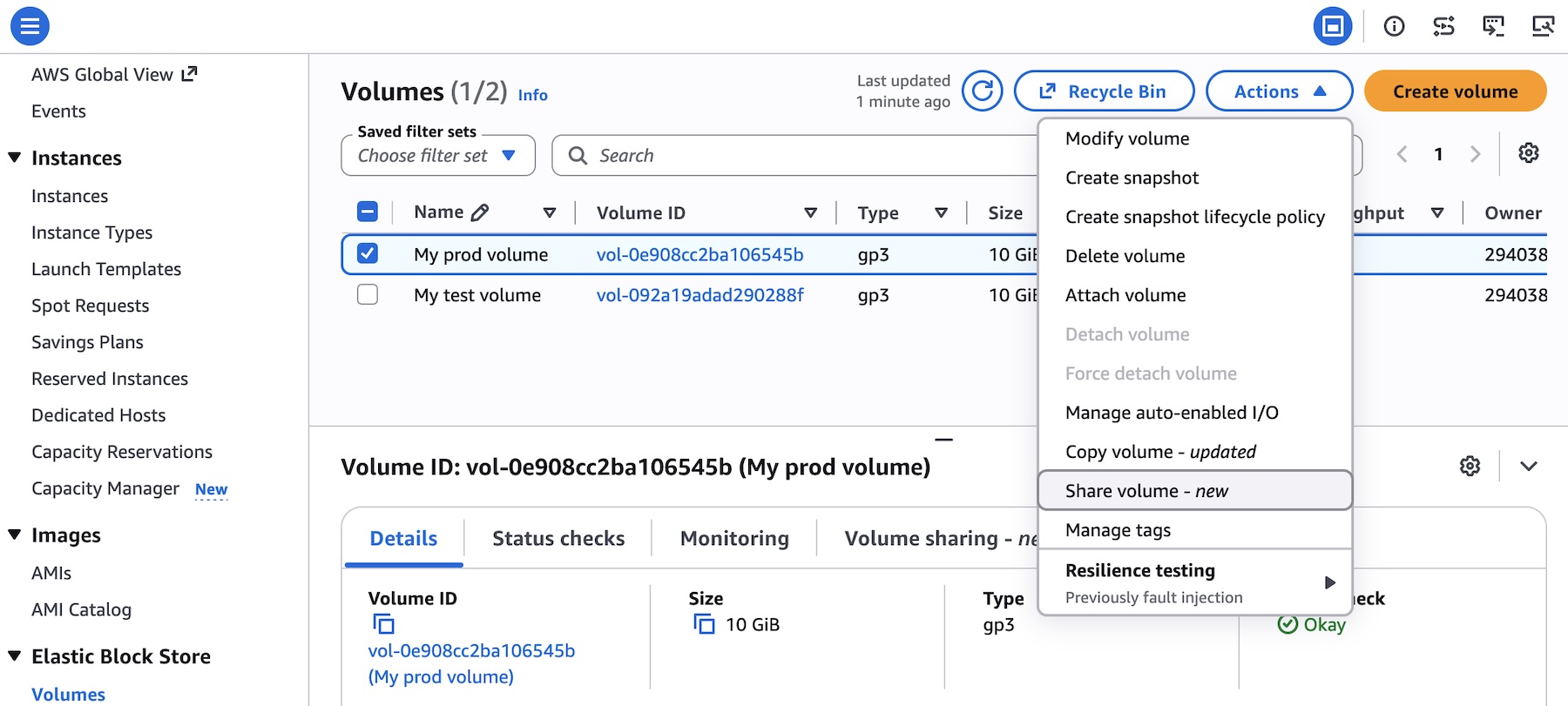
- Initiation in the Source Account:
The owner of the source EBS volume navigates to the Amazon EBS console, selects the desired storage volume, and chooses the Share volume option. - Resource Sharing via AWS RAM:
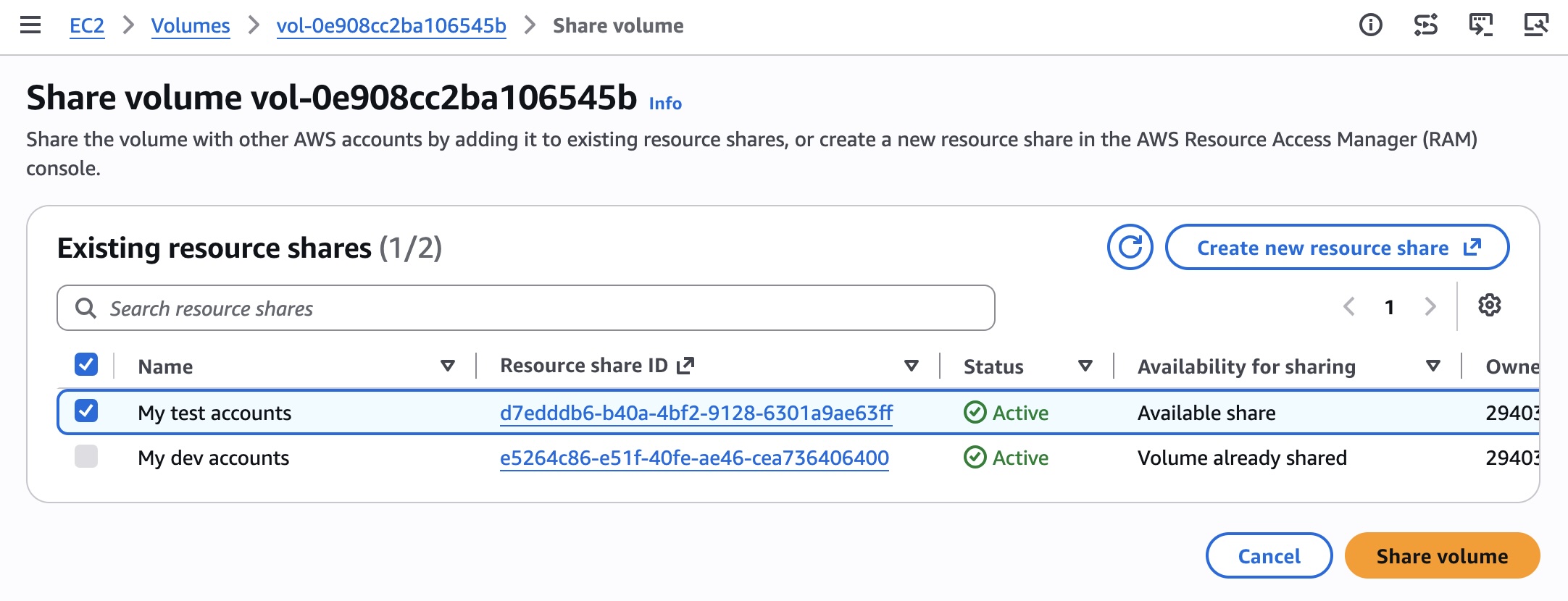
The volume is added to an existing resource share or a newly created resource share within the AWS RAM console. AWS RAM ensures that sharing can happen securely across accounts within the same AWS Organization or with specific external AWS account IDs. - Acceptance in the Target Account:
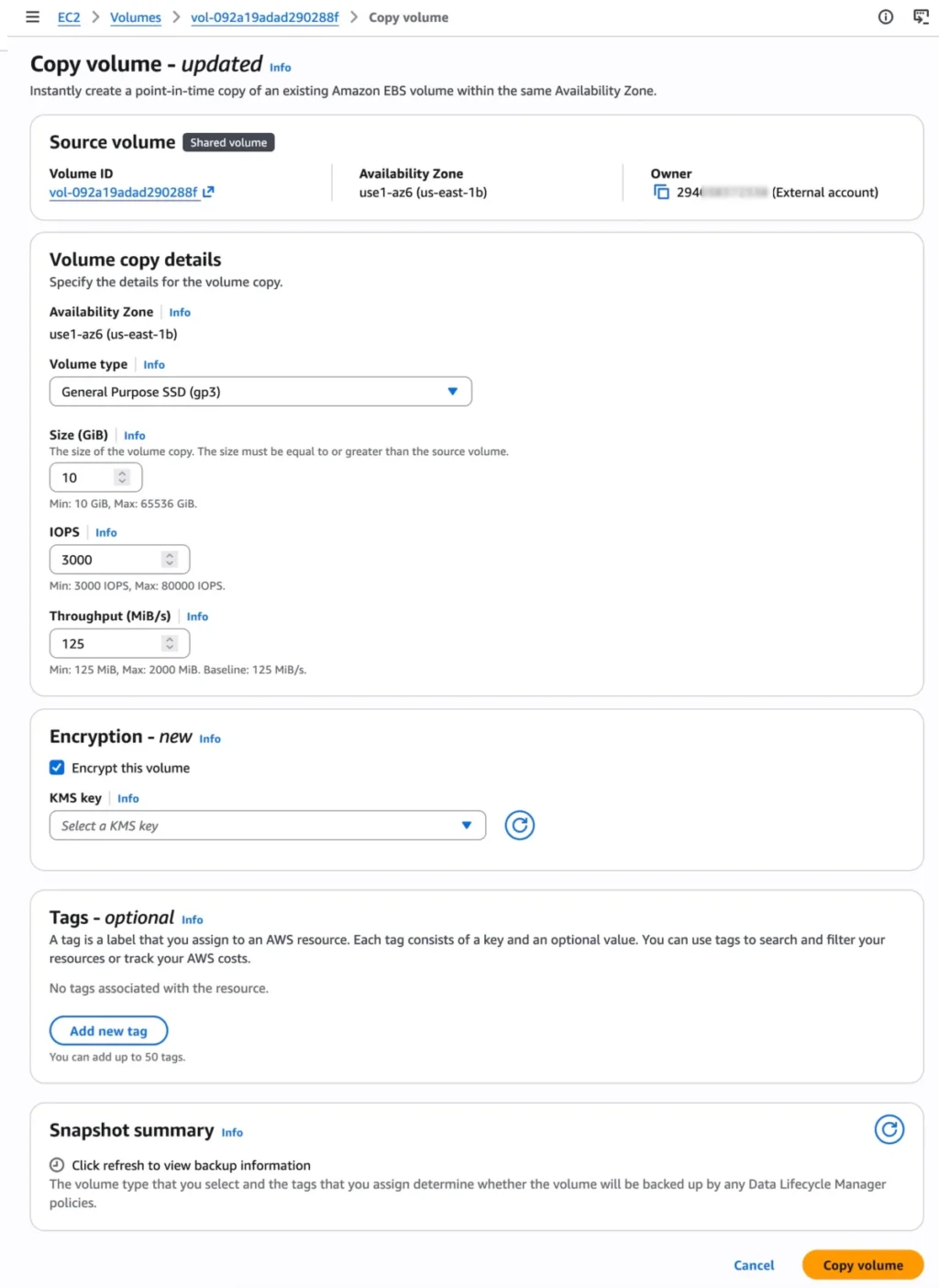
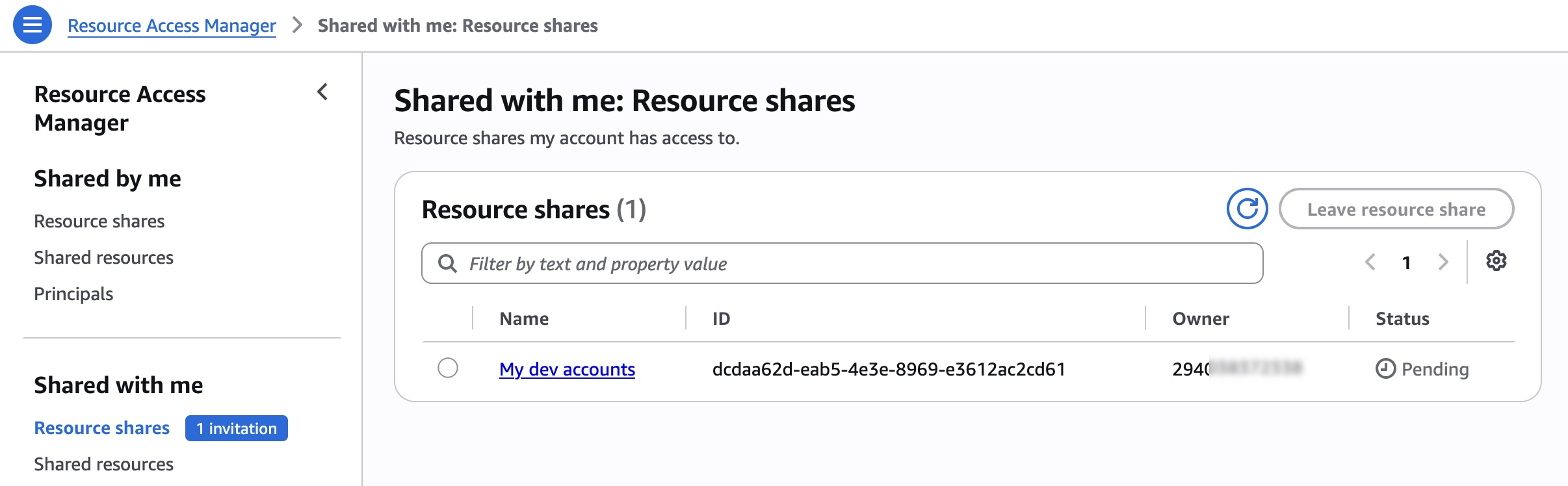
The administrator of the target AWS account logs into their RAM console, views the pending invitation, and explicitly accepts the resource share. Once accepted, the shared volume becomes visible within the target account’s EBS console interface. - Copying and Re-encryption:
From the target account interface, the administrator selects Copy volume. During this step, the system allows the user to apply a target-account AWS KMS key, ensuring that data sovereignty and encryption keys remain under the absolute control of the receiving account’s security team.
Programmatic and AI-Assisted Operations
For DevOps teams prioritizing Infrastructure as Code (IaC) and automation, AWS has ensured that cross-account volume sharing and copying can be invoked via APIs. Furthermore, AWS has integrated support for the AWS MCP Server and related plugins, allowing engineers to manage, script, and troubleshoot these cross-account routines using preferred AI coding assistants and developer tools.
4. Official Responses and Industry Context
Industry analysts and AWS architecture spokespeople have emphasized that this feature directly addresses the "multi-account tax"—the operational friction that often accompanies enterprise security best practices.
Speaking on the release, AWS engineering representatives noted that modern enterprise applications demand agility without compromising security posture. By segregating environments into distinct AWS accounts, organizations mitigate blast radiuses and enforce strict access controls. Yet, this isolation often creates bottlenecks when developers need realistic, up-to-date data sets to diagnose bugs or test new features.
"Cross-account volume clones eliminate the compromise between security and developer velocity," noted cloud infrastructure specialists following the release. "Teams no longer have to choose between keeping production strictly locked down or providing developers with stale, anonymized mock data. They can now pipe fresh, production-grade insights securely across accounts in a matter of clicks."
5. Implications for Enterprise Architecture and Security
The introduction of cross-account Amazon EBS Volume Clones carries far-reaching implications across multiple dimensions of cloud operations:
Enhanced Security and Compliance
In highly regulated sectors such as finance, healthcare, and government, compliance frameworks demand that production data never mingle with development sandboxes. The ability to route clones into separate accounts and immediately wrap them in target-account-controlled KMS encryption keys ensures that data governance policies remain unbroken. Auditors can clearly trace data lineage and ownership from production to staging environments.

Accelerated Software Delivery Life Cycles (SDLC)
Development and QA teams frequently suffer delays waiting for database seeds or large storage arrays to provision. By leveraging instant volume clones that can now be dispatched directly to developer accounts, CI/CD pipelines can dynamically spin up ephemeral testing environments loaded with exact replicas of production data. This dramatically improves the fidelity of integration tests and shortens time-to-market for software releases.
Cost Optimization and Resource Efficiency
While traditional snapshot copying and multi-region or multi-account restorations can incur significant storage and network overhead, the underlying architecture of EBS Volume Clones minimizes redundant storage consumption through its efficient allocation model. Organizations can maintain leaner, more responsive testbeds without bloating their cloud storage bills.
Availability and Next Steps
Cross-account volume clones for Amazon EBS are generally available starting today. The feature is deployed across all AWS Regions that currently support Amazon EBS Volume Clones.
Cloud architects, DevOps engineers, and system administrators can begin experimenting with the capability immediately through the Amazon EC2 Console. For detailed technical documentation, API references, and regional rollout roadmaps, practitioners are encouraged to consult the official Amazon EBS User Guide and share feedback via the AWS re:Post community channels.