The AI Shift: Custom GPTs Retire, Major Model Updates Land, and the Blueprint for Brand Consistency

As the digital landscape prepares for another weekend, the artificial intelligence sector is moving at a breakneck pace. Major platform pivots are disrupting long-standing marketing strategies, tier-one foundational models are getting sweeping upgrades, and marketers are forced to re-evaluate how they build lead magnets, design assets, and deploy intelligent agents.
With OpenAI sunsetting custom GPTs, Anthropic rolling out high-efficiency speed demons, and Google, Meta, and OpenAI introducing massive model upgrades, the definition of digital marketing automation is being rewritten in real-time.
Here is a comprehensive breakdown of the major shifts, chronological developments, supporting data, official responses, and long-term implications for professionals navigating the modern AI economy.
Main Facts: The Core Developments Shaping the Industry
The digital marketing and AI ecosystems are experiencing structural shocks across three primary pillars: infrastructure deprecation, enterprise-grade model launches, and paradigm shifts in user interface design.
- The Death of Custom GPTs: OpenAI has officially announced the retirement of custom GPTs, scheduled for December 11. As old GPT links stop functioning, digital marketers relying on them for lead generation must migrate to alternative architectures.
- The Rise of ChatGPT Sites: Positioned as an upgrade rather than a mere replacement, ChatGPT Sites allow creators to host interactive, standalone web pages built and managed directly by ChatGPT. These pages require no login for visitors, fundamentally transforming static lead magnets into dynamic calculators, quizzes, and recommendation tools.
- A Saturated Advice Market: The sheer volume of AI "hot takes" has created widespread noise for marketers trying to separate actionable tactics from superficial theories, driving a demand for peer-reviewed, practitioner-led training.
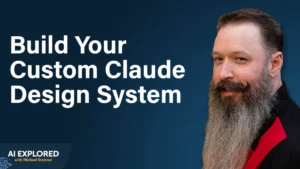
- The Blueprint for Brand Consistency via Claude Design: AI strategist Jeff Sieh has demonstrated how Claude Design can act as a programmatic art director. By establishing a portable design system, marketers can scale on-brand slide decks, landing pages, and motion graphics across disparate tools without falling into the trap of generic, template-driven output.
- Major Breakthroughs in Foundational Models: Over a single weekly cycle, nearly every major AI titan—Anthropic, Google, Meta, and OpenAI—has shipped revolutionary updates to their models, focusing heavily on agentic workflows, multi-app integration, intelligent UIs, and cost-efficiency.
Chronology: A Week of Rapid Evolution
To understand how quickly the ground is shifting beneath marketers’ feet, it is essential to look at the timeline of releases and policy announcements driving this week’s news cycle:
- Early Week: Industry reports and benchmark surveys—such as the newly released 2026 AI Marketing Industry Report—begin circulating, highlighting a startling statistic: 93% of marketers are learning AI entirely through self-taught trial and error, with only 7% receiving formal corporate training.
- Mid-Week (Infrastructure & Model Updates):
- Anthropic launches Claude Haiku 5.5, optimizing high-volume workloads for speed and cost while introducing adjustable reasoning effort. Simultaneously, cache-read costs for Sonnet 5.5 are slashed.
- Google deploys Gemini 4 Argon to consumer applications, weaving in Google Antigravity for macOS, dedicated task delegation modes, and connectivity spanning over 40 third-party platforms.
- Meta unveils the Muse Wonder and Muse Wonder Full model families, aiming to bridge the gap between administrative document analysis and automated application development.
- Late Week (Platform Policy & UI Revolutions):
- OpenAI announces the widespread rollout of GPT-6 alongside Intelligent UI, shifting ChatGPT away from plain text into a dynamic canvas capable of rendering real-time charts, interactive forms, and calculators.
- X (formerly Twitter) introduces expanded capabilities for Grok Bot, enabling direct content tracking, user feedback monitoring, and automated recurring industry summaries without requiring complex developer configurations.
- OpenAI’s Legacy Countdown: The impending December 11 retirement date for custom GPTs gains intense industry focus, forcing creators to weigh moving instructions into private Skills or restricted plugins versus transitioning to ChatGPT Sites.
Supporting Data: What the Numbers Tell Us
Navigating the AI era requires empirical grounding rather than anecdotal optimism. Recent data paints a vivid picture of how organizations are adapting—and where they are faltering:
- The Training Void: A comprehensive survey of 681 marketers conducted for the 2026 AI Marketing Industry Report revealed that 93% of professionals receive zero formal AI training from their employers. This reliance on solo trial-and-error leaves teams vulnerable to inefficiencies and inconsistent outputs.
- The Migration Urgency: With custom GPT links set to permanently break on December 11, thousands of businesses face sudden friction in their top-of-funnel conversion paths. Replacing passive chat interfaces with interactive, zero-login ChatGPT Sites is projected to drastically reduce drop-off rates.
- Model Efficiency Gains: Anthropic’s release of Claude Haiku 5.5 and Google’s Gemini 4 Argon signal a race to the bottom for latency and cost in high-volume programmatic tasks, making browser automation and customer support subagents economically viable for small-to-medium businesses for the first time.
Official Responses and Industry Reactions
As platform architectures shift, creators, developers, and tech executives are responding to the new operational reality.
- On the Retirement of Custom GPTs: OpenAI’s structural pivot has forced a reassessment of lead-generation funnels. Digital strategists note that while moving prompts into private Skills preserves internal logic, the public-facing friction of a blank chat window was always a conversion killer. Industry experts are universally championing ChatGPT Sites as a necessary evolution toward conversational UI that asks questions before providing answers.
- On Design Systems and AI Branding: Jeff Sieh, addressing the common pitfall of generic AI graphics, emphasized that treating models like basic image generators guarantees sub-par results: "A design system is the foundation for everything. When you treat Claude Design like an art director and export a portable design file, you carry your brand identity safely across every tool in your tech stack."
- On Enterprise Agentic Workflows: Representatives from Meta and Google have highlighted that the current wave of models—ranging from Muse Wonder to Gemini 4 Argon—is purposefully designed to move past simple text generation. The focus has decisively shifted toward action execution, allowing models to coordinate workflows across dozens of third-party business applications autonomously.
Implications: What This Means for Marketers and Business Leaders
The convergence of these events carries profound strategic implications for anyone building a brand, a product, or a content engine in the digital space.

1. The Death of the Passive Lead Magnet
If your business relies on a custom GPT link tucked inside a blog post, white paper, or social media bio, you are operating on borrowed time. December 11 marks the end of an era. The mandate moving forward is interactivity. Marketers must pivot toward ChatGPT Sites or alternative web applications that engage prospects with diagnostic quizzes, tailored calculators, and interactive assessments rather than expecting cold traffic to know how to prompt a blank text box.
2. Operationalizing Brand Identity
The democratization of content creation has flooded the internet with homogenized, easily identifiable "AI slop." To stand out, brands must invest heavily in proprietary design systems. By leveraging tools like Claude Design to generate structured, portable brand guides, marketers can enforce visual consistency across newsletters, podcasts, video thumbnails, and automated websites, protecting their brand equity from looking mass-produced.

3. Embracing Agentic Automation
We are moving past the era where AI is used exclusively for drafting copy. With Google’s task-mode integrations, Meta’s Muse Wonder models, and Anthropic’s high-speed Haiku subagents, AI is becoming an active participant in operational workflows. Marketers who learn to orchestrate multi-app automation and browser agents will dramatically outpace competitors who remain tethered to manual data entry and repetitive administrative tasks.
4. Closing the Knowledge Gap
With 93% of marketers navigating the AI revolution entirely on their own, institutionalizing education has become a competitive advantage. Forward-thinking organizations are moving away from isolated experiments and toward structured, practitioner-led training communities to ensure their teams understand not just which tools to use, but how to build durable systems that survive platform updates.

Final Thoughts
The rules of the AI playbook are being rewritten overnight. Whether it is adapting to the loss of custom GPTs, mastering new design protocols, or deploying agentic workflows, standing still is no longer an option. The businesses that audit their tech stacks today, embrace interactive site architectures, and double down on foundational brand systems will own the next era of digital marketing.