Google Overhauls AI Search Link Presentation: Five Major Updates Aim to Boost Visibility for Publishers and Creators
MOUNTAIN VIEW, Calif. — In a sweeping effort to refine how users interact with generative artificial intelligence within search, Google has announced a suite of five major updates altering how links, sources, and creator profiles are presented in AI Mode and AI Overviews. Unveiled in a detailed blog post by Hema Budaraju, VP of Product Management at Google, the changes seek to establish a more transparent, navigable, and user-centric ecosystem for web traffic.
The updates arrive as search engines increasingly grapple with the balance between delivering direct answers via AI and driving essential traffic to third-party publishers, creators, and official resource hubs. Among the most notable modifications are the increased prominence of inline links, the introduction of top-tier official source sections for niche queries, expanded geographical rollouts for timely article carousels, and the integration of creator Search profiles directly into AI Mode video results.
Main Facts: What Is Changing in Google’s AI Search?
Google’s latest product evolution introduces five specific adjustments designed to reshape the architecture of AI-generated search results:
- Higher-Placement Inline Links: Google has significantly increased the presence of inline citations, placing them higher up within response listings to give users immediate access to foundational sources.
- Dedicated Official Source Sections: The search giant is currently testing a specialized section at the very top of select AI responses. This feature highlights official, authoritative websites for task-oriented searches where reliable resources are scarce.
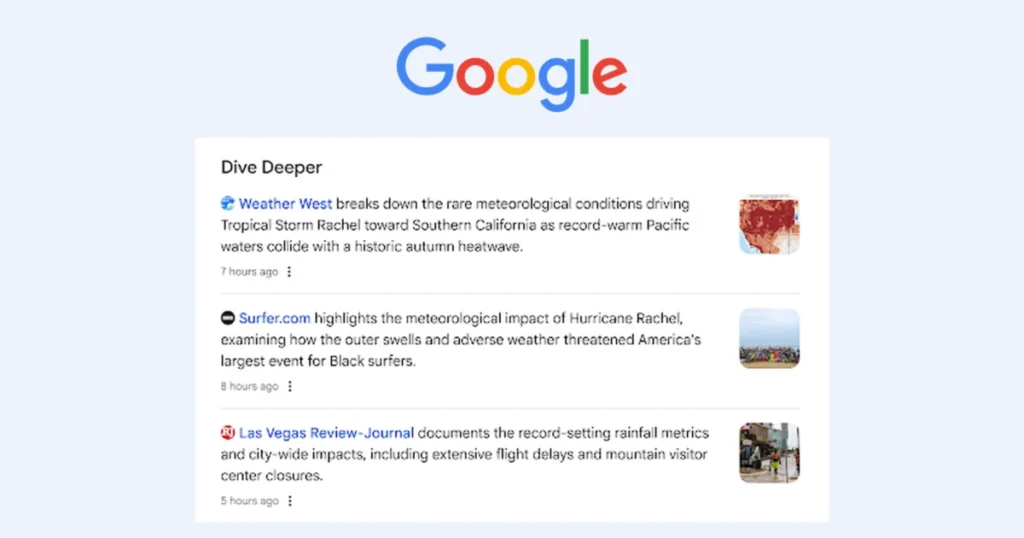
- Redesigned "Dive Deeper" Cards: Links positioned at the bottom of AI responses are receiving a visual overhaul, now featuring prominent image thumbnails and a design engineered to encourage higher click-through rates.
- Global Expansion of Timely Article Carousels: Carousels that highlight breaking or developing news from a user’s "Preferred Sources" are rolling out to additional international markets and languages.
- AI Mode Creator and Publisher Profiles: Google has begun testing clickable creator and publisher names within AI Mode video results, directly linking users to comprehensive Search profiles.
Chronology: The Evolution of Google’s AI Linking Strategy
To fully understand the weight of these updates, it is necessary to examine the timeline of Google’s recent structural shifts regarding AI-driven search experiences:

- May (Earlier This Year): Google initially signaled a shift toward deeper source integration during a major search update, noting that users could soon expect to see more inline links displayed directly adjacent to relevant text blocks. The company also introduced the concept of "Preferred Sources," allowing users to curate publications they wished to prioritize, alongside initial plans for topical article carousels.
- June: Google officially launched Search profiles for creators and publishers. Designed as centralized hubs, these profiles aggregate a creator’s articles, videos, and social media footprint into a single cohesive landing page accessible via mobile knowledge panels and Discover feeds.
- October (Current Week): Google officially announced the five-point update detailed by Hema Budaraju. Simultaneously, the company initiated live tests for embedding creator Search profile links directly inside AI Mode video results, while expanding timely article carousels globally.
Supporting Data and Technical Metrics
While Google has remained tight-lipped on exact mathematical increments regarding traffic distribution, company disclosures and platform documentation reveal notable trends:
- Surge in "Preferred Sources" Adoption: According to Google’s latest metrics, the volume of users actively engaging with the "Preferred Sources" feature has skyrocketed to more than seven times its baseline figure from the beginning of the year. While exact user counts were omitted, the massive multiplier underscores a growing consumer demand for editorial control over AI feeds.
- Eligibility Boundaries for Search Profiles: Google’s official support documentation dictates strict baseline requirements for creators and publishers wishing to establish a Search profile. Availability is currently restricted to the United States, Canada, and India. Furthermore, creators must boast a minimum following of 10,000 users on major platforms such as YouTube, Instagram, X (formerly Twitter), or TikTok, and must manage their presence through a Google Account belonging to an individual aged 18 or older.
- Search Console Architecture: SEO professionals must note that Search Console still treats all inline links within an AI Overview as sharing the overview’s singular collective position in search engine results pages (SERPs). Consequently, simply moving an inline citation higher within the text block does not inherently alter the underlying technical ranking position of that specific link inside Search Console analytics.
Official Responses and Strategic Intent
Google’s leadership frames these modifications as a continuous commitment to connecting users with high-quality, trustworthy content while empowering the publishers and independent creators who produce it.
In her blog post, Hema Budaraju emphasized that the updates are engineered to give searchers clearer pathways to the primary originators of information. By placing inline links higher in response bodies, Google aims to mitigate the "black box" critique often leveled at generative AI models—namely, that they synthesize information without adequately crediting or driving traffic to human creators.
The introduction of dedicated official-site modules at the top of task-based searches—accompanied by explicit context explaining why a particular link is recommended—reflects a proactive measure against misinformation or low-quality aggregation in critical consumer scenarios, such as government filings, airline refunds, or emergency services.

Implications for Publishers, Creators, and SEO Professionals
For digital publishers, SEO strategists, and independent content creators, these five updates carry profound implications for organic visibility, audience acquisition, and technical optimization:
1. The Value of Inline Citations
With Google making continuous, substantial increases to inline link presence near the top of AI responses, earning a citation early in an AI-generated paragraph is more critical than ever. Although Search Console lumps these links into the overarching overview’s ranking tier, early visual placement dramatically elevates the probability of direct user engagement.
2. Capitalizing on Preferred Sources
As the timely article carousels expand across more languages and international territories, publishers must encourage their core audiences to utilize Google’s "Preferred Sources" feature. According to Google’s developer documentation, a site must be properly indexed within generative AI features in Search Console to qualify for inclusion in these specialized carousels. Publishers can leverage native buttons and deep links to prompt their regular readers to explicitly add their domain to their Preferred Sources list.
3. Integrating Search Profiles for Enhanced Authority
For video creators and publishers who meet the 10,000-follower threshold, setting up a Search profile is rapidly becoming a vital branding requirement. With Google testing direct profile links inside AI Mode video results, establishing an official Search profile ensures that users can seamlessly transition from an AI-curated video snippet directly into a trusted, centralized repository of the creator’s broader body of work.

Looking Ahead
As Google continues to test its newly proposed task-based official site sections and AI Mode creator profiles in isolated environments, a definitive rollout date has not yet been established. However, because the geographic and linguistic expansion of timely article carousels is already underway, web administrators and digital marketers are advised to closely monitor their AI Search performance metrics across global markets.
Ultimately, these changes signal a maturing phase for generative search—one where Google is actively experimenting with architectural bridges to keep publishers, creators, and authoritative sources inextricably linked to the AI-driven future of the web.