Beyond the Bottleneck: How Speculative Decoding is Supercharging LLM Inference
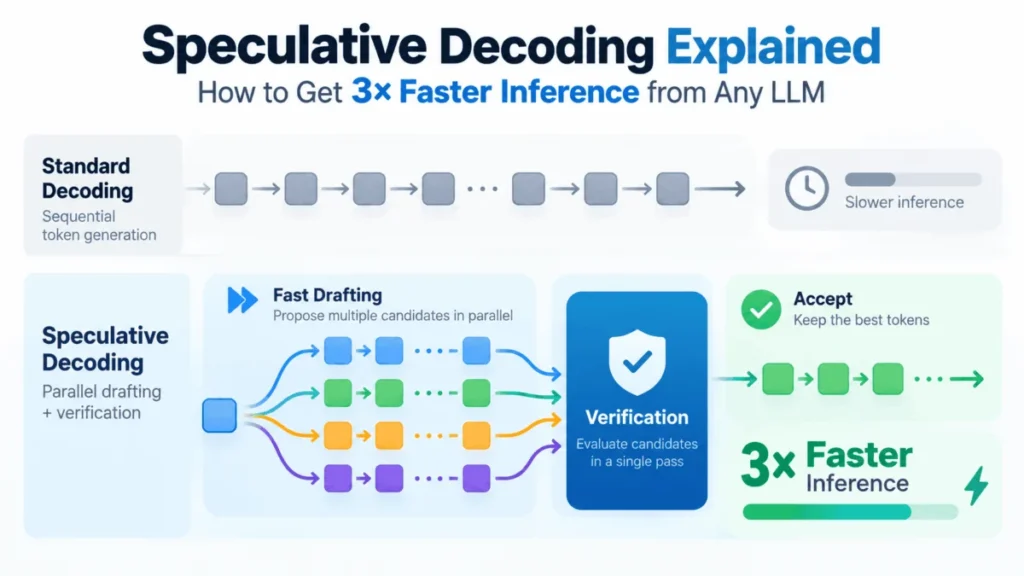
In the rapidly evolving landscape of generative artificial intelligence, the gap between model capability and deployment efficiency has become the industry’s most pressing challenge. While researchers continue to push the boundaries of model size and reasoning, the practical reality for engineers is governed by the "memory wall." Every time a user prompts a chatbot, the model generates text one token at a time—a slow, sequential process that feels like reading a book by opening the cover, reading one word, closing the book, and repeating the process for every subsequent word.
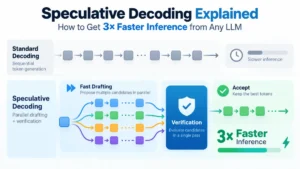
Speculative decoding has emerged as the industry’s most elegant solution to this limitation. By decoupling the generation process into a rapid, "drafting" phase and a rigorous, parallel "verification" phase, this technique allows Large Language Models (LLMs) to achieve 2x to 3x speed improvements without sacrificing the integrity of the output.
The Core Problem: The Memory Bandwidth Wall
To understand the genius of speculative decoding, one must first understand the fundamental constraint of modern GPU architecture. Large Language Models are, by nature, autoregressive; they generate the next token based solely on the sequence of tokens that came before.
The primary bottleneck is not the mathematical complexity of the calculations themselves, but the physical movement of data. An LLM consists of billions of parameters—weights that must be loaded from high-bandwidth memory (HBM) into the GPU’s compute units. For every single token generated, the entire model must be "read" from memory. Because the processor is significantly faster than the memory’s ability to supply data, the compute units spend the vast majority of their time idling, waiting for the next set of weights to arrive. This state is known as being "memory-bandwidth bound."
Adding more compute power, such as stacking more H100 GPUs, does not solve this problem because the bottleneck remains the speed at which the model’s parameters can be fed into the processors. This is the "one-token-at-a-time" tax that makes real-time AI agents and high-frequency coding assistants so computationally expensive.
The Mechanics of Speculative Decoding: A Two-Model Symphony
Speculative decoding solves this by shifting the strategy from "generate one, wait, generate next" to "draft a batch, verify all." It introduces a two-tier system:
- The Draft Model: A small, highly efficient, and lightweight model that "guesses" the next few tokens. Because it is small, it can generate these tokens at incredible speeds.
- The Target Model: The high-quality, large-scale model that acts as the final arbiter.
The Operational Loop
The process functions as a high-speed loop:
- Drafting: The draft model predicts a sequence of candidate tokens (typically four to eight).
- Verification: Instead of processing these tokens sequentially, the target model performs a single "forward pass" over the entire candidate sequence. Because modern GPUs are optimized for parallel matrix operations, verifying four tokens takes almost the same amount of time as processing a single token.
- Correction: The target model compares the draft tokens against its own internal probability distribution. If the target model agrees with the draft, the tokens are kept. If it disagrees, the target model rejects the incorrect tokens, replaces them with its own, and the loop resets.
Crucially, this is not an approximation. Through a specific statistical sampling method, the final output is mathematically guaranteed to be identical to what the target model would have produced on its own. The user gets the speed of a small model with the intelligence of a massive one.
Chronology of Innovation: From Research to Production
The evolution of speculative decoding has moved at breakneck speed. The initial theoretical framework was popularized in 2023 through seminal research papers like "Fast Inference from Transformers via Speculative Decoding."
- Early 2023: Researchers demonstrate that using a small DistilBERT-style model to draft for a larger T5 or Llama model significantly reduces latency without losing perplexity.
- Late 2023: The technique begins migrating from academic labs into production-grade inference engines. Projects like
llama.cppintroduce speculative decoding, making the technology accessible to developers running local models on consumer hardware. - 2024: The emergence of "Draft-less" speculative decoding. Researchers realize that they can eliminate the need for a separate model entirely. Methods like Medusa and Eagle introduce additional "heads" to the existing model, allowing it to predict multiple future tokens simultaneously.
Supporting Data: When Does it Actually Help?
The efficacy of speculative decoding is not universal; it is highly dependent on the "acceptance rate"—the frequency at which the target model agrees with the draft model.
| Task Type | Expected Acceptance Rate | Typical Speedup |
|---|---|---|
| Code Completion | High (80%+) | 2.5x – 3.0x |
| Document Summarization | Moderate (60-70%) | 1.8x – 2.2x |
| Creative Writing | Low (40-50%) | 1.2x – 1.5x |
| Highly Random/Chatty | Low (<40%) | Negligible/Overhead |
The data confirms that the technique shines in structured domains. In coding, where the syntax is rigid and predictable, the draft model rarely misses. Conversely, in open-ended creative writing where the "next token" is highly unpredictable, the overhead of the draft model can sometimes outweigh the benefits.
Official Perspectives and Industry Implementations
Industry leaders have been quick to integrate this into the core infrastructure of the AI stack.
- vLLM and Hugging Face: Both major inference platforms have treated speculative decoding as a "first-class citizen." By providing easy-to-use APIs for speculative execution, they have enabled startups to slash their cloud compute bills by half.
- The "Prompt Lookup" Paradigm: Many practitioners have moved toward "Prompt Lookup Decoding." By leveraging the fact that LLMs often repeat content found in the user’s prompt (such as variable names in code or specific terminology in a legal document), this method skips the draft model entirely, using the prompt itself as the "guess."
According to engineering leads at top AI infrastructure firms, the shift is not just about cost—it is about user experience. "A chatbot that responds in 200 milliseconds feels like a tool," one lead engineer noted. "A chatbot that responds in 2 seconds feels like a service. Speculative decoding is the difference between those two realities."
Implications for the Future of AI Scaling
The implications of speculative decoding reach far beyond mere speed.
1. Democratizing Access
By reducing the compute cost per token, speculative decoding effectively lowers the barrier to entry for smaller companies. When a single NVIDIA H100 can serve three times as many users, the cost per request drops proportionally, allowing for more aggressive deployment of sophisticated models.
2. The Death of the "Slow" Model
As speculative techniques become standard, the industry may shift away from optimizing models for raw parameter counts alone. We are seeing a move toward "model families"—where a massive "teacher" model is trained in tandem with a specialized "drafting" model, creating a cohesive, high-performance ecosystem.
3. Energy Efficiency
In an era where the environmental impact of AI training and inference is under intense scrutiny, speculative decoding offers a greener path forward. By ensuring that the expensive, power-hungry target model only does the "heavy lifting" when absolutely necessary, we can optimize the energy footprint of large-scale deployments.
Conclusion
Speculative decoding has transformed the "one-token-at-a-time" bottleneck from an immutable law of physics into a manageable engineering challenge. By intelligently layering a fast, speculative layer over a robust, verified core, the AI community has unlocked a new tier of efficiency.
Whether through the use of secondary draft models, multi-headed architectures like Medusa, or simple prompt-lookup heuristics, the message is clear: the future of AI inference is parallel. As these techniques continue to mature and integrate into the underlying hardware-software stack, we can expect the "instant response" threshold—the point at which an AI feels as fast as a local computer—to become the standard for every application, from global enterprise search to the next generation of personal AI assistants.
The era of waiting for tokens to trickle onto our screens is rapidly coming to an end. Through speculative decoding, the response is already waiting for us.