Bridging the Visual Gap: Building Advanced Multi-Modal RAG Pipelines for Complex Documents
In the rapidly evolving landscape of Artificial Intelligence, Retrieval-Augmented Generation (RAG) has emerged as the gold standard for grounding Large Language Models (LLMs) in private, domain-specific data. However, standard RAG architectures—those designed primarily for plain text—are increasingly hitting a performance ceiling. When confronted with corporate annual reports, technical engineering schematics, or medical PDFs, these traditional systems often fail. They treat a document as a flat stream of text, effectively "blinding" the model to the critical insights buried in charts, tables, and infographics.
This article explores the technical architecture of a multi-modal RAG pipeline, a sophisticated solution designed to treat visual elements as first-class citizens within an information retrieval system. By integrating Python, LangChain, and OpenAI’s GPT-4o, developers can now build systems that truly "read" documents in their entirety, synthesizing prose with visual evidence to provide comprehensive, accurate answers.
The Problem: The "Blind Spot" in Legacy RAG
The core limitation of conventional RAG lies in its preprocessing stage. Most pipelines rely on simple text-based chunking, which typically strips away formatting and ignores non-textual elements entirely. When an LLM attempts to answer a question about a quarterly revenue trend that is depicted only in a bar graph, it may find the surrounding text but fail to interpret the visual data points.
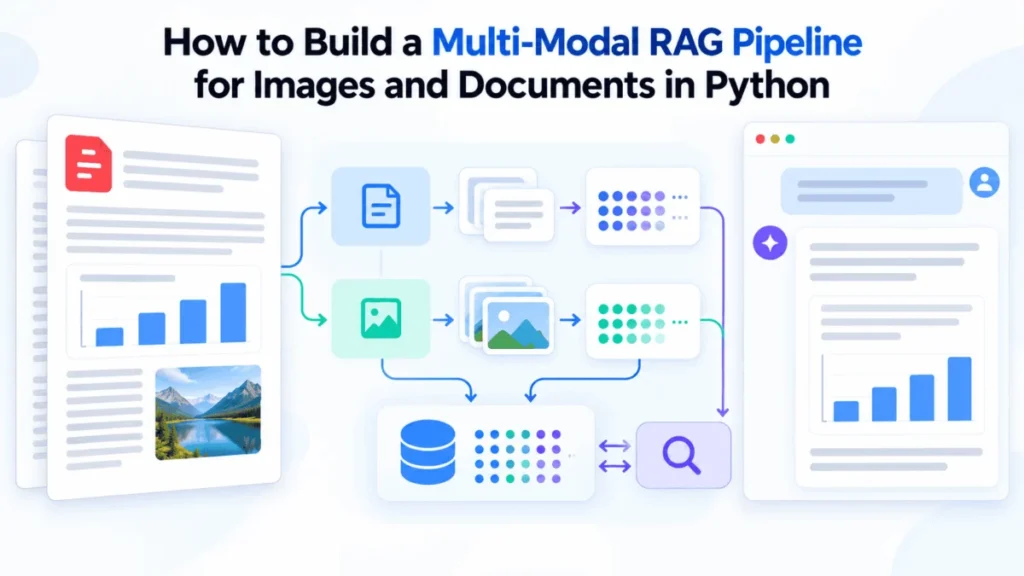
This fragmentation leads to "hallucinations" or, worse, "confidently incorrect" answers. In a business context, this is unacceptable. A multi-modal RAG pipeline addresses this by parsing documents into heterogeneous elements—text, tables, and images—and ensuring that each element is indexed in a way that preserves its context.
Chronology of the Pipeline: From Extraction to Insight
Building a multi-modal RAG system follows a precise, four-stage lifecycle. Each stage is essential for ensuring that the final output is not just a summary of text, but a cohesive synthesis of multi-modal evidence.
Stage 1: Granular Document Parsing
The process begins with the unstructured library, a powerful tool for document ingestion. Unlike standard PDF readers, partition_pdf() classifies content types during the parsing phase. It effectively "deconstructs" a document, identifying paragraphs, distinct tables, and isolated image blocks. By extracting these into separate objects, the pipeline prevents the loss of structure that typically occurs during standard text conversion.
Stage 2: The Summarization Bridge
A vector database cannot natively "see" an image. To make an image searchable, we must create a text-based proxy that describes the visual content with enough granularity to be retrieved by a natural language query. We leverage GPT-4o to act as an automated annotator. By sending the image to the model with a prompt optimized for retrieval—asking it to describe the image in the context of a search system—we generate a high-quality summary that serves as the "indexable" representation of that visual.
Stage 3: The Multi-Vector Store Architecture
Once we have text chunks and image summaries, we must store them. A MultiVectorRetriever is used to manage the relationship between these searchable summaries and the raw documents. The vector store holds the embeddings, while a secondary document store holds the original assets. This separation allows for efficient similarity searches while maintaining the integrity of the source files.
Stage 4: Multimodal Retrieval and Reasoning
The final stage occurs at query time. When a user submits a question, the retriever fetches both relevant text chunks and the summaries of relevant images. The system then assembles these elements—text and the raw image files—and feeds them into a multimodal LLM like GPT-4o. This allows the model to "look" at the chart and "read" the text simultaneously to construct a unified answer.
Supporting Technical Data: Implementation Prerequisites
To implement this architecture, developers must prepare their environment. The system relies on several core dependencies, including langchain, langchain-openai, unstructured, chromadb, and pillow. Crucially, users must install poppler-utils on the host machine to facilitate the low-level rendering required for PDF image extraction.
Code Snippet: Initializing the Parser
from unstructured.partition.pdf import partition_pdf

raw_elements = partition_pdf(
    filename="financial_report.pdf",
    extract_image_block_types=["Image"],
    extract_image_block_output_dir="./extracted_images",
    infer_table_structure=True,
    chunking_strategy="by_title",
    max_characters=4000,
)
This parsing strategy is the foundation of the pipeline. By setting infer_table_structure=True, the developer ensures that complex grids are not just flattened into unintelligible strings, but interpreted as structured data, which is essential for analytical tasks.
Implications for Enterprise AI
The move toward multi-modal RAG represents a significant shift in how enterprises approach document intelligence. The implications are three-fold:
- Enhanced Decision Support: For sectors like finance, law, and engineering, the ability to query "What was the year-over-year growth shown in the Q3 summary table?" provides an unprecedented level of accuracy.
- Operational Efficiency: Automating the synthesis of visual reports reduces the manual burden on analysts who previously had to correlate text summaries with embedded visuals manually.
- Cost-Benefit Realities: While the cost of running GPT-4o for every image during indexing can be significant, the value derived from high-fidelity answers often offsets these operational expenses. Strategic filtering—such as ignoring small icons or repetitive logos—can further optimize costs.
Official Best Practices and Expert Guidance
As noted in current industry literature, such as the Multimodal AI Guide on KDnuggets, the future of AI is inherently native to multiple data types. When designing these systems, consider the following best practices:
- Implement Re-ranking: After retrieving potential matches, use a cross-encoder or re-ranking model to ensure the most relevant visual evidence is prioritized. This mitigates the noise that can sometimes be introduced by overly broad semantic searches.
- Persistent Storage: While
InMemoryStoreis excellent for prototypes, production systems should transition to persistent stores like Chroma, Pinecone, or Milvus to ensure data durability. - Latency Management: Because image processing and multimodal generation are computationally intensive, consider asynchronous processing for indexing large libraries of documents to keep the system responsive.
Conclusion and Future Outlook
The transition from text-only RAG to multi-modal RAG is not merely a feature update; it is a fundamental maturation of AI-driven document management. By bridging the gap between text and visual data, organizations can unlock the latent value trapped in their document archives.
As we look toward the future, the integration of specialized vision-language models—such as ColPali, which embeds document pages as images—may eventually render traditional parsing obsolete. For now, however, the approach outlined in this tutorial provides a robust, production-ready framework for businesses seeking to gain a competitive edge in how they process, search, and understand complex, document-heavy workflows. The ability to reason over what you see, rather than just what you read, is the new benchmark for intelligence in the enterprise.