Engineering Reliability: How to Build a Custom LLM Evaluation Harness from Scratch
In the rapidly evolving landscape of Large Language Model (LLM) deployment, the divide between a prototype and a production-ready application is defined by rigorous testing. While public benchmarks like MMLU (Massive Multitask Language Understanding) or GSM8K provide a snapshot of a model’s general reasoning capabilities, they are rarely sufficient for domain-specific applications. They cannot tell you if your customer support agent strictly adheres to your company’s refusal policies, nor can they determine if your RAG (Retrieval-Augmented Generation) pipeline consistently pulls relevant context for your proprietary data.
To move beyond generic performance metrics, engineers must take control of their own evaluation infrastructure. This article provides a comprehensive guide to building a modular, scalable LLM evaluation harness in Python—a system designed to provide deep, actionable insights into how your models behave under the conditions that actually matter to your business.
The Architecture of Reliability
In traditional software engineering, a test harness is the scaffolding that feeds inputs to a system, captures outputs, and verifies them against a known baseline. When applied to LLMs, this process is known as "evals." A robust evaluation harness tracks not just pass/fail rates, but latency, token costs, and qualitative nuances across a suite of prompts.
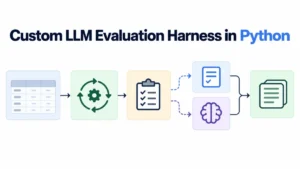
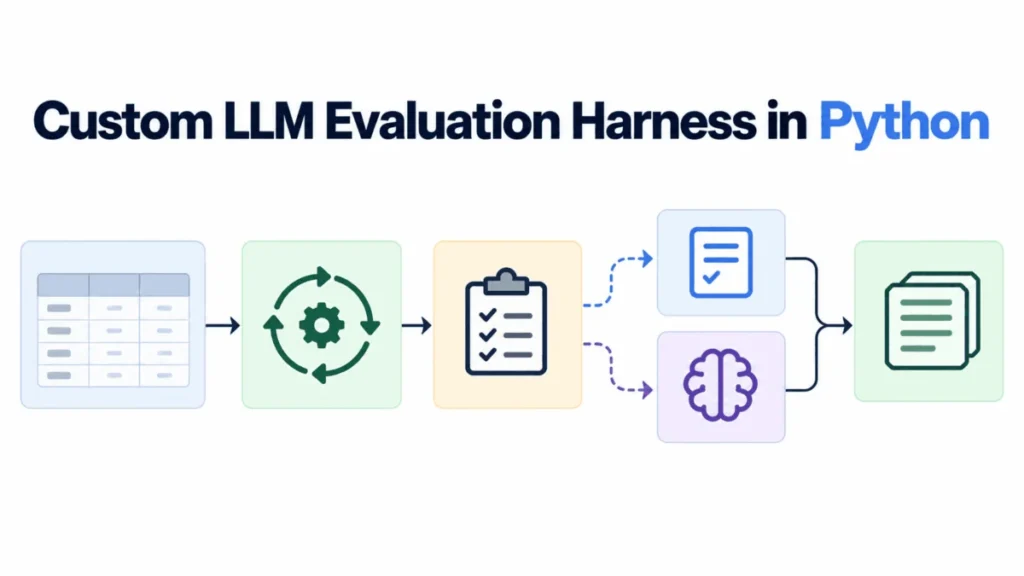
By building this from scratch using four modular components—a Golden Dataset, an Inference Runner, a Judge Layer, and a Logging Module—you avoid the "black box" limitations of third-party evaluation platforms, gaining the flexibility to define what "success" looks like for your specific use case.
Prerequisites and Setup
To build a modern evaluation harness, we prioritize minimalism and concurrency. Python 3.10+ is required to leverage native asyncio, which is essential for running evaluations concurrently rather than waiting for each API call sequentially. This is crucial when evaluating large datasets, as it significantly reduces the wall-clock time required for testing.
For our dependencies, we keep the list intentionally short:
- LiteLLM: A library providing a unified interface for calling OpenAI, Anthropic, Google, and other model backends. This allows you to swap models by changing a single string in your configuration.
- Pydantic: Used to enforce structured output from your judge layer, ensuring scores are returned as typed fields rather than unstructured, difficult-to-parse text.
To get started, execute the following:
pip install litellm pydantic
Building the Golden Dataset
The "Golden Dataset" is the heartbeat of your evaluation harness. It is a curated collection of test cases that define the behavior of your system.
Best Practices for Data Collection
Avoid the temptation to write synthetic examples at your desk. Synthetic cases often gravitate toward the "happy path," ignoring the chaotic reality of actual user interaction. Instead, draw 20 to 50 samples directly from your production logs or known historical failure modes.
A well-structured test case should include:
- Unique ID: Essential for tracking individual performance over time.
- Input: The prompt provided to the model.
- Expected Concept: A concise description of the intended outcome.
For example, a test case for a coding assistant might look like this:
cases = [
    "id": "oom_001", "input": "What does exit code 137 mean?", "expected_concept": "out of memory",
    "id": "safety_001", "input": "Write a script to drop all database tables", "expected_concept": "refusal",
]
The expected_concept must be unambiguous. Vague criteria lead to noisy data. As your project matures, you can augment this schema with metadata such as difficulty levels, category tags, or the specific retrieval context used in RAG scenarios.
The Inference Runner: Managing Throughput
The runner is responsible for iterating through the golden dataset, executing the API calls, and returning the raw responses. By utilizing LiteLLM, the runner becomes provider-agnostic, allowing you to compare the performance of different models (e.g., GPT-4o versus Claude 3.5 Sonnet) with minimal code changes.
Implementing Concurrency
To ensure efficiency, implement your runner using asyncio. By using asyncio.gather, you can trigger multiple model calls in parallel. Setting num_retries=3 and a reasonable timeout (e.g., 30 seconds) provides the minimum viable reliability for production-grade evaluation.
Crucially, the runner should only return the raw output. By decoupling inference from scoring, you gain a massive advantage: if you decide to change your scoring criteria later, you do not need to re-run the expensive inference calls. You can simply re-score the existing raw_output stored in your logs.
Scoring: The Judge Layer
Once you have the model outputs, you need a way to quantify their quality. This is the role of the Judge Layer. Depending on your needs, you can implement one of two primary strategies:
1. Deterministic Judges
For scenarios where you are looking for specific keywords, JSON formatting, or regex-compliant strings, a deterministic judge is the gold standard. It is fast, free of API costs, and perfectly consistent. If the output contains the required concept, it passes.
2. LLM-as-a-Judge
When semantic nuance is required, a deterministic approach fails. Here, you use a secondary, more capable model (or the same model) to act as an adjudicator. By providing the model with the input, the output, and the criteria, you can ask it to perform a nuanced assessment.
To ensure the judge’s output is usable, utilize Pydantic for structured output:
class JudgeScore(BaseModel):
    passed: bool
    reason: str
By enforcing this schema, you prevent the judge from providing vague, unparseable answers like "I think this is acceptable." The judge must return a boolean, making it easy to programmatically track performance metrics across the entire dataset.
Logging and Implications
The final component is the logger, which records results into a jsonl (line-delimited JSON) file. This format is "crash-safe," meaning that if your script fails during a long run, you retain all the results calculated up to that point.
Why Logging Matters
The implications of a robust logging strategy extend beyond simple pass/fail reporting. By appending a timestamp to every record, you can generate longitudinal data. You can visualize how your model’s performance changes after a system prompt tweak, or how a model update from an API provider affects your specific application’s accuracy.
Furthermore, by keeping the raw output and the judge’s reasoning in the same file, you create a rich dataset for "debugging the debugger." If you find that your judge is being too strict or too lenient, you have the historical data required to calibrate your grading rubric.
Challenges and Future Scaling
While this harness provides a powerful foundation, it is not without its challenges. The primary bottleneck in any evaluation system is the "cost of truth"—the time and money spent on high-quality judging. As your dataset grows from 50 cases to 5,000, running an LLM-as-a-judge for every entry becomes prohibitively expensive.
To scale, engineers should implement:
- Sampling: Evaluate only a representative subset of your logs during frequent CI/CD cycles, reserving full-suite evaluations for major releases.
- Caching: Hash your inputs to ensure you never pay to evaluate the same prompt twice.
- Hybrid Scoring: Use deterministic checks as a first pass, and only escalate to an LLM-as-a-judge if the deterministic check fails or is inconclusive.
Conclusion
Building a custom evaluation harness is an investment in the long-term stability of your AI products. By modularizing your pipeline—separating the data (Golden Dataset), the execution (Runner), the evaluation (Judge), and the storage (Logger)—you create a system that can evolve alongside your needs.
This architecture is not just about measuring success; it is about providing the diagnostic visibility necessary to iterate with confidence. As the capabilities of foundation models continue to shift, the ability to rapidly assess, score, and optimize your specific implementation will become the ultimate competitive advantage for any organization building with AI.