The Reverse Logistics Revolution: Navigating the E-commerce Returns Landscape in Europe
In the modern digital economy, the completion of a transaction is no longer marked by the "purchase" click. Instead, the true conclusion of the customer journey—or, in many cases, the beginning of a new one—lies in the management of returns. For European e-commerce merchants, returns are not merely a logistical nuisance; they are a critical business pillar that defines brand loyalty, operational profitability, and environmental footprint.
As European markets mature, the "try-before-you-buy" culture has transformed from a luxury into a standard expectation. This article provides a comprehensive analysis of the state of returns in Europe, the multifaceted challenges they pose, and the strategic imperatives for merchants aiming to optimize their reverse logistics.
1. Overview of E-commerce Returns in Europe: The New Normal
E-commerce returns have evolved into an integral component of the European commercial landscape. What was once a secondary concern has moved to the boardroom, as the sheer volume of returned goods puts pressure on margins and operational infrastructure.
The Statistical Reality
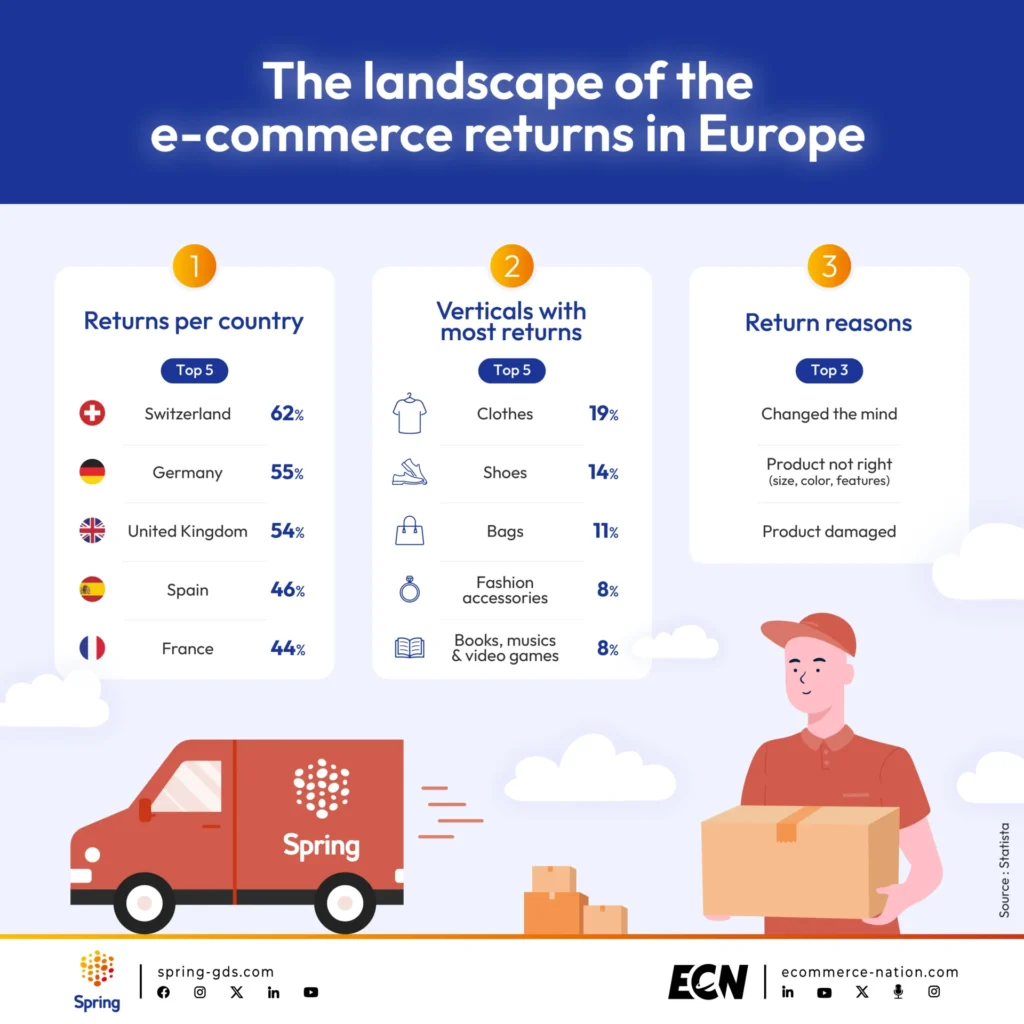
The scale of the phenomenon is staggering. Current data indicates that the average return rate in Europe oscillates between 30% and 40%, though these figures are highly sensitive to sector and geography.
- Switzerland: Leading the charts with a 62% return rate, Swiss consumers exhibit a high propensity for "bracketing"—the practice of ordering multiple sizes or colors with the intent of returning the items that do not fit.
- Germany: Known for its rigorous consumer protection laws and high e-commerce adoption, Germany follows closely with a 55% return rate.
- United Kingdom: With a 54% return rate, the UK market mirrors the German trend, driven by a highly competitive fashion retail environment.
The Impact on Profitability and Satisfaction
The "Free Returns" era is facing a reckoning. As logistical costs rise, merchants are increasingly reconsidering their policies. From a profitability perspective, returns are a "triple threat": they incur processing fees, demand labor-intensive restocking, and often lead to revenue degradation as goods are sold at deep discounts in secondary markets.
However, the consumer side presents a paradox. A transparent, frictionless return policy is often the primary driver of initial purchase confidence. Retailers who over-complicate the return process risk losing not just the current sale, but the customer’s lifetime value.
2. Chronology of Market Evolution: From Convenience to Cost
The trajectory of returns in Europe has shifted over the last decade:
- The Growth Phase (2010–2018): Merchants competed on "No Questions Asked" return policies to build trust in online shopping. Free returns became a marketing tool to lower the barrier to entry for digital retail.
- The Scaling Phase (2019–2021): The COVID-19 pandemic caused an unprecedented surge in online shopping, which simultaneously caused a spike in return volumes. Logistics networks were pushed to their limits, highlighting the fragility of reverse supply chains.
- The Optimization Phase (2022–Present): Faced with inflation, high energy costs, and sustainability mandates, retailers began rolling back free returns. We are now seeing a shift toward "intelligent returns," where data and technology are used to predict and mitigate return triggers.
3. The Multi-Dimensional Challenges
Managing returns in a fragmented European market is a feat of logistical engineering.
Logistical and Cross-Border Complexity
Unlike domestic shipping, cross-border returns involve navigating disparate customs regulations, varying VAT rules, and local return address requirements. For a merchant based in France selling to a customer in Poland, the cost of the return transit can occasionally exceed the value of the product itself.
The Financial Burden
The financial challenge is compounded by the "hidden costs" of returns:
- Processing: The labor cost of inspecting, cleaning, and repacking a returned item.
- Devaluation: Items that cannot be sold as "new" must be liquidated, often at a loss.
- Asset Immobilization: Capital tied up in inventory that is currently in transit or waiting to be processed.
The Ecological Mandate
The environmental impact of reverse logistics is a growing concern for both regulators and consumers. The carbon footprint generated by the "return loop"—shipping a product back to a warehouse, often across borders—is substantial. Furthermore, the reliance on single-use packaging during the initial shipment often leads to excessive waste, as consumers struggle to repack items correctly.
4. Supporting Data: Why Do Consumers Return?
Understanding the root cause is the first step toward mitigation. Market research highlights several recurring drivers for returns:
- Size and Fit (40-50%): Predominantly in the fashion sector, where vanity sizing and lack of standardized measurements lead to disappointment.
- Product Discrepancy (20%): The product does not match the online description or imagery.
- Damaged/Defective Goods (15%): Failures in packaging or quality control.
- Bracketing (10%): Intentional over-purchasing.
- Late Delivery (5%): The customer no longer requires the item by the time it arrives.
5. Official Responses and Industry Shifts
Major European retailers have begun implementing "Official Responses" to the returns crisis, signaling a broader industry shift:
- Charging for Returns: Industry giants have transitioned from universal free returns to charging a flat fee or deducting shipping costs from refunds to discourage abuse.
- Restocking Fees: Some electronics and luxury retailers have introduced restocking fees to cover the labor of technical verification.
- Local Consolidation Centers: To combat cross-border costs, firms are investing in regional hubs that consolidate returns before shipping them back to the primary distribution center, significantly reducing carbon emissions and transit expenses.
6. Strategic Recommendations: How to Optimize Returns
To turn returns from a liability into a competitive advantage, merchants should adopt a three-pronged strategy: Technological, Operational, and Educational.
Technological Integration
- Advanced Size Recommendations: Use AI-driven tools that analyze customer measurements and historical data to recommend the correct size, significantly reducing the "I bought three sizes to see which one fits" behavior.
- Virtual Try-Ons: Leveraging Augmented Reality (AR) to help customers visualize products, which has shown a measurable impact on reducing return rates in the beauty and eyewear sectors.
Operational Streamlining
- Data-Driven Analytics: Treat return data as a diagnostic tool. If a specific SKU has a return rate 20% higher than the category average, it is likely due to a product defect or an inaccurate description. Use this data to trigger an immediate audit of the product page.
- Automated Reverse Logistics: Invest in platforms that automate the creation of return labels and tracking, providing the customer with real-time updates. This reduces support tickets and maintains trust.
Ecological and Customer-Centric Policies
- Eco-Education: Be transparent with customers about the environmental cost of their return. Some brands have successfully implemented "Green Rewards"—offering credit if a customer chooses to keep an item they intended to return or opt for a slower, consolidated shipping method.
- Sustainable Packaging: Use resealable, durable packaging that makes it easy for the customer to return the item without the need for additional plastic or tape, reducing waste and damage during the return journey.
7. Conclusion: The Path Forward
The European e-commerce market is at a crossroads. While the convenience of returns was the engine of early growth, the future lies in precision and sustainability.
Merchants who view returns as a "necessary evil" will continue to bleed margins. Conversely, those who treat reverse logistics as a core business function—leveraging data to prevent returns, using technology to simplify the process, and adopting sustainable practices—will not only protect their bottom line but also build stronger, more loyal relationships with their customers.
In the evolving European regulatory and economic climate, the most successful retailers will be those who can provide a seamless shopping experience while encouraging more conscious consumption. The goal is no longer just to sell; it is to ensure that what is sold stays sold.