Mastering Memory-Efficient Data Pipelines: The Art of Pythonic Streaming
In the modern landscape of data engineering and software development, the mantra "bigger is better" often leads to catastrophic failure. Developers frequently build robust scripts to handle data logs, CSV exports, or JSONL datasets, only to watch those scripts crash under the weight of unforeseen volume. When a nightly log processing job—previously reliable—suddenly dies with a MemoryError after a log rotation creates a 9 GB file, the culprit is rarely the logic. The culprit is almost always the way data is stored: the eager list.
This article explores how Python’s iterators and generators provide a sophisticated, memory-efficient framework for building data pipelines that can process petabytes of information while keeping the memory footprint nearly flat.
The Core Problem: The Eager Trap
The primary reason for memory exhaustion in Python scripts is the "eager" evaluation pattern. Consider a common pattern for processing log files:
with open("app.log") as f:
    records = [parse(line) for line in f]  # The "Eager" Trap
errors = [r for r in records if r["level"] == "ERROR"]
slow = [r for r in errors if int(r["latency_ms"]) > 1000]
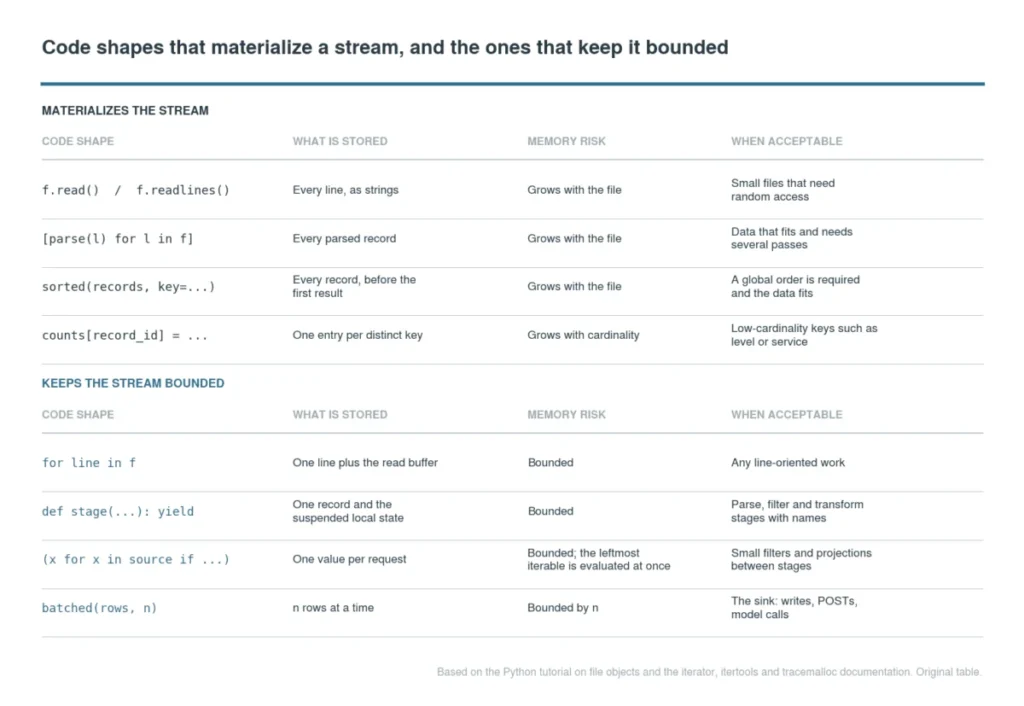
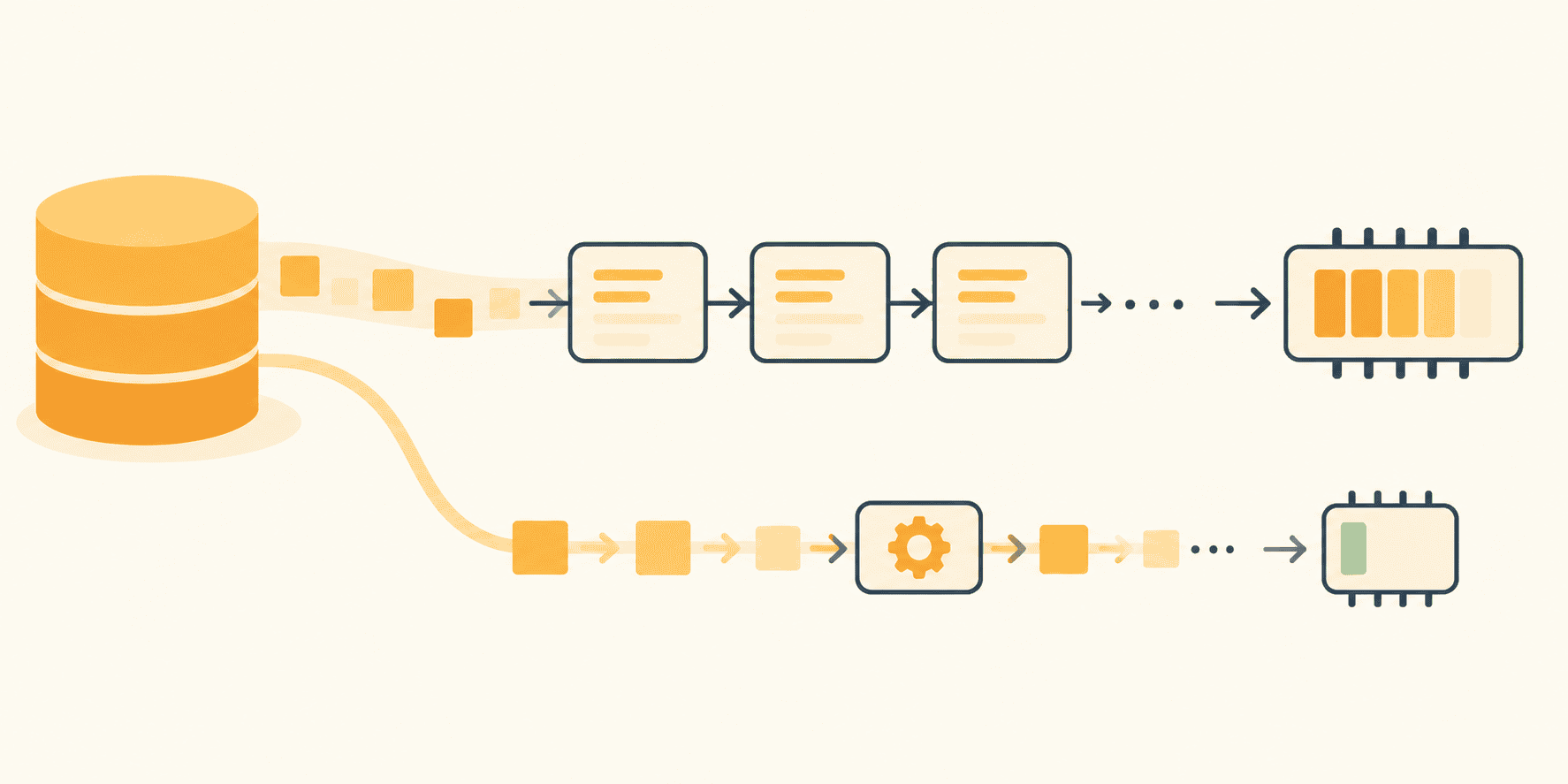
At first glance, this code is idiomatic and clean. However, it violates the first rule of memory efficiency: it holds the entire dataset in RAM. By building a list of records, the script consumes memory proportional to the size of the input file. If the file grows to 9 GB, the script demands at least 9 GB of RAM. When the input exceeds available physical memory, the system triggers an Out-Of-Memory (OOM) error, and the process is killed.
The solution is to embrace "lazy" evaluation. By using generators, developers can build a pipeline that pulls a single record through every stage of transformation, discarding it before the next record is fetched.
Chronology of the Iterator Protocol
To understand how streaming works in Python, one must look at the iterator protocol, a design pattern that has been at the heart of the language for over two decades.
The mechanism is deceptively simple:
- The Iterable: An object that can return an iterator (e.g., lists, files, dictionaries).
- The Iterator: An object that maintains the state of the iteration, keeping track of the "cursor" position.
When you execute a for loop, Python calls iter() on your object to retrieve the iterator, then repeatedly calls next() until a StopIteration exception is raised. This is not an error; it is the formal signal that the stream has been exhausted. By relying on this protocol, developers can process a 100 GB file using only a few kilobytes of RAM, as the iterator only needs to hold a small buffer of the current data chunk.
The Foundation: File Objects as Streams
Before writing complex generator functions, developers should leverage the standard library’s built-in streaming capabilities. A file object in Python is already an iterator.
# Memory Efficient: One line at a time
with open("app.log") as f:
    for line in f:
        handle(line)
By iterating directly over the file object, Python reads the file in buffered chunks. This approach is highly efficient because the memory used remains constant regardless of the file size. However, this only solves the problem if the transformation is performed line-by-line. If the pipeline requires sorting, global deduplication, or complex cross-referencing, a simple iterator will not suffice. This is where developers often make the mistake of reverting to list() or readlines(), re-introducing the memory bottleneck.
Architectural Evolution: Generator Functions
To maintain readability while ensuring memory efficiency, developers should shift to generator functions. Any function containing the yield keyword becomes a generator. When called, it does not execute the function body; instead, it returns a generator object. The code inside the function advances only when the caller requests the next item.
Structuring a Pipeline
By breaking the pipeline into named stages, you gain both testability and modularity:
- Read Stage: Uses
yield fromto chain multiple files, ensuring that only one file is open at a time. - Parse Stage: Converts raw strings into structured dictionaries.
- Filter Stage: Discards irrelevant data points without storing them.
This "pipeline" approach allows you to chain these stages together like a series of pipes. Because the execution is suspended at each yield point, the local state (the current record) is preserved, processed, and then immediately garbage collected as the next iteration begins.
Supporting Data: Measuring the Impact
The only way to verify that a pipeline is truly lazy is to measure it. The tracemalloc module provides a window into the memory allocation of a Python process.

In controlled tests, an "eager" script processing a 17 MB log file peaked at nearly 200 MB of RAM usage. A refactored "lazy" version of the same script—utilizing generators—peaked at a mere 0.4 MB. Crucially, as the log file grew to 1 GB, the lazy script’s peak memory usage remained effectively flat, while the eager script’s memory consumption scaled linearly until the system crashed.
This data underscores the reality: for large-scale data processing, the difference between an iterator-based architecture and a list-based architecture is the difference between a system that runs for years and one that dies on its first encounter with a production-sized dataset.
Implications for Modern Machine Learning
The implications of these patterns extend far beyond simple log parsing. In the field of Machine Learning, "data starvation" is a common issue when training models on large datasets. If a dataset does not fit in RAM, many developers reach for complex distributed frameworks like Spark or Dask. While these tools have their place, they often introduce unnecessary overhead for datasets that fit on a single disk but not in RAM.
By utilizing Python’s native streaming capabilities, developers can:
- Prepare Data for Fine-Tuning: Efficiently stream massive JSONL files into tokenizer pipelines.
- Handle Large-Scale Exports: Generate massive reports from databases without exhausting the server’s heap memory.
- Build Sustainable Pipelines: Create code that is inherently more readable and easier to debug, as each transformation stage is isolated and testable.
The "Batch" Boundary
The only time it is appropriate to "materialize" a stream is at the final destination (the sink). Whether writing to a database, an API, or a file, batching is the key. Using itertools.batched() (available in Python 3.12+), developers can group records into fixed-size chunks. This allows for efficient I/O operations—such as writelines() or bulk database inserts—without ever loading the entire dataset into memory.
Final Recommendations: A Discipline of Laziness
To build robust, production-grade data pipelines, follow these fundamental principles:
- Start at the Source: Always treat files and data streams as iterators. Avoid
readlines()andread()at all costs. - Compose with Generators: Use generator functions for complex transformations. Each function should be a discrete, testable unit.
- Use Generator Expressions for Simple Tasks: For one-line transformations, use generator expressions (using parentheses
(), not square brackets[]). - Beware of the Sink: Only materialize data at the final stage of your pipeline, and always do so in controlled, defined batches.
- Measure, Don’t Guess: Use
tracemallocto audit your pipeline. If your peak memory scales with your input size, you have a "memory leak" in your logic that needs to be refactored.
Ultimately, memory-efficient programming is a discipline. It requires the developer to think about the data as a flowing river rather than a stationary pool. By mastering the art of the iterator, you ensure that your code remains scalable, maintainable, and—most importantly—resilient against the ever-growing datasets of the digital age.