Anthropic and AWS Navigate Regulatory Headwinds: The Status of Claude 5 Models
By Editorial Staff
Updated: June 12, 2026
In a rapidly shifting landscape for artificial intelligence, the collaboration between Anthropic and Amazon Web Services (AWS) has encountered a significant regulatory hurdle. As of June 12, 2026, access to the high-performance models Claude Fable 5 and Claude Mythos 5 has been suspended across the Amazon Bedrock ecosystem. This development, prompted by new directives from the United States government regarding export controls, highlights the increasingly complex intersection of geopolitical policy and generative AI development.
Despite this localized disruption, the broader partnership remains intact, with other cornerstone models—most notably Opus 4.8—continuing to operate without interruption. This report examines the timeline of these events, the technical nuances of the affected models, and the implications for enterprises relying on AWS for their AI infrastructure.
1. Main Facts: Understanding the Suspension
The decision to revoke access to Claude Fable 5 and Claude Mythos 5 follows a directive concerning US government export control regulations. These regulations are designed to prevent the proliferation of highly capable AI models that could pose national security risks, particularly in sensitive domains such as cybersecurity, advanced chemistry, and biological research.
Anthropic, in coordination with AWS, moved swiftly to ensure full compliance. While the suspension is comprehensive, it is important to note that the restriction applies specifically to the Fable 5 and Mythos 5 iterations. Organizations currently utilizing Claude Opus 4.8 can continue their workflows, as these models fall outside the scope of the new export control mandate.
The Distinction Between Models
- Claude Mythos 5: Positioned as the most capable model in the series, it is reserved for a highly vetted, limited group of users to mitigate potential misuse.
- Claude Fable 5: Designed for broader enterprise application, it offers state-of-the-art performance across software engineering and knowledge-based tasks. It includes built-in safeguards to throttle responses in sensitive areas, defaulting to Opus 4.8 for queries related to high-risk topics.
- Claude Opus 4.8: The reliable, fully available standard for current enterprise production environments.
2. Chronology of Events
The trajectory of the Claude 5 rollout has been characterized by intense anticipation followed by rapid regulatory recalibration.
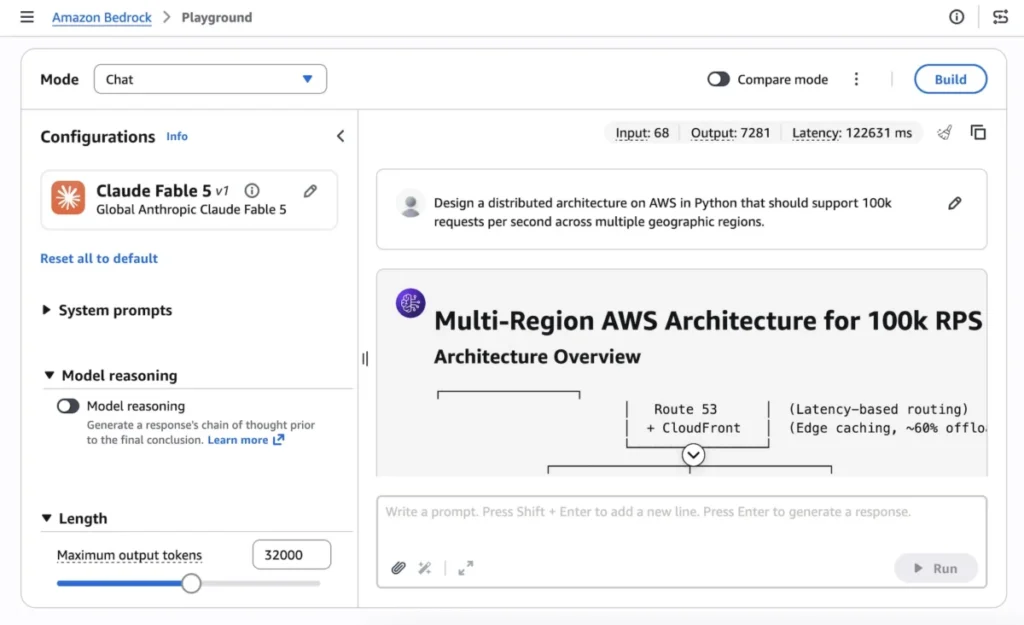
- Initial Launch (Early June 2026): Anthropic announced the availability of Claude Fable 5 on Amazon Bedrock and the Claude Platform on AWS. The model was lauded for its superior reasoning, vision capabilities, and suitability for long-running, ambitious computational tasks.
- June 9–10, 2026: AWS issued technical updates to its documentation, clarifying the integration of the
bedrock-runtimeengine and the implementation of required data retention settings. Developers were provided with specific scripts to enableprovider_data_sharemodes to facilitate compliance and oversight. - June 12, 2026: A critical update was posted to the AWS developer portal. Following a US government export control directive, Anthropic and AWS officially revoked access to the Claude 5 series. The announcement underscored that the suspension was a necessary step to maintain regulatory alignment.
3. Supporting Data: The Technical Architecture of Fable 5
Before the suspension, Claude Fable 5 represented a "step-change" in AI utility. Engineered for complex, multi-step reasoning, it was specifically optimized for software engineering and data-intensive knowledge work.
Deployment Infrastructure
The integration of Fable 5 into AWS relied on two primary conduits:
- Amazon Bedrock: This allowed users to maintain their existing AWS environments, scaling inference workloads through the
bedrock-runtimeorbedrock-mantleendpoints. - Claude Platform on AWS: This offered a native Anthropic experience, providing a more streamlined interface for those requiring direct access to Anthropic’s specific feature sets.
The "Data Retention" Mandate
One of the most critical aspects of the Fable 5 deployment was the strict data retention requirement. To gain access to the model, users were required to opt into a data-sharing protocol via the Data Retention API. This protocol necessitated:
- A 30-day retention period for all model inputs and outputs.
- Mandatory human review protocols to support AWS’s abuse detection efforts.
- Configuration via
provider_data_shareto ensure that model providers (Anthropic) could monitor for safety violations in real-time.
For developers, this involved utilizing the AWS CLI or SDKs to update account-level retention settings, a process that required a deep understanding of AWS SigV4 (Signature Version 4) authentication.
4. Official Responses and Industry Context
Anthropic has directed all concerned parties to their official statement, which emphasizes that the company is committed to safety and regulatory compliance above all else. By developing "more powerful safeguards," Anthropic aims to eventually broaden the availability of its most powerful models. However, until those safeguards meet the stringent requirements of current US export policy, access remains gated.
The industry response has been one of cautious observation. As AI models become more powerful, they are increasingly viewed through the same lens as dual-use technologies—tools that have significant commercial value but also carry inherent risks if misused in the wrong hands. The proactive nature of the AWS/Anthropic response suggests a mature understanding of these responsibilities.
5. Implications for the Future
The suspension of these models has several profound implications for the enterprise AI sector.
For Enterprise Users
Companies that had begun integrating Fable 5 into their CI/CD pipelines or automated research tools must now revert to stable, permitted models like Opus 4.8. While this may cause temporary friction in projects that relied on the enhanced reasoning capabilities of the 5-series, it underscores the importance of model-agnostic architecture. Developers who built their applications using the Bedrock API abstraction are better positioned to pivot back to previous model versions with minimal code changes.

For Regulatory Compliance
The "Data Retention" requirements introduced during the Fable 5 rollout may become the new industry standard. By forcing users to opt into data-sharing for "advanced" models, AWS and Anthropic are creating a transparent, auditable trail that regulators demand. This may be a harbinger of a future where access to the most powerful AI is contingent upon verifiable, real-time oversight.
For Global AI Competition
The US government’s export control directives are, in part, a response to the global arms race in AI. By limiting access to the most sophisticated iterations of these models, the US is attempting to preserve a strategic advantage. However, this creates a challenge for global firms that operate across borders and must navigate varying regional regulations. As Anthropic continues to refine its safeguards, the ability to "unlock" these models for specific, low-risk use cases will be a major differentiator for the company.
Conclusion
The current unavailability of Claude Fable 5 and Claude Mythos 5 is a reminder that we are entering an era of "responsible scaling." The technology exists, but its deployment is governed by a complex web of national security concerns and safety standards.
For the developer community, the lesson of the past few days is clear: stay close to the official AWS documentation and maintain flexibility in your model deployments. While the 5-series models are currently offline, the rapid updates provided by AWS indicate that the infrastructure is ready for their return the moment regulatory clearance is achieved. Until then, the ecosystem remains robust, with Opus 4.8 continuing to power the next wave of innovation on the AWS cloud.
For ongoing updates and technical guidance, users are encouraged to monitor the AWS re:Post for Amazon Bedrock and consult their AWS Support representatives for architectural guidance during this transition period.