The Paradox of Automation: Jeff Bezos Projects AI-Driven Labor Shortages Amid Mounting Tech Layoffs and Space-Age Ambitions
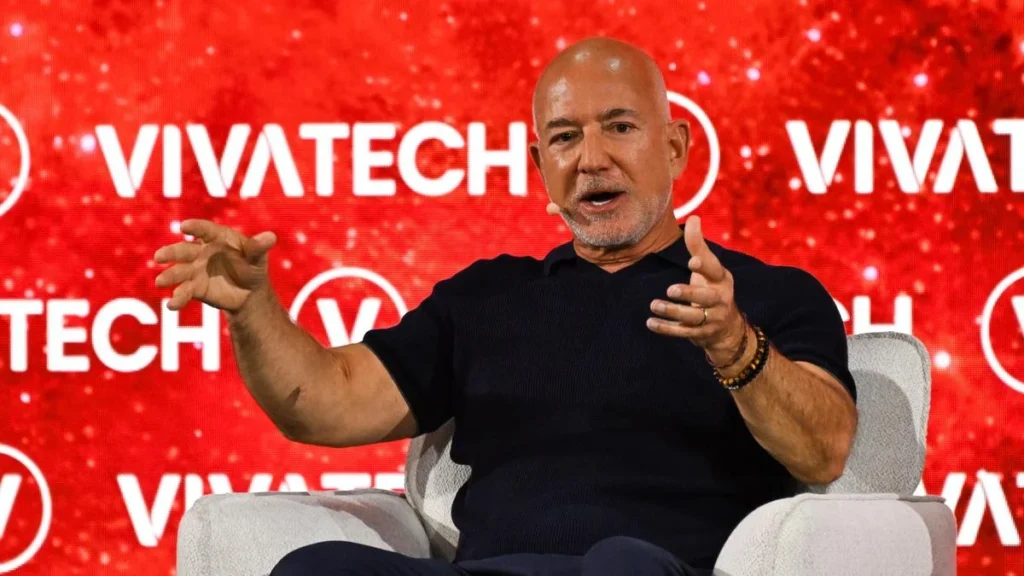
PARIS — In a striking departure from the prevailing anxieties surrounding generative artificial intelligence, Amazon founder and multi-billionaire Jeff Bezos has projected a highly optimistic future for the global workforce. Speaking at the VivaTech technology conference in Paris, Bezos argued that rather than triggering mass unemployment and rendering humanity redundant, the rapid integration of artificial intelligence (AI) will ultimately culminate in widespread labor shortages.
Bezos’s contrarian remarks arrive at a critical juncture. The global tech sector is undergoing a profound restructuring, marked by tens of thousands of layoffs directly attributed to AI-driven efficiency gains. Despite these immediate macroeconomic headwinds, the world’s fourth-richest man presented a rosy vision of technological progress, linking the evolution of AI to his ambitious space exploration endeavors with Blue Origin and his newly unveiled AI startup, Prometheus.
Main Facts: The Bezos Vision at VivaTech
During his headline appearance at VivaTech, one of Europe’s largest startup and tech exhibitions, Jeff Bezos addressed the deep-seated fears that AI technologies will displace human workers.
"I know there’s a lot of concern that many people have, including many smart people, that AI is going to make humans redundant and so on," Bezos told the audience. "I totally disagree with this point of view. And I think, in fact, AI is going to create a labor shortage."
                       JEFF BEZOS'S TWO-FRONT FUTURE

          ┌───────────────────────────────────────────────────────┐
          │                                                       │
          ▼                                                       ▼
┌──────────────────┐                                    ┌──────────────────┐
│    PROMETHEUS    │                                    │   BLUE ORIGIN    │
│ (Physical AI)    │                                    │ (Space Commerce) │
├──────────────────┤                                    ├──────────────────┤
│ • Speeds up physical                                  │ • Offshores heavy│
│   manufacturing.                                      │   industry.      │
│ • Lowers operational                                  │ • Rebuilding FL  │
│   barriers.                                           │   launch pad.    │
└──────────────────┘                                    └──────────────────┘
Bezos’s argument rests on the premise that human desire and ingenuity are "endless." By lowering the technical and operational barriers to execution, AI will unlock an unprecedented volume of new projects, enterprises, and scientific endeavors. This explosion of economic activity, Bezos contends, will outpace the available supply of human labor, shifting the bottleneck from a lack of opportunities to a deficit of workers to manage them.
To illustrate this paradigm shift, Bezos highlighted two of his primary focal points:
- Prometheus: His new, stealth-adjacent AI startup aimed at accelerating physical manufacturing processes through machine learning and advanced automation.
- Blue Origin: His aerospace venture, which aims to transition heavy, polluting industries off Earth to preserve the planet.
Appearing alongside Bezos was Blue Origin Chief Executive Officer David Limp. Limp confirmed that reconstruction has officially commenced on the company’s Florida launch pad for the New Glenn heavy-lift rocket, following a dramatic and highly publicized test stand explosion in May.
Chronology of the AI and Space Race (2025–2026)
The dialogue surrounding AI’s impact on the workforce and its intersection with space exploration has accelerated rapidly over the last year. The timeline below outlines the key events leading to Bezos’s Paris address:
Late 2025: Corporate Restructuring Accelerates
Following massive capital expenditure on AI infrastructure, major tech conglomerates, including Amazon, begin restructuring their workforces. Amazon trims approximately 30,000 corporate roles, citing automation efficiencies and a pivot toward AI-centric development.
May 2026: Layoffs and Launch Pad Setbacks
- Early May: US-based employers announce a sharp spike in job cuts. Outplacement firm Challenger, Gray & Christmas links 40% of these layoffs directly to AI integration.
- Mid-May: Blue Origin suffers a significant setback when a ground test of its New Glenn rocket hardware results in a dramatic explosion at its Florida facility, temporarily halting launch schedules.
- Late May: SpaceX prepares for its highly anticipated initial public offering (IPO), with founder Elon Musk outlining plans to establish self-sustaining cities on Mars and the Moon.
June 2026: Public Pushback and the Paris Summit
- Early June: A Reuters/Ipsos poll reveals that half of all Americans fear AI-induced job loss. Simultaneously, labor unions representing South Korean automakers and Hollywood creative guilds stage protests against unregulated AI use.
- June 11, 2026: In an interview with JPMorgan Chase CEO Jamie Dimon, Elon Musk floats the concept of launching AI data centers into space and colonizing the lunar surface for commercial tourism.
- June 17, 2026: Jeff Bezos and David Limp take the stage at VivaTech in Paris, offering a counter-narrative to labor anxiety and confirming the rebuilding of Blue Origin’s launch infrastructure.
Supporting Data: The Labor and Economic Reality
While Bezos’s long-term outlook is optimistic, current empirical data highlights a starkly different immediate reality for the global workforce. The tension between executive optimism and worker vulnerability is underscored by several key metrics:

The Layoff Landscape
According to a report from global outplacement firm Challenger, Gray & Christmas, U.S. employers announced 97,006 job cuts in May 2026 alone. Notably, 40% of those layoffs were directly linked to the implementation and efficiency gains of artificial intelligence.
May 2026 US Job Cuts: 97,006 Total
┌───────────────────────────────────────┐
│ [██████████████] AI-Linked (40%)      │
│ [█████████████████████] Other (60%)    │
└───────────────────────────────────────┘
Public Sentiment and Labor Resistance
The anxiety regarding AI is not confined to tech corridors. It has permeated the broader global working class:
- The Household Fear Index: A Reuters/Ipsos poll conducted in June 2026 found that 50% of Americans fear that the rise of AI could put them, or a member of their household, out of work.
- Demographic and Union Resistance: Pushback has intensified across demographic and industrial sectors. Gen Z workers entering the job market report heightened anxiety over entry-level role displacement. Meanwhile, organized labor—ranging from South Korean automotive manufacturing unions to Hollywood scriptwriters—has actively negotiated contracts to restrict algorithmic replacement.
Amazon’s Internal Transition
Despite Bezos’s role as Amazon’s executive chairman, the company he founded has been a primary driver of the automation trend. Amazon has eliminated roughly 30,000 corporate positions since late last year. Current CEO Andy Jassy has explicitly stated that increasing automation through generative AI tools will inevitably result in further corporate job reductions in the near term.
Official Responses and Counter-Perspectives
The debate over the future of work has polarized tech leadership, labor advocates, and policymakers. Bezos’s comments have drawn sharp contrasts from other industry titans and labor representatives.
The Corporate Skepticism of Andy Jassy
While Bezos focuses on the theoretical long-term expansion of labor, Amazon’s current CEO, Andy Jassy, has maintained a pragmatic, cost-conscious stance. Jassy has repeatedly signaled to shareholders that AI is a tool for streamlining operations. In corporate communications, Jassy noted that the deployment of AI coding assistants and automated customer service agents has dramatically reduced the need for human redundancy, directly contradicting the idea that AI will immediately create a shortage of traditional corporate jobs.
The Labor Union Position
Labor advocates have responded to Bezos’s comments with skepticism, accusing the billionaire of ignoring the immediate pain of displacement. A representative from the Hollywood writers’ coalition stated:
"It is easy to predict a labor shortage from a superyacht. For the writers, artists, and manufacturing workers losing their livelihoods today, AI is not lowering barriers—it is erecting walls between workers and fair wages."
Elon Musk’s Galactic Alternative
Bezos’s primary space rival, Elon Musk, has offered a parallel yet distinct vision. While Bezos envisions moving heavy industry off Earth to return the planet to its "pre-Industrial Revolution state," Musk’s focus remains on multi-planetary colonization.
               TWO PATHS FOR THE FUTURE OF HUMANITY

       JEFF BEZOS (Blue Origin)          ELON MUSK (SpaceX)
     ┌─────────────────────────┐       ┌─────────────────────────┐
     │ • Save the Earth        │       │ • Multi-planetary life  │
     │ • Move industry to space│       │ • Cities on Mars/Moon   │
     │ • Restore "garden" state│       │ • Orbiting AI servers   │
     └─────────────────────────┘       └─────────────────────────┘
In his recent discussion with JPMorgan’s Jamie Dimon, Musk proposed hosting AI data centers in orbit to utilize solar energy and natural cooling, while preparing SpaceX for commercial lunar vacations. Musk has previously warned that artificial general intelligence (AGI) could render all human labor obsolete, directly opposing Bezos’s labor-shortage hypothesis.
Implications: Re-engineering Earth and the Workplace
The competing philosophies voiced by Bezos and his peers carry profound implications for the global economy, industrial policy, and environmental science.

1. The Labor Market Paradigm Shift
If Bezos’s hypothesis holds true, the global economy will undergo a massive transition period. While frictional unemployment will spike as traditional roles (such as basic programming, administrative support, and content creation) are automated, new industries will emerge.
His startup, Prometheus, represents this shift: by automating the complex design and physical manufacturing pipeline, it could allow small teams to manufacture advanced hardware, electric vehicles, and medical devices. However, this relies on the workforce rapidly upskilling to manage these AI-driven systems, risking a severe structural mismatch in the labor market.
2. Environmental Decarbonization via Space Industrialization
Bezos’s environmental vision for Blue Origin is radical. By leveraging the low gravity and resources of asteroids, near-Earth objects, and the Moon, he aims to relocate heavy, carbon-emitting manufacturing into space.
"If space travel gets reliable enough and inexpensive enough… then this garden planet can be returned to its pre-Industrial Revolution state," Bezos asserted.
This vision, however, requires a massive reduction in orbital payload costs. While Blue Origin’s New Glenn rocket is designed to compete with SpaceX’s reusable Falcon 9 and Starship platforms, the May test-stand explosion highlights the immense technical hurdles that remain before space-based manufacturing becomes economically viable.
3. The Geopolitical Corporate Space Race
The race to colonize and industrialize space is no longer just between nation-states; it is driven by corporate balance sheets. With SpaceX eyeing a massive public market debut and Blue Origin rebuilding its launch infrastructure in Florida under David Limp, the privatization of orbital space is accelerating.
The integration of AI into these space ventures—whether through Bezos’s Prometheus optimizing rocket manufacturing or Musk’s proposed space-bound data centers—suggests that the future of computing and the future of aerospace are inexorably linked.
As AI continues to reshape the global economy, the ultimate validation of Bezos’s optimistic labor theory remains to be seen. What is certain is that the intersection of artificial intelligence and aerospace technology will continue to redefine the boundaries of human labor, both on Earth and beyond.